
Table of Contents
Hannibal is one of history’s most recognizable names, immortalized by the Carthaginian general who challenged Rome’s supremacy. This ancient Phoenician name carries a rich legacy that spans millennia, from its religious origins to its modern cultural resonance. While often associated with military genius and strategic brilliance, the name’s true meaning reveals its deep roots in ancient Near Eastern tradition.
Meaning of Hannibal
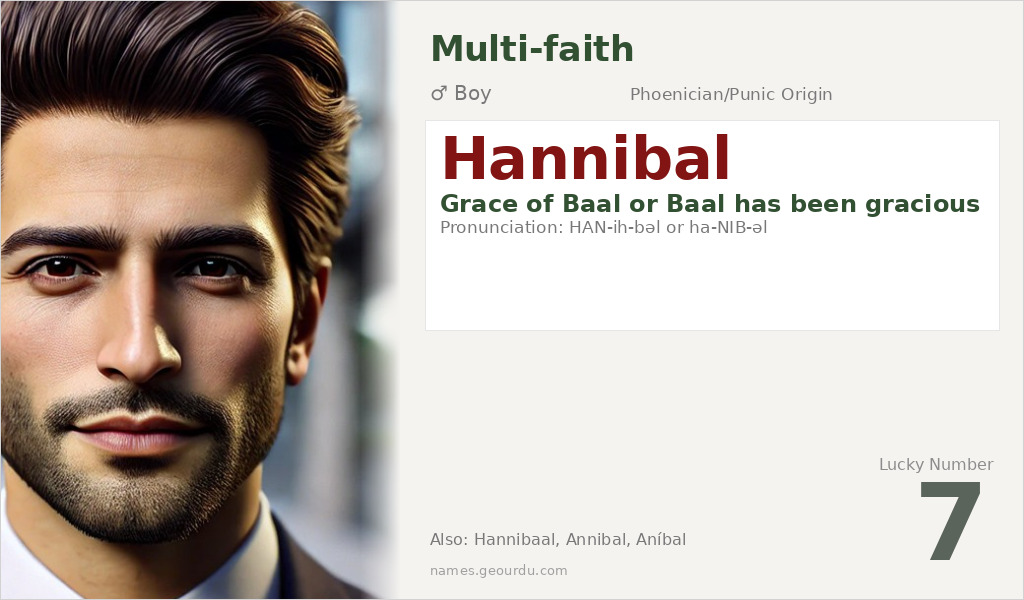
The name Hannibal originates from the Phoenician language, specifically the Punic dialect spoken in ancient Carthage. It is composed of two elements: ‘ḥann’ meaning ‘grace’ or ‘favor,’ and ‘baʿal’ referring to the Canaanite deity Baal, a major god in the Phoenician pantheon associated with storms, fertility, and kingship. Thus, Hannibal literally translates to ‘grace of Baal’ or ‘Baal has been gracious.’ This theophoric name pattern was common in Semitic languages, where names incorporated divine elements to express devotion or seek protection. The name reflects the religious practices of Phoenician civilization before the spread of Christianity and Islam in the region.
| 📛 Name | Hannibal |
| 💎 Meaning | Grace of Baal or Baal has been gracious |
| 👤 Gender | Boy |
| 🕌 Religion | Multi-faith |
| 🌍 Origin | Phoenician/Punic |
| 🗣 Pronunciation | HAN-ih-bəl or ha-NIB-əl |
| ✍️ Urdu | ہنیبل |
| ✍️ Arabic | حنبعل |
| 🔢 Numerology | 7 |
| ✨ Spellings | Hannibaal, Annibal, Aníbal, Hannibale |
Origin & Cultural Significance
Hannibal has its origins in ancient Phoenicia, particularly among the Carthaginians who established colonies across the Mediterranean. The name gained historical prominence through Hannibal Barca (247–183 BCE), the Carthaginian military commander who led forces against Rome during the Second Punic War. While the name has Phoenician roots, it has been adopted in various cultures over time, including Spanish (Aníbal), Italian (Annibale), and Portuguese (Aníbal) forms. Despite its pre-Christian origins, the name has been used by people of various religious backgrounds in modern times, though it maintains strongest associations with its Carthaginian heritage rather than any specific contemporary religion.
Personality Traits
The name Hannibal evokes qualities of strategic brilliance, determination, and leadership, largely influenced by the historical figure’s legendary military campaigns. Those bearing this name are often perceived as intelligent problem-solvers who approach challenges with careful planning and unconventional thinking. The name carries an air of historical weight and intellectual prowess, suggesting someone who is both formidable and intellectually gifted.
Similar Names
If you like Hannibal, consider: Hasdrubal, Hamilcar, Barca, Baal, Hananiah, Hanan
Famous People Named Hannibal
- Hannibal Barca — Carthaginian general who famously crossed the Alps during the Second Punic War (247–183 BCE)
- Hannibal Lecter — fictional character created by Thomas Harris, appearing in novels and films including 'The Silence of the Lambs'
Frequently Asked Questions About Hannibal
What does Hannibal mean?
Hannibal means 'Grace of Baal' or 'Baal has been gracious' in Phoenician, combining 'ḥann' (grace) and 'baʿal' (the Canaanite god Baal).
Is Hannibal a boy or girl name?
Hannibal is exclusively a boy's name with historical usage dating back to ancient Carthage. There are no traditional feminine forms of this name.
What is the origin of Hannibal?
Hannibal originates from the Phoenician/Punic language of ancient Carthage and was famously borne by the Carthaginian general Hannibal Barca during the Punic Wars against Rome.





