
Table of Contents
Hanns is a traditional German name with deep biblical roots that has maintained its popularity in German-speaking regions for centuries. This masculine name carries a profound spiritual meaning that reflects its Hebrew origins while embodying Germanic linguistic characteristics. As a variant of the timeless name John, Hanns connects modern bearers to a rich historical and religious tradition that spans multiple cultures and languages.
Meaning of Hanns
The name Hanns derives from the Hebrew name Yochanan (יוֹחָנָן), which is composed of two elements: ‘Yah’ (a shortened form of Yahweh, the Hebrew name for God) and ‘chanan’ meaning ‘to be gracious’. This gives the name the precise meaning ‘Yahweh is gracious’ or ‘God is gracious’. Through Greek transmission as Ioannes (Ἰωάννης) and Latin as Iohannes, the name entered Germanic languages where it evolved into various forms including Johannes, which then shortened to Hannes and Hanns in German. The ‘s’ ending represents a common German diminutive suffix, making Hanns essentially mean ‘little John’ or ‘dear John’ in affectionate terms.
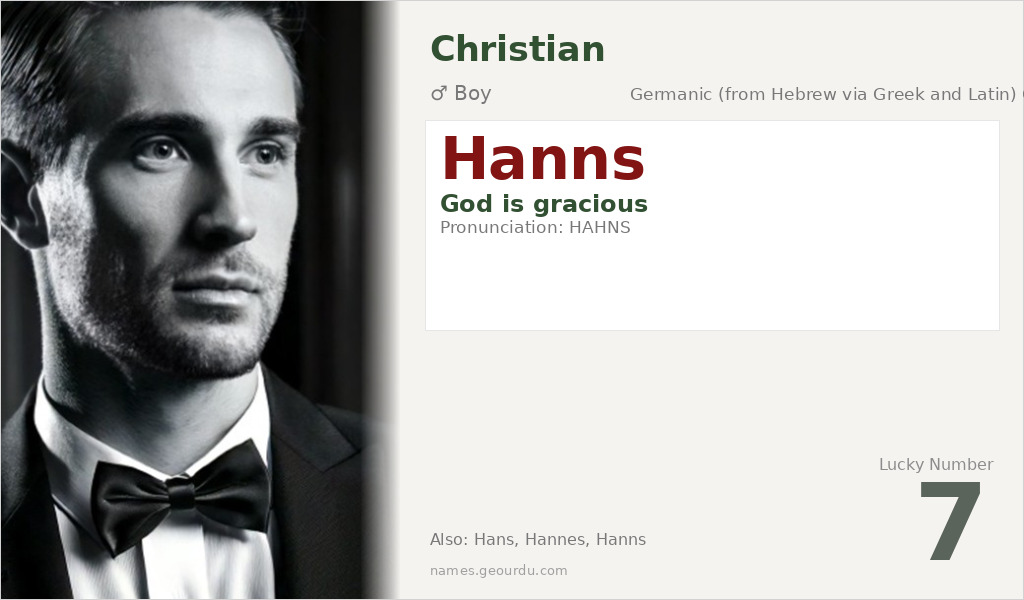
| 📛 Name | Hanns |
| 💎 Meaning | God is gracious |
| 👤 Gender | Boy |
| 🕌 Religion | Christian |
| 🌍 Origin | Germanic (from Hebrew via Greek and Latin) |
| 🗣 Pronunciation | HAHNS |
| ✍️ Urdu | ہانس |
| ✍️ Arabic | هانس |
| 🔢 Numerology | 7 |
| ✨ Spellings | Hans, Hannes, Hanns, Hannß |
Origin & Cultural Significance
Hanns originated in German-speaking regions, particularly southern Germany and Austria, as a vernacular form of Johannes (the German equivalent of John). The name gained popularity during the Middle Ages due to the veneration of Saint John the Baptist and Saint John the Evangelist. It became particularly common in Bavaria, where traditional naming patterns favored vernacular forms of biblical names. While primarily associated with Christian communities, the name’s usage spread throughout German-speaking Europe and has been borne by notable figures in music, literature, and academia, reflecting its enduring cultural significance in Germanic societies.
Personality Traits
Those named Hanns are often associated with characteristics of thoughtfulness, reliability, and spiritual depth. The name’s biblical origins and meaning ‘God is gracious’ suggest a personality inclined toward gratitude, faith, and moral integrity. In German cultural context, the name carries connotations of tradition, stability, and intellectual pursuit, often associated with individuals who value heritage while engaging thoughtfully with the modern world.
Similar Names
If you like Hanns, consider: Hans, Johannes, John, Sean, Ivan
Famous People Named Hanns
- Hanns Eisler — German-Austrian composer known for his collaborations with Bertolt Brecht
- Hanns Johst — German playwright and Nazi poet, author of the phrase 'When I hear the word culture, I reach for my pistol'
Frequently Asked Questions About Hanns
What does Hanns mean?
Hanns means 'God is gracious'. It is a German variant of the Hebrew name Yochanan, which entered Germanic languages through Greek Ioannes and Latin Iohannes.
Is Hanns a boy or girl name?
Hanns is exclusively a masculine name. It is the German masculine form derived from Johannes (John) and has never been used as a feminine name in its cultural context.
What is the origin of Hanns?
Hanns originated in German-speaking regions as a vernacular form of Johannes. Its ultimate origin is Hebrew (Yochanan), transmitted through Greek and Latin before evolving into its German form.





