
Table of Contents
Hans is a classic masculine name with deep roots in Germanic and Scandinavian cultures. As a short form of Johannes (the German equivalent of John), it carries the profound meaning ‘God is gracious’. This name has been borne by royalty, artists, scientists, and everyday people across centuries, maintaining its timeless appeal while adapting to modern usage.
Meaning of Hans
The name Hans derives from the Germanic diminutive of Johannes, which itself comes from the Hebrew name Yochanan (יוֹחָנָן). Yochanan combines two Hebrew elements: ‘Yah’ (a shortened form of Yahweh, the Hebrew name for God) and ‘chanan’ (meaning ‘to be gracious’). Thus, the complete meaning is ‘Yahweh is gracious’ or ‘God is gracious’. This etymology traveled through Greek as Ioannes, Latin as Iohannes, and into Germanic languages where Johannes became common. The shortened form Hans emerged in medieval Germany and spread throughout Germanic-speaking regions and Scandinavia.
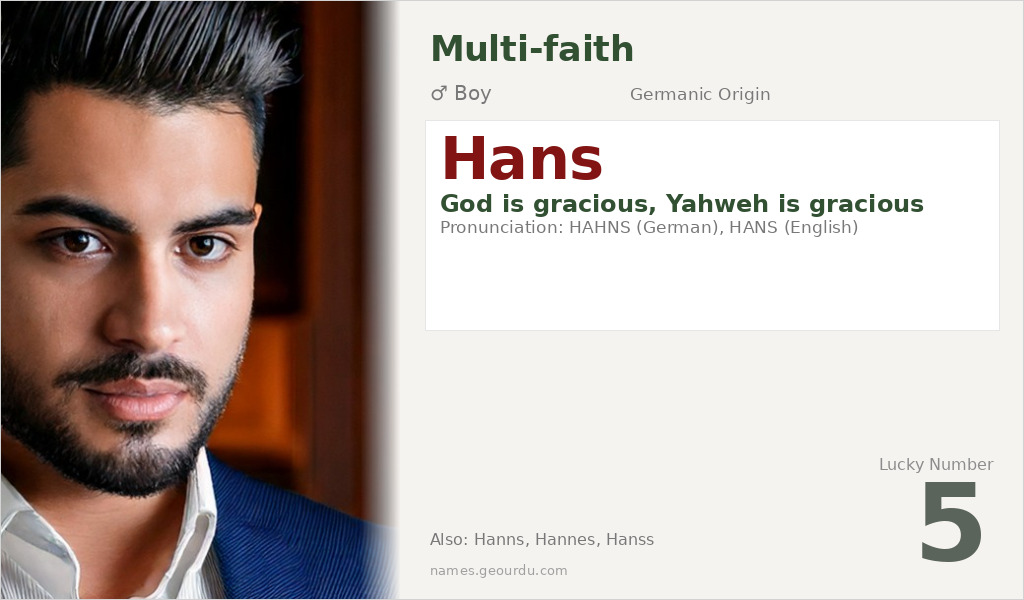
| 📛 Name | Hans |
| 💎 Meaning | God is gracious, Yahweh is gracious |
| 👤 Gender | Boy |
| 🕌 Religion | Multi-faith |
| 🌍 Origin | Germanic |
| 🗣 Pronunciation | HAHNS (German), HANS (English) |
| ✍️ Urdu | ہانس |
| ✍️ Arabic | هانس |
| 🔢 Numerology | 5 |
| ✨ Spellings | Hanns, Hannes, Hanss |
Origin & Cultural Significance
Hans originated as a German and Scandinavian diminutive of Johannes, first appearing in medieval records. It became particularly popular in German-speaking countries (Germany, Austria, Switzerland) and Scandinavian nations (Denmark, Sweden, Norway). The name gained royal associations through figures like Hans of Denmark, King of Denmark, Norway, and Sweden in the 15th century. During the 19th and 20th centuries, Hans remained common in German-speaking Europe while also being adopted internationally, especially through immigration and cultural exchange. Its usage extends beyond Christian communities to secular contexts and other religious traditions where the name John has significance.
Personality Traits
Those named Hans often embody characteristics associated with their Germanic origins: practicality, reliability, and a strong sense of tradition. The name’s meaning ‘God is gracious’ suggests a personality that combines spiritual depth with human kindness. Historically, bearers of this name have excelled in diverse fields from literature to science, reflecting the name’s versatility and enduring appeal across generations.
Similar Names
If you like Hans, consider: Johannes, John, Jan, Hansel, Hanspeter
Famous People Named Hans
- Hans Christian Andersen — Danish author famous for fairy tales like 'The Little Mermaid' and 'The Ugly Duckling'
- Hans Zimmer — German film composer known for scores like 'The Lion King' and 'Inception'
Frequently Asked Questions About Hans
What does Hans mean?
Hans means 'God is gracious' or 'Yahweh is gracious'. It is a Germanic short form of Johannes, which derives from the Hebrew name Yochanan.
Is Hans a boy or girl name?
Hans is exclusively a masculine name in all cultures where it is used. There are no established feminine variants, though similar names like Hanna exist for girls.
What is the origin of Hans?
Hans originates from Germanic languages as a diminutive of Johannes (the German form of John). Its ultimate origin is Hebrew through Greek and Latin transmission.





