
Table of Contents
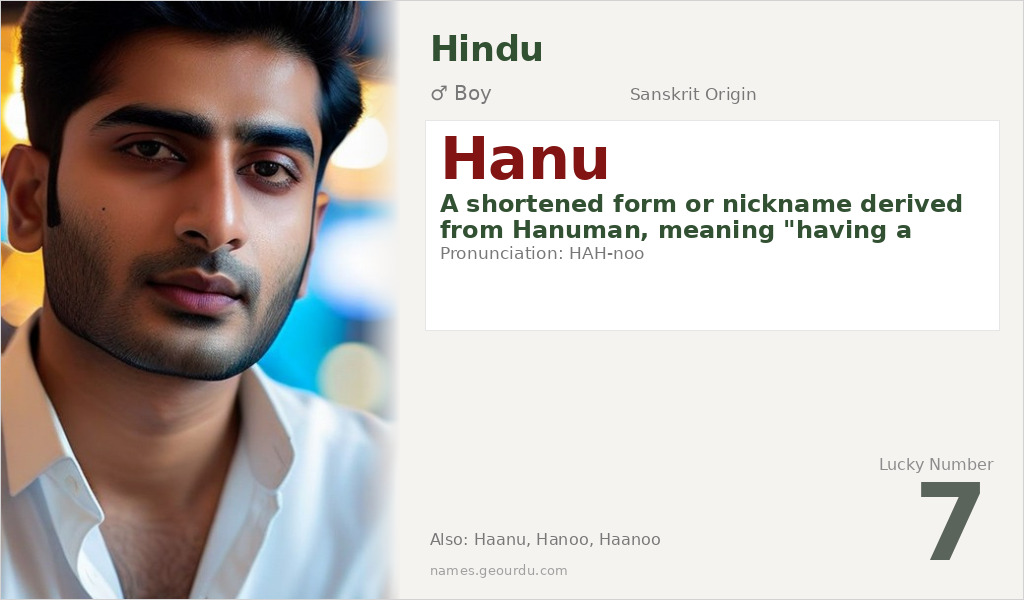
Hanu is a distinctive Hindu boy name with deep roots in Sanskrit mythology and tradition. As a shortened form of the revered name Hanuman, it carries significant cultural weight within Hindu communities. This name connects bearers to one of Hinduism’s most beloved deities, known for strength, devotion, and loyalty. Parents choosing Hanu often seek to imbue these qualities in their child while using a more concise, modern form of the traditional name.
Meaning of Hanu
The name Hanu derives directly from Sanskrit, where it serves as a diminutive or affectionate form of Hanuman. The full name Hanuman comes from the Sanskrit components ‘hanu’ (हनु), meaning ‘jaw’, and ‘mān’ (मान्), meaning ‘having’ or ‘possessing’. This etymology references the mythological story where the infant Hanuman attempted to swallow the sun, causing the god Indra to strike him with a thunderbolt and injure his jaw. Thus, Hanuman literally means ‘one having a disfigured or prominent jaw’. Hanu preserves this connection while offering a shorter, more informal alternative used in various Hindu communities across South Asia.
| 📛 Name | Hanu |
| 💎 Meaning | A shortened form or nickname derived from Hanuman, meaning "having a prominent jaw" or "disfigured jaw" in Sanskrit |
| 👤 Gender | Boy |
| 🕌 Religion | Hindu |
| 🌍 Origin | Sanskrit |
| 🗣 Pronunciation | HAH-noo |
| ✍️ Urdu | ہنو |
| ✍️ Arabic | هانو |
| 🔢 Numerology | 7 |
| ✨ Spellings | Haanu, Hanoo, Haanoo |
Origin & Cultural Significance
Hanu originates from Sanskrit, the classical language of ancient India, and is deeply embedded in Hindu tradition through its connection to Hanuman, the monkey god and central figure in the Ramayana epic. The name emerged as a colloquial shortening in various Indian languages, particularly in regions with strong Hanuman devotion. While less common than the full form Hanuman, Hanu appears in modern naming practices, especially among families seeking traditional roots with contemporary brevity. Its usage spans Hindu communities in India, Nepal, and the diaspora, maintaining religious significance while adapting to modern naming preferences.
Personality Traits
Those named Hanu are often associated with qualities of loyalty, courage, and devotion, mirroring attributes of Hanuman from Hindu mythology. They tend to exhibit strong protective instincts toward loved ones and demonstrate resilience in facing life’s challenges. The name’s connection to a revered deity often inspires bearers to develop a sense of duty and spiritual awareness, making them respected members of their communities.
Similar Names
If you like Hanu, consider: Hanuman, Hanumanth, Hari, Harsh, Himanshu, Hiten, Hrithik
Famous People Named Hanu
- Hanu Dixit — Indian child actor known for roles in Hindi television shows
- Hanu Roj — Nepali filmmaker and director
Frequently Asked Questions About Hanu
What does Hanu mean?
Hanu means 'having a prominent jaw' in Sanskrit, derived as a shortened form of Hanuman, the name of the Hindu monkey god.
Is Hanu a boy or girl name?
Hanu is exclusively a boy name in Hindu tradition, as it derives from Hanuman, a male deity in Hinduism.
What is the origin of Hanu?
Hanu originates from Sanskrit, the classical language of ancient India, and is specifically a diminutive form of the name Hanuman from Hindu mythology.





