
Table of Contents
Harihara is a profound Sanskrit name that embodies one of Hinduism’s most significant theological syntheses. This name represents the harmonious union of Vishnu (the preserver) and Shiva (the destroyer) in a single divine form. Historically borne by rulers of the Vijayanagara Empire, Harihara carries both religious depth and royal heritage. Its philosophical richness makes it a meaningful choice for parents seeking a name with spiritual and historical resonance.
Meaning of Harihara
Harihara derives from the Sanskrit words ‘Hari’ (हरि) and ‘Hara’ (हर), which are primary epithets of Vishnu and Shiva respectively. ‘Hari’ means ‘one who takes away’ or ‘remover’, referring to Vishnu’s role in removing suffering and sin, while ‘Hara’ means ‘the destroyer’ or ‘one who takes’, referring to Shiva’s destructive aspect within the cosmic cycle. The compound name emerged during the early medieval period (4th-6th centuries CE) as Hindu theologians sought to reconcile the Vaishnava and Shaiva traditions. The Harihara deity is artistically depicted with Vishnu’s characteristics (blue skin, conch, discus) on the right side and Shiva’s attributes (matted hair, third eye, trident) on the left. This synthesis represents the philosophical unity of preservation and destruction within Hindu cosmology.
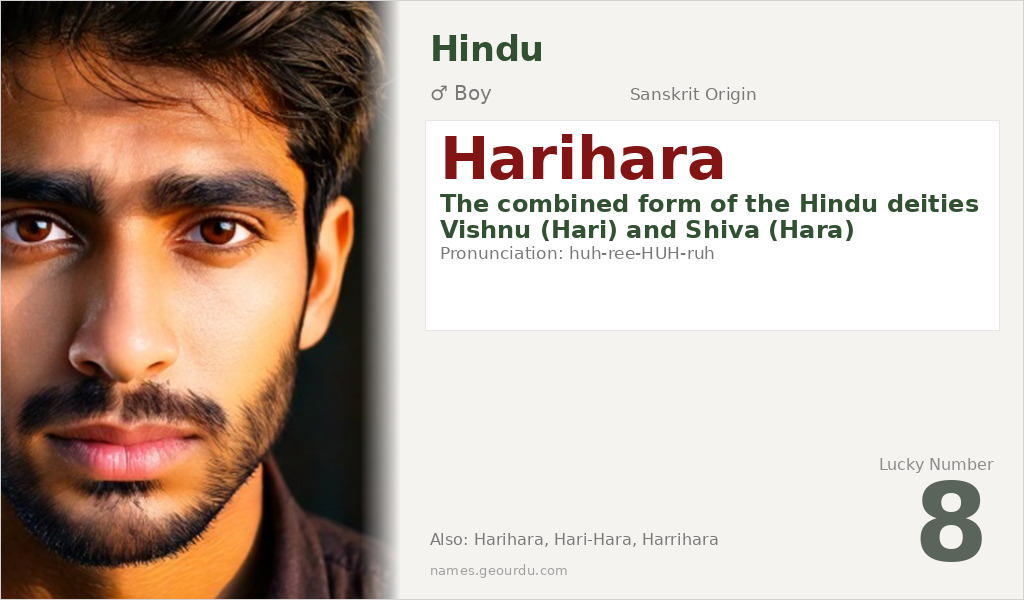
| 📛 Name | Harihara |
| 💎 Meaning | The combined form of the Hindu deities Vishnu (Hari) and Shiva (Hara) |
| 👤 Gender | Boy |
| 🕌 Religion | Hindu |
| 🌍 Origin | Sanskrit |
| 🗣 Pronunciation | huh-ree-HUH-ruh |
| ✍️ Urdu | ہری ہر |
| ✍️ Arabic | هاري هارا |
| 🔢 Numerology | 8 |
| ✨ Spellings | Harihara, Hari-Hara, Harrihara |
Origin & Cultural Significance
Harihara originates from classical Sanskrit and Hindu theological traditions, with its earliest references appearing in Puranic literature and temple iconography from the Gupta period onward. The concept gained particular prominence in South India, where it became an important symbol of religious unity. Historically, the name was notably borne by Harihara I, who founded the Vijayanagara Empire in 1336 CE alongside his brother Bukka Raya I. This empire became a major center of Hindu culture, art, and architecture that resisted Islamic expansion in South India for centuries. The name reflects the syncretic tendencies within Hinduism that sought to harmonize different devotional paths while maintaining distinct theological identities.
Personality Traits
Those named Harihara often exhibit a dual nature that balances contemplation with action. They tend to be mediators who can understand multiple perspectives and find common ground in conflicts. With roots in a name representing divine synthesis, they may show aptitude for bringing together disparate elements into harmonious wholes. Their personality often combines spiritual depth with practical leadership qualities, reflecting the name’s historical association with empire-builders and religious synthesizers.
Similar Names
If you like Harihara, consider: Harish, Harishankar, Harinath, Hariprasad, Haresh
Famous People Named Harihara
- Harihara I — Founder of the Vijayanagara Empire (1336-1356 CE), established one of South India's greatest Hindu kingdoms
- Harihara II — Ruler of the Vijayanagara Empire (1377-1404 CE), expanded the empire's territory and patronage of literature
Frequently Asked Questions About Harihara
What does Harihara mean?
Harihara means 'the combined form of Vishnu (Hari) and Shiva (Hara)' in Sanskrit. It represents a syncretic Hindu deity that unites the preserver and destroyer aspects of the divine.
Is Harihara a boy or girl name?
Harihara is exclusively a masculine name in Hindu tradition. It has been historically borne by male rulers and is associated with male deities in Hindu theology.
What is the origin of Harihara?
Harihara originates from Sanskrit and Hindu religious traditions, emerging around the 4th-6th centuries CE as a theological synthesis. It gained particular prominence in South Indian history through the Vijayanagara Empire rulers.





