
Table of Contents
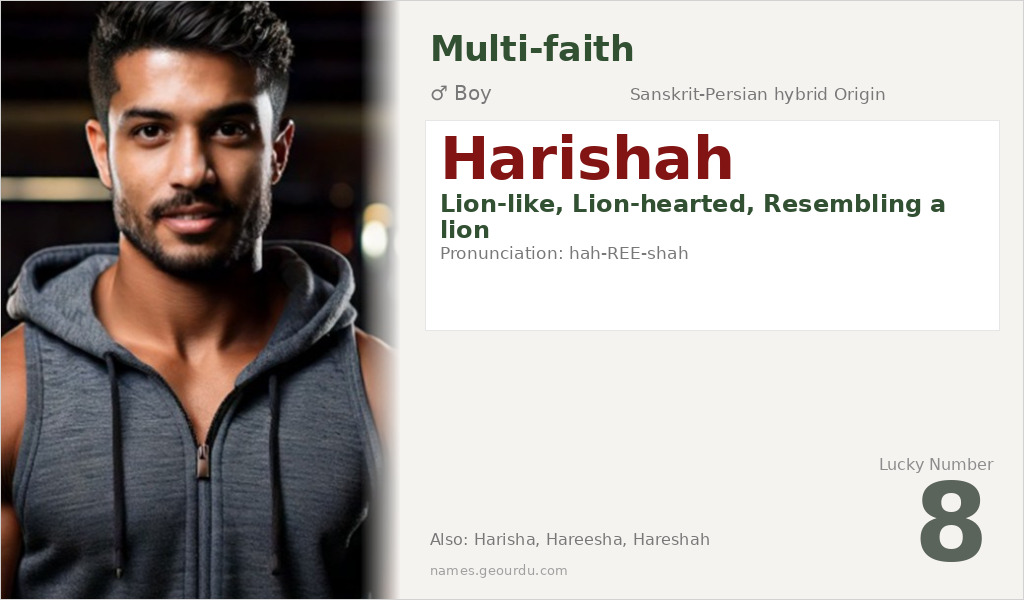
Harishah is a powerful masculine name with deep roots in South Asian culture, blending Sanskrit and Persian linguistic traditions. Meaning ‘lion-like ruler’ or ‘lion-king’, this name carries connotations of strength, courage, and leadership. While popular in Hindu communities, it has also been adopted by some Muslim families in the Indian subcontinent, particularly those with cultural exchanges between traditions. The name’s hybrid nature reflects the rich historical interplay between Sanskrit and Persian influences in the region.
Meaning of Harishah
Harishah derives from two distinct linguistic sources: the Sanskrit word ‘hari’ (हरि) and the Persian suffix ‘-shah’. In Sanskrit, ‘hari’ primarily means ‘lion’ or refers to a tawny, golden color associated with lions. It also appears in Hindu mythology as an epithet for Vishnu and Shiva, deities often depicted with lion-like attributes of power and protection. The Persian component ‘-shah’ means ‘king’ or ‘ruler’, a title of royalty and authority. When combined, Harishah literally translates to ‘lion-king’, symbolizing regal strength and courageous leadership. This hybrid construction is common in South Asian names, where Sanskrit roots are modified with Persian elements, especially during periods of cultural synthesis under various empires.
| 📛 Name | Harishah |
| 💎 Meaning | Lion-like, Lion-hearted, Resembling a lion |
| 👤 Gender | Boy |
| 🕌 Religion | Multi-faith |
| 🌍 Origin | Sanskrit-Persian hybrid |
| 🗣 Pronunciation | hah-REE-shah |
| ✍️ Urdu | ہریشہ |
| ✍️ Arabic | هاريشاه |
| 🔢 Numerology | 8 |
| ✨ Spellings | Harisha, Hareesha, Hareshah, Harishaa |
Origin & Cultural Significance
The name Harishah originates from the Indian subcontinent, where Sanskrit and Persian languages historically interacted through trade, conquest, and cultural exchange. Sanskrit, as the classical language of Hinduism, provides the core meaning ‘lion’, while Persian influence entered via Islamic rulers and poets from medieval times onward. This created a naming tradition where Hindu families might use Persianized forms, and some Muslim families adopted Sanskrit-derived elements. The name is most prevalent in regions with significant Hindu populations, particularly in Gujarat, Rajasthan, and Maharashtra, but also appears among Muslims in Pakistan and Bangladesh. Its usage reflects the syncretic culture of South Asia, where religious boundaries often blur in linguistic and naming practices.
Personality Traits
Those named Harishah are often associated with lion-like qualities: bravery, dignity, and a protective nature. They may exhibit natural leadership, commanding respect through their strength of character rather than aggression. In social settings, they tend to be loyal and steadfast, with a deep sense of responsibility toward family and community. Their personality combines the Sanskrit ideal of dharma (righteous duty) with the Persian concept of shahanshahi (kingly grace), making them both principled and magnanimous.
Similar Names
If you like Harishah, consider: Harish, Hari, Harishankar, Harishchandra, Harsh
Famous People Named Harishah
- Harishah Singh — Indian classical musician specializing in dhrupad singing
- Harishah Patel — Gujarati poet and writer known for his works on spirituality
Frequently Asked Questions About Harishah
What does Harishah mean?
Harishah means 'lion-king' or 'lion-like ruler', derived from Sanskrit 'hari' (lion) and Persian '-shah' (king).
Is Harishah a boy or girl name?
Harishah is exclusively a masculine name, used for boys in Hindu and some Muslim communities in South Asia.
What is the origin of Harishah?
Harishah has a Sanskrit-Persian hybrid origin, emerging from cultural exchanges in the Indian subcontinent, with roots in Hindu tradition and Persian linguistic influence.





