Table of Contents
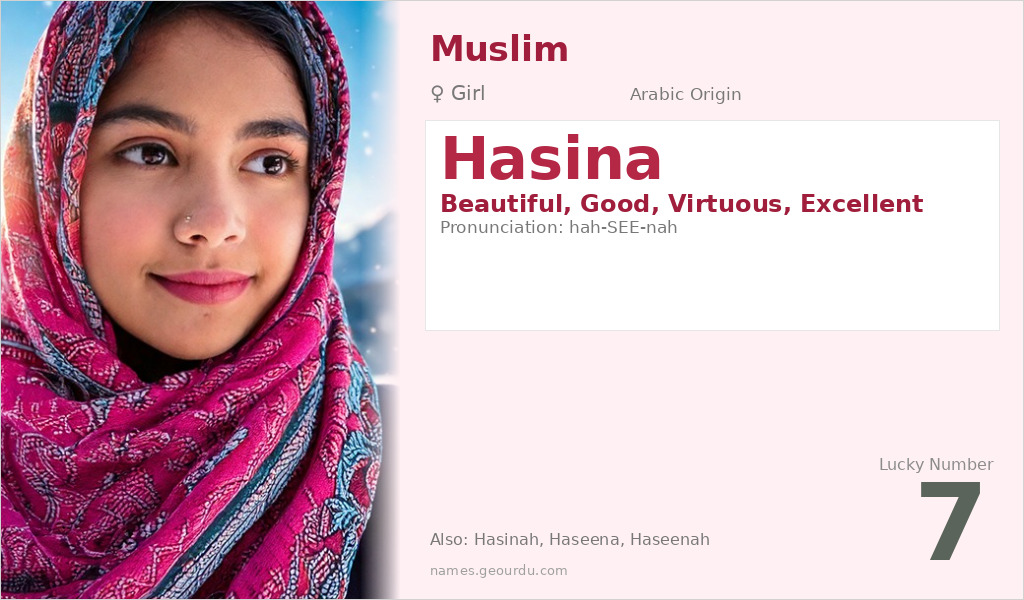
Hasina is a timeless and elegant name with deep roots in Arabic language and Islamic culture. Primarily used for girls, it carries connotations of beauty, virtue, and excellence that have made it popular across Muslim communities worldwide. From South Asia to the Middle East, this name reflects both aesthetic and moral ideals. In this guide, we explore its linguistic origins, cultural significance, and notable personalities who bear this meaningful name.
Meaning of Hasina
Hasina originates from the Arabic root ح-س-ن (ḥ-s-n), which encompasses meanings related to beauty, goodness, and excellence. As the feminine form of ‘hasan’ (حَسَن), it specifically describes a female who is beautiful, virtuous, or outstanding. This root appears in many Arabic words, such as ‘ihsan’ (إحسان, meaning benevolence) and ‘husn’ (حُسْن, meaning beauty), highlighting the name’s connection to positive qualities. In Islamic contexts, these attributes are often associated with both physical and spiritual beauty, making Hasina a name that conveys inner grace as well as outward appeal. Its meaning is consistently documented in classical Arabic lexicons like Lisān al-ʿArab and modern dictionaries, confirming its semantic stability across centuries.
| 📛 Name | Hasina |
| 💎 Meaning | Beautiful, Good, Virtuous, Excellent |
| 👤 Gender | Girl |
| 🕌 Religion | Muslim |
| 🌍 Origin | Arabic |
| 🗣 Pronunciation | hah-SEE-nah |
| ✍️ Urdu | حسینہ |
| ✍️ Arabic | حَسِينَة |
| 🔢 Numerology | 7 |
| ✨ Spellings | Hasinah, Haseena, Haseenah, Hasena |
Origin & Cultural Significance
Hasina has its origins in classical Arabic, where it evolved as a feminine adjective from the root ḥ-s-n. It spread through the Islamic world via the Arabic language, becoming common in regions influenced by Arab culture and Islam, such as South Asia, Southeast Asia, the Middle East, and Africa. In countries like Bangladesh, Pakistan, and India, it is widely used among Muslim populations, often adapted into local scripts like Urdu and Bengali. The name gained additional prominence through historical and contemporary figures, such as Sheikh Hasina of Bangladesh, reinforcing its cultural resonance. While it is primarily associated with Muslim communities, its linguistic roots are purely Arabic, without significant variants in non-Arabic languages beyond phonetic adaptations.
Personality Traits
Those named Hasina are often seen as embodying the qualities their name signifies: beauty, goodness, and virtue. They may exhibit a calm and graceful demeanor, with a strong sense of ethics and compassion toward others. This name suggests a personality that values harmony, aesthetics, and moral integrity, often leading to roles where diplomacy and care are emphasized. While individual traits vary, the name’s meaning can inspire a lifelong pursuit of excellence and kindness.
Similar Names
If you like Hasina, consider: Hasan, Husna, Jamila, Zainab, Aisha
Famous People Named Hasina
- Sheikh Hasina — Prime Minister of Bangladesh
- Hasina Momand — Afghan Pashto singer and actress
Frequently Asked Questions About Hasina
What does Hasina mean?
Hasina means 'beautiful, good, virtuous, or excellent' in Arabic, derived from the root ḥ-s-n.
Is Hasina a boy or girl name?
Hasina is exclusively a girl's name, as it is the feminine form of the Arabic adjective 'hasan'.
What is the origin of Hasina?
Hasina originates from the Arabic language, with its roots in the classical Arabic root ḥ-s-n, and is widely used in Muslim cultures globally.