
Table of Contents
Hava is a beautiful and timeless name with deep roots in ancient Hebrew, meaning ‘Life’ or ‘Living one.’ As a variant of Eve (Chavah), it carries profound significance across Judaism, Christianity, and Islam, symbolizing the first woman and the essence of existence. This name has transcended cultures, appearing in various forms from the Middle East to Europe, and continues to be cherished for its meaningful heritage. In this guide, we explore the rich etymology, cultural impact, and personality traits associated with Hava.
Meaning of Hava
Hava originates from the Hebrew name חַוָּה (Chavah), derived from the root ח-י-ה (ch-y-h), which means ‘to live’ or ‘to breathe.’ This etymological connection gives Hava its core meaning of ‘Life,’ ‘Living,’ or ‘Breath.’ In the Hebrew Bible, Chavah (Eve) is named as such because she was ‘the mother of all living’ (Genesis 3:20), emphasizing her role as the source of human life. The name has been adapted into languages like Arabic (حواء, Hawwa), Persian, and Turkish, where it retains this life-affirming connotation. Linguistically, it is a prime example of how ancient Semitic roots have influenced naming traditions globally, with variations like Eva and Eve spreading through Latin and Greek translations.
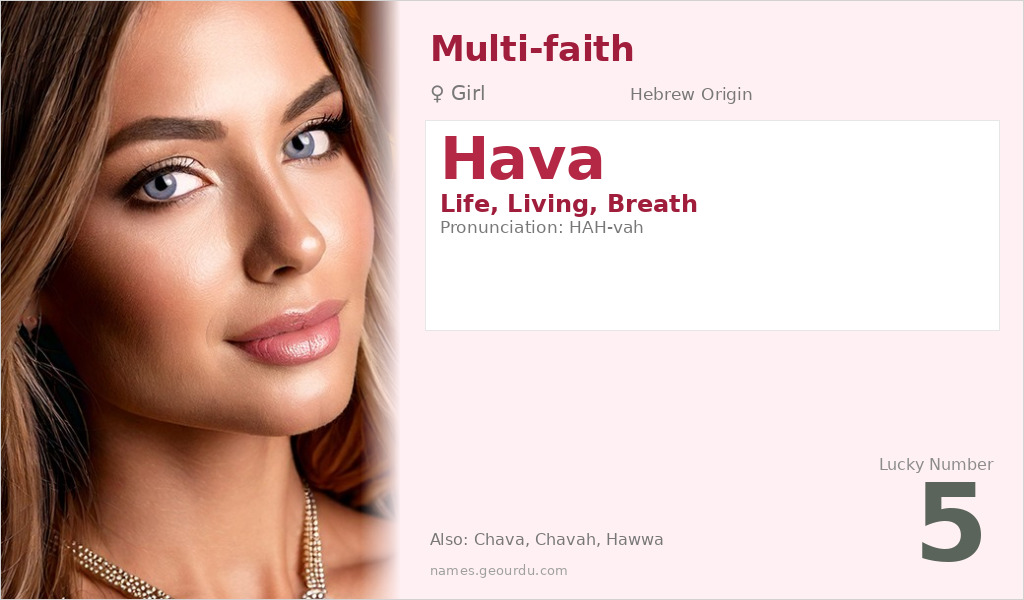
| 📛 Name | Hava |
| 💎 Meaning | Life, Living, Breath |
| 👤 Gender | Girl |
| 🕌 Religion | Multi-faith |
| 🌍 Origin | Hebrew |
| 🗣 Pronunciation | HAH-vah |
| ✍️ Urdu | حوا |
| ✍️ Arabic | حواء |
| 🔢 Numerology | 5 |
| ✨ Spellings | Chava, Chavah, Hawwa, Hawa, Eve, Eva |
Origin & Cultural Significance
Hava has its origins in Hebrew culture, dating back to biblical times as the name of the first woman, Eve. It holds significant religious importance in Judaism, Christianity, and Islam, where Eve (or Hawwa) is a central figure in creation stories. Over centuries, the name spread through trade, migration, and religious texts, evolving into forms like Hava in Kurdish and Turkish, Chava in Yiddish, and Hawwa in Arabic. In regions like the Middle East and Central Asia, it is commonly used among Jewish, Muslim, and Christian communities, reflecting its multi-faith appeal. Historically, the name symbolizes beginnings, motherhood, and the continuity of life, making it a popular choice for girls in diverse cultures.
Personality Traits
People named Hava are often perceived as vibrant and life-enhancing, mirroring the name’s meaning of ‘Life.’ They tend to be caring, empathetic, and strong-willed, with a natural ability to nurture others and foster growth. Their personality is marked by resilience and a positive outlook, embracing challenges with a sense of renewal and hope. In social settings, Havas are usually warm and inviting, drawing people in with their genuine and spirited demeanor.
Similar Names
If you like Hava, consider: Eve, Eva, Chaya, Zoe, Vida
Famous People Named Hava
- Chava Alberstein — Israeli folk singer and songwriter
- Hava Nagila — famous Hebrew folk song meaning 'Let us rejoice,' though not a person, it popularizes the name in cultural context
Frequently Asked Questions About Hava
What does Hava mean?
Hava means 'Life,' 'Living,' or 'Breath,' originating from the Hebrew name Chavah (Eve), derived from the root meaning 'to live.'
Is Hava a boy or girl name?
Hava is traditionally a girl's name, as it is the Hebrew and Kurdish/Turkish variant of Eve, the first woman in Abrahamic traditions.
What is the origin of Hava?
Hava originates from Hebrew, with significant usage in Jewish, Christian, and Islamic cultures, and has spread to languages like Arabic, Persian, Kurdish, and Turkish.





