Table of Contents
Hawa is one of the most significant feminine names in human history, representing the first woman in Abrahamic traditions. This name carries profound religious and cultural weight across Muslim, Christian, and Jewish communities. With roots in ancient Semitic languages, Hawa symbolizes life, creation, and the beginning of humanity. Understanding this name’s true meaning reveals its enduring importance across civilizations.
Meaning of Hawa
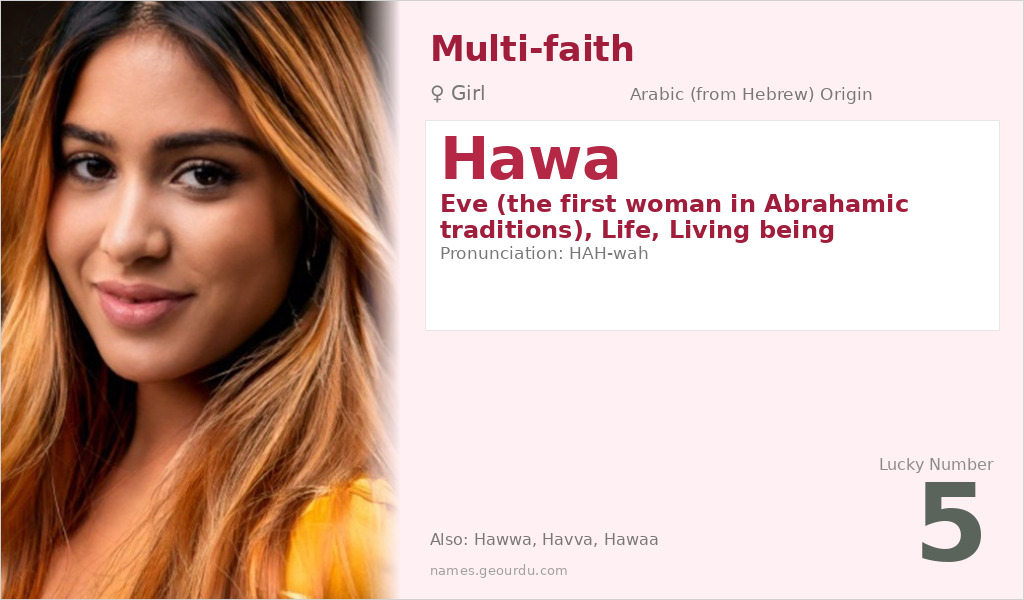
Hawa (حواء) is the Arabic form of the name Eve, derived from the Hebrew חַוָּה (Chawwah), which literally means ‘life’ or ‘living one.’ The name originates from the Semitic root Ḥ-Y-Y (ح ي ي), which conveys concepts of life, living, and vitality. In the Quran and Islamic tradition, Hawa is mentioned as the wife of Prophet Adam and the mother of all humans. The name’s etymology directly connects to the creation narrative, where Eve/Hawa was created from Adam’s rib and named for being ‘the mother of all living’ (Genesis 3:20). This linguistic connection makes Hawa one of the most semantically transparent and meaningful names in Abrahamic traditions.
| 📛 Name | Hawa |
| 💎 Meaning | Eve (the first woman in Abrahamic traditions), Life, Living being |
| 👤 Gender | Girl |
| 🕌 Religion | Multi-faith |
| 🌍 Origin | Arabic (from Hebrew) |
| 🗣 Pronunciation | HAH-wah |
| ✍️ Urdu | حوا |
| ✍️ Arabic | حواء |
| 🔢 Numerology | 5 |
| ✨ Spellings | Hawwa, Havva, Hawaa, Hawa' |
Origin & Cultural Significance
Hawa originates from ancient Semitic languages, specifically Hebrew, where it appears as Chawwah in the Torah. The name was adopted into Arabic as Ḥawwāʾ during the early Islamic period and appears in the Quran. While the name is most prominent in Arabic-speaking Muslim communities, it also appears in various forms across Abrahamic faiths—as Eve in English, Eva in Latin and Romance languages, and Chava in Hebrew. The name has been used for centuries in the Middle East, North Africa, and among Muslim communities worldwide. In some African cultures, particularly in Somalia and Ethiopia, Hawa has been adopted while maintaining its original meaning and significance.
Personality Traits
Those named Hawa often embody qualities associated with life, nurturing, and foundational strength. They are frequently perceived as maternal figures who value family, tradition, and continuity. The name’s historical association with the first woman lends it an aura of originality, resilience, and universal motherhood. People with this name may naturally gravitate toward caregiving roles and often demonstrate compassion and emotional intelligence in their relationships.
Similar Names
If you like Hawa, consider: Eve, Chava, Eva, Haya, Hayat
Famous People Named Hawa
- Hawa Abdi — Somali human rights activist and physician
- Hawa Essuman — Ghanaian film director known for 'Soul Boy'
Frequently Asked Questions About Hawa
What does Hawa mean?
Hawa means 'Life' or 'Living one' and is the Arabic name for Eve, the first woman in Abrahamic traditions. It comes from the Semitic root meaning 'to live.'
Is Hawa a boy or girl name?
Hawa is exclusively a feminine name. In all cultural and religious contexts where it appears, it refers to the first woman and is never used for males.
What is the origin of Hawa?
Hawa originates from Hebrew (Chawwah) and was adopted into Arabic. It is an ancient Semitic name with roots in Abrahamic religious texts, used across Muslim, Christian, and Jewish traditions.