
Table of Contents
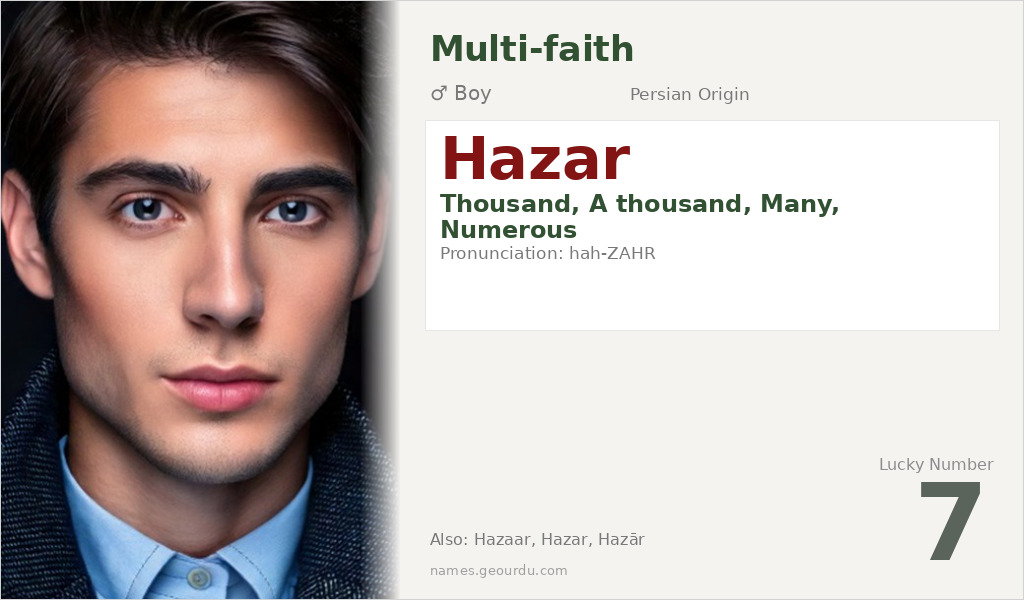
Hazar is a distinctive boy’s name with deep roots in Persian culture, meaning ‘thousand’ and evoking ideas of multitude and prosperity. Used across various regions including Iran, Afghanistan, Turkey, and among Kurdish communities, it carries a sense of grandeur and significance. This name is not tied to a single religion but is appreciated in multi-faith contexts for its powerful connotations. Explore the rich linguistic and cultural background of Hazar in this detailed guide.
Meaning of Hazar
Hazar originates from the Persian word ‘هزار’ (hazār), which directly translates to ‘thousand’. In Persian and related languages such as Urdu, Pashto, and Kurdish, it serves as a numeral and is often used metaphorically to denote abundance, greatness, or a large number. The name symbolizes strength in multiplicity, prosperity, and importance, making it a popular choice for boys in these cultures. Its usage extends beyond literal meaning to represent someone who is significant or has the potential for great achievements. Etymologically, it is well-documented in Persian dictionaries and historical texts, with no connection to meanings like ‘attention’ or ‘nightingale’ as sometimes incorrectly suggested.
| 📛 Name | Hazar |
| 💎 Meaning | Thousand, A thousand, Many, Numerous |
| 👤 Gender | Boy |
| 🕌 Religion | Multi-faith |
| 🌍 Origin | Persian |
| 🗣 Pronunciation | hah-ZAHR |
| ✍️ Urdu | ہزار |
| ✍️ Arabic | هزار |
| 🔢 Numerology | 7 |
| ✨ Spellings | Hazaar, Hazar, Hazār, Hazaar |
Origin & Cultural Significance
Hazar has its origins in Persian, one of the oldest Indo-European languages, and is widely used in Iran, Afghanistan, and parts of Central Asia. It is also prevalent among Kurdish, Pashto, and Urdu-speaking communities, reflecting cross-cultural adoption. Historically, the name appears in Persian literature and poetry, often symbolizing vastness or excellence. While it is common in Muslim-majority regions due to Persian linguistic influence, it is not exclusively Islamic and can be found in multi-faith contexts. The name’s spread through trade, migration, and cultural exchange has made it a recognizable choice in various naming traditions.
Personality Traits
People named Hazar are often perceived as leaders with a strong sense of purpose and ambition. They tend to be analytical, thoughtful, and driven by a desire to make a meaningful impact. Their name, meaning ‘thousand’, may inspire them to pursue goals with perseverance and a focus on achieving great things. In social settings, they are often seen as influential and resourceful, capable of bringing people together and fostering success.
Similar Names
If you like Hazar, consider: Hazarat, Hazaragi, Hazarwan, Hazara, Hazaribagh
Famous People Named Hazar
- Hazar Ergüçlü — Turkish actress of Kurdish descent
- Hazar Motan — Kurdish singer and musician
Frequently Asked Questions About Hazar
What does Hazar mean?
Hazar means 'thousand' in Persian, symbolizing abundance, multitude, and greatness.
Is Hazar a boy or girl name?
Hazar is primarily a boy's name, though it can be used as unisex in some modern contexts, but traditionally it is masculine.
What is the origin of Hazar?
Hazar originates from Persian, with usage in related languages like Urdu, Pashto, and Kurdish, and is common in regions such as Iran, Afghanistan, and among Kurdish communities.





