Table of Contents
Himabindu is an elegant Sanskrit name that beautifully captures nature’s delicate beauty. Meaning ‘drop of snow’ or ‘snow particle,’ this name evokes images of pristine winter landscapes and crystalline purity. Popular in Hindu communities, Himabindu carries both poetic imagery and spiritual significance. Let’s explore the rich linguistic and cultural layers of this captivating name.
Meaning of Himabindu
Himabindu derives from two Sanskrit words: ‘Hima’ (हिम) meaning ‘snow, frost, or cold’ and ‘Bindu’ (बिन्दु) meaning ‘drop, particle, or point.’ The combination creates a vivid poetic image of a snowflake or droplet of snow, symbolizing purity, clarity, and transient beauty. In Sanskrit literature, ‘Hima’ frequently appears in references to the Himalayas (literally ‘abode of snow’) and winter elements, while ‘Bindu’ holds deep significance in yoga and tantric traditions as a point of concentrated consciousness. The name’s etymology is firmly established in classical Sanskrit dictionaries like Monier-Williams’ Sanskrit-English Dictionary, where both components have clear, documented meanings. This linguistic construction follows common Sanskrit naming patterns where natural elements combine to create meaningful compounds.
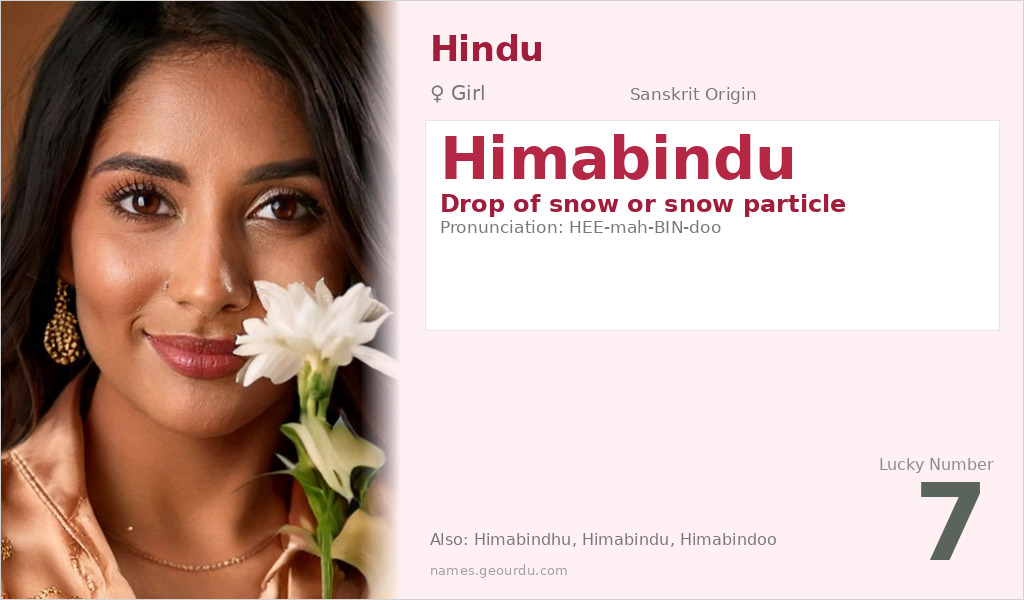
| 📛 Name | Himabindu |
| 💎 Meaning | Drop of snow or snow particle |
| 👤 Gender | Girl |
| 🕌 Religion | Hindu |
| 🌍 Origin | Sanskrit |
| 🗣 Pronunciation | HEE-mah-BIN-doo |
| ✍️ Urdu | ہما بندو |
| ✍️ Arabic | هيما بيندو |
| 🔢 Numerology | 7 |
| ✨ Spellings | Himabindhu, Himabindu, Himabindoo |
Origin & Cultural Significance
Himabindu originates from classical Sanskrit, the ancient liturgical language of Hinduism, Buddhism, and Jainism. As a compound name, it reflects the sophisticated word-formation techniques characteristic of Sanskrit literature. The name appears in various Indian cultural contexts, from classical poetry to modern usage, though it remains relatively uncommon compared to simpler Sanskrit names. In Hindu tradition, names containing natural elements like ‘Hima’ often connect children to divine aspects of nature, with snow symbolizing purity and the Himalayan mountains representing spiritual abodes. While primarily used in India and among Hindu communities worldwide, the name’s Sanskrit roots give it pan-Indian appeal across linguistic regions. Its usage has been documented in Indian naming traditions for centuries, particularly among families valuing classical education and literary heritage.
Personality Traits
Those named Himabindu are often associated with qualities reflecting their name’s snowy imagery. They tend to exhibit calmness, clarity of thought, and a pure-hearted nature. Like a snowflake’s unique structure, Himabindus often possess distinctive personalities with attention to detail and aesthetic appreciation. Their composed exterior may conceal deep emotional sensitivity, much like snow that appears cold but transforms into nurturing water. These individuals typically value peace, introspection, and meaningful connections over superficial interactions.
Similar Names
If you like Himabindu, consider: Himani, Himadri, Himani, Bindu, Himani, Himanshi, Himaja, Himani, Himani
Famous People Named Himabindu
- Himabindu — Indian classical dancer and choreographer known for Bharatanatyam performances
- Himabindu — Character in Indian literature and media representing purity and grace
Frequently Asked Questions About Himabindu
What does Himabindu mean?
Himabindu means 'drop of snow' or 'snow particle' in Sanskrit, combining 'Hima' (snow) and 'Bindu' (drop/particle).
Is Himabindu a boy or girl name?
Himabindu is exclusively a girl's name in Hindu naming traditions, following feminine grammatical forms in Sanskrit.
What is the origin of Himabindu?
Himabindu originates from classical Sanskrit, the ancient language of India, and is used primarily in Hindu communities with roots in Indian literary and cultural traditions.