
Table of Contents
Himank is a distinctive Sanskrit name for boys that evokes the majestic imagery of snow-covered mountain peaks. Rooted in ancient Indian geography and literature, this name carries connotations of purity, strength, and natural beauty. Popular in Hindu communities, Himank symbolizes resilience and lofty aspirations. Discover the rich etymology, cultural context, and personality traits associated with this meaningful name.
Meaning of Himank
Himank derives from the Sanskrit words ‘Hima’ (हिम), meaning ‘snow, frost, or ice’, and ‘Anka’ (अङ्क), meaning ‘mark, sign, peak, or summit’. Together, they form ‘Himank’, which literally translates to ‘snow-marked’ or ‘ice-peak’. In classical Sanskrit texts, this term specifically refers to the snowy summits of the Himalayas, symbolizing purity, grandeur, and permanence. The name is deeply embedded in Hindu cultural and geographical descriptions, often used metaphorically to denote something exalted and untainted. Unlike gemstone names, Himank’s meaning is firmly tied to natural landscapes rather than minerals.
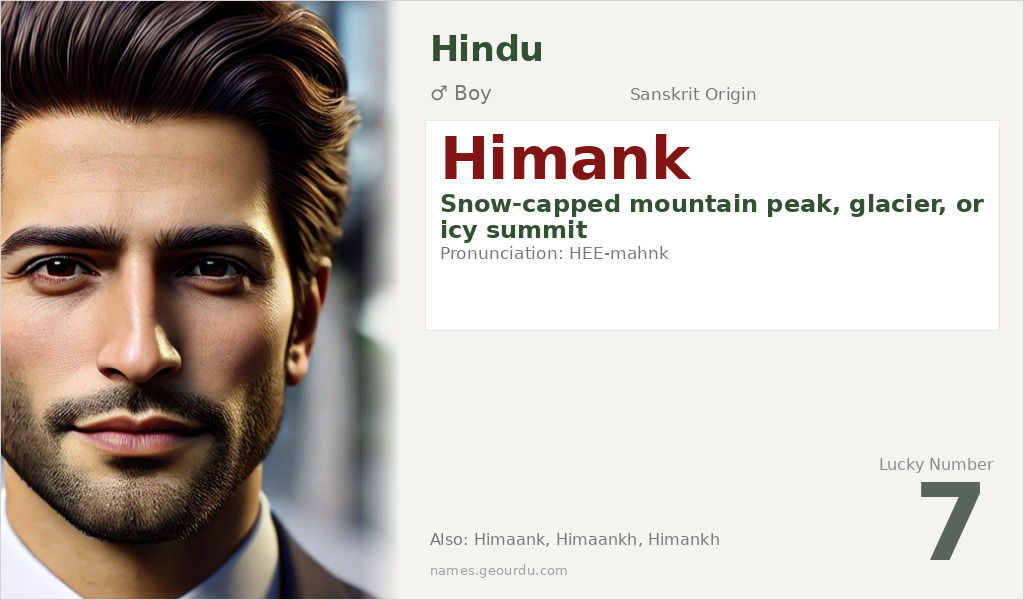
| 📛 Name | Himank |
| 💎 Meaning | Snow-capped mountain peak, glacier, or icy summit |
| 👤 Gender | Boy |
| 🕌 Religion | Hindu |
| 🌍 Origin | Sanskrit |
| 🗣 Pronunciation | HEE-mahnk |
| ✍️ Urdu | ہیمانک |
| ✍️ Arabic | هيمانك |
| 🔢 Numerology | 7 |
| ✨ Spellings | Himaank, Himaankh, Himankh |
Origin & Cultural Significance
Himank originates from Sanskrit, an ancient Indo-Aryan language foundational to Hindu scriptures, literature, and philosophy. The name reflects India’s mountainous geography, particularly the Himalayas, which hold sacred significance in Hinduism as the abode of gods like Shiva. Historically, Sanskrit names describing natural elements like snow and mountains were common, emphasizing virtues such as stability and purity. Himank remains primarily used in Hindu communities across India and the diaspora, though its usage is less widespread than related names like Himanshu. It represents a connection to nature and traditional values within Hindu naming practices.
Personality Traits
People named Himank are often seen as calm, dependable, and introspective, mirroring the steadfast nature of mountains. They may exhibit a thoughtful demeanor, valuing knowledge and ethical principles. Their resilience in facing life’s challenges is a key trait, inspired by the enduring quality of snow-capped peaks. This name suggests a personality that is both strong and serene, with a deep inner wisdom.
Similar Names
If you like Himank, consider: Himanshu, Himalay, Himadri, Himavat, Ankit
Famous People Named Himank
- Himank Bansal — Indian student and academic achiever
- Himank Goswami — Indian cricketer from Assam
Frequently Asked Questions About Himank
What does Himank mean?
Himank means 'snow-capped mountain peak', 'glacier', or 'icy summit'. It comes from Sanskrit, combining 'Hima' (snow) and 'Anka' (peak).
Is Himank a boy or girl name?
Himank is traditionally a boy's name in Hindu culture, derived from masculine Sanskrit roots and commonly given to males.
What is the origin of Himank?
Himank originates from Sanskrit, an ancient Indian language. It is deeply rooted in Hindu geography and literature, referring to the snowy peaks of the Himalayas.





