Table of Contents
Holika is a name steeped in Hindu mythology and cultural tradition. Unlike common given names, Holika refers specifically to a mythological demoness whose story is central to the Holi festival. This name carries deep religious significance and connects directly to one of India’s most vibrant celebrations. Understanding Holika requires exploring the rich tapestry of Hindu mythology and its enduring cultural impact.
Meaning of Holika
The name Holika originates from Sanskrit, deriving from roots related to ‘burning’ or ‘fire’. In Hindu mythology, Holika was a demoness, sister of the demon king Hiranyakashipu, who possessed a boon that made her immune to fire. She attempted to kill her nephew Prahlada, a devotee of Vishnu, by sitting with him in a pyre. However, due to Prahlada’s devotion and Holika’s evil intentions, the boon reversed – Holika burned to death while Prahlada emerged unharmed. This mythological event is commemorated during the Holi festival, where bonfires symbolize the burning of Holika and the triumph of good over evil. The name thus carries meanings of transformation, purification through fire, and the consequences of malicious intent.
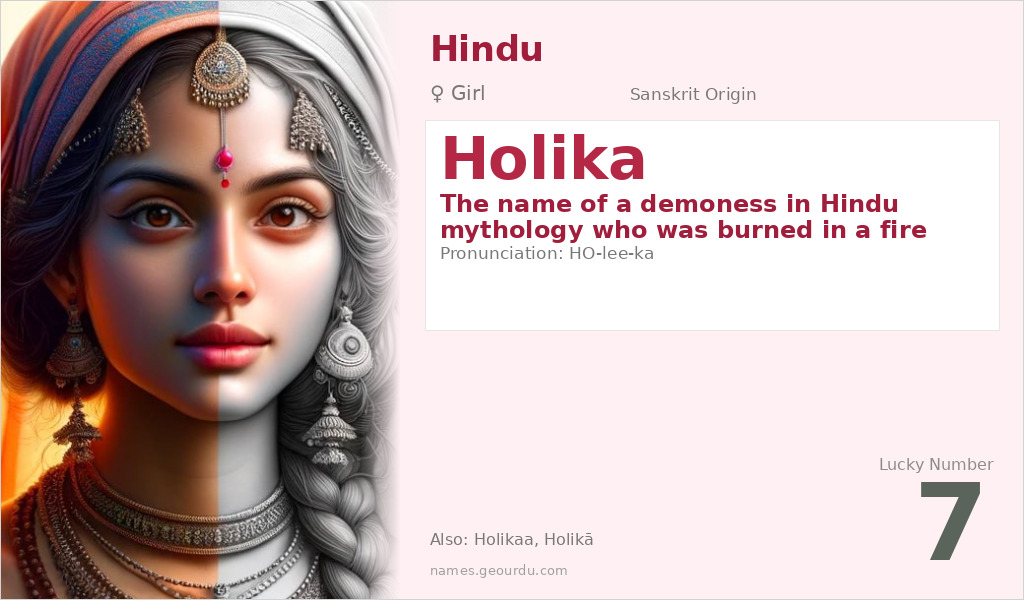
| 📛 Name | Holika |
| 💎 Meaning | The name of a demoness in Hindu mythology who was burned in a fire |
| 👤 Gender | Girl |
| 🕌 Religion | Hindu |
| 🌍 Origin | Sanskrit |
| 🗣 Pronunciation | HO-lee-ka |
| ✍️ Urdu | ہولیکا |
| ✍️ Arabic | هوليكا |
| 🔢 Numerology | 7 |
| ✨ Spellings | Holikaa, Holikā |
Origin & Cultural Significance
Holika has its origins in ancient Sanskrit texts and Hindu Puranic literature, particularly the Bhagavata Purana and Vishnu Purana. The story dates back to at least the 4th century CE and has been central to Hindu tradition for millennia. While not commonly used as a personal name in modern times due to its association with a villainous character, the name remains culturally significant through the Holi festival celebrated across India and Hindu communities worldwide. The festival’s name ‘Holi’ itself derives from ‘Holika’, making this one of the few cases where a mythological figure’s name directly names a major religious celebration. The story is particularly important in Vaishnavism, where it illustrates the power of devotion to Vishnu.
Personality Traits
While Holika is primarily a mythological name rather than a common given name, its associations suggest themes of transformation and moral lessons. The story emphasizes how evil intentions ultimately lead to self-destruction, while devotion and righteousness prevail. In contemporary interpretation, the name might symbolize the idea that negative qualities can be transformed or purified. The mythological context gives the name a weighty, dramatic quality rather than describing personal characteristics.
Similar Names
If you like Holika, consider: Prahlada, Hiranyakashipu, Holi, Hema, Hiranya
Famous People Named Holika
- Holika (mythological figure) — The demoness from Hindu mythology who gives her name to the Holi festival
- No contemporary famous people with this name found — it is primarily used in mythological context
Frequently Asked Questions About Holika
What does Holika mean?
Holika means 'the burning one' or 'she who burns' in Sanskrit. Specifically, it refers to the mythological demoness who was burned in a fire while attempting to kill Prahlada in Hindu mythology.
Is Holika a boy or girl name?
Holika is exclusively a girl's name as it refers to a female mythological figure – the demoness Holika in Hindu tradition. The name has no masculine forms or usage.
What is the origin of Holika?
Holika originates from Sanskrit and Hindu mythology. The name comes from ancient Indian texts like the Bhagavata Purana and is directly connected to the Holi festival, one of Hinduism's major celebrations.