
Table of Contents
Hooman is a distinguished Persian name with deep roots in Iranian history and literature. Meaning ‘good-natured’ or ‘benevolent,’ this name carries centuries of cultural significance from its Zoroastrian origins to its appearance in Ferdowsi’s epic Shahnameh. While popular in Iran and among Persian-speaking communities worldwide, Hooman has also found appreciation across different cultures for its positive meaning and melodic sound. This guide explores the rich etymology, historical context, and modern usage of this classic name.
Meaning of Hooman
Hooman derives from the Middle Persian word ‘hūmān,’ which itself comes from the Avestan term ‘hū-mata’ meaning ‘good thought.’ In Zoroastrian theology, Hūmat (good thoughts) represents one of the three fundamental principles alongside Hūxt (good words) and Hvaršt (good deeds). The name embodies the concept of benevolent thinking and noble character. In Ferdowsi’s 10th-century epic Shahnameh (Book of Kings), Hooman appears as a loyal companion and advisor to the legendary hero Rostam, further cementing the name’s association with wisdom and faithfulness. Modern Persian speakers interpret Hooman as meaning someone with a good disposition, kind-hearted nature, and ethical character.
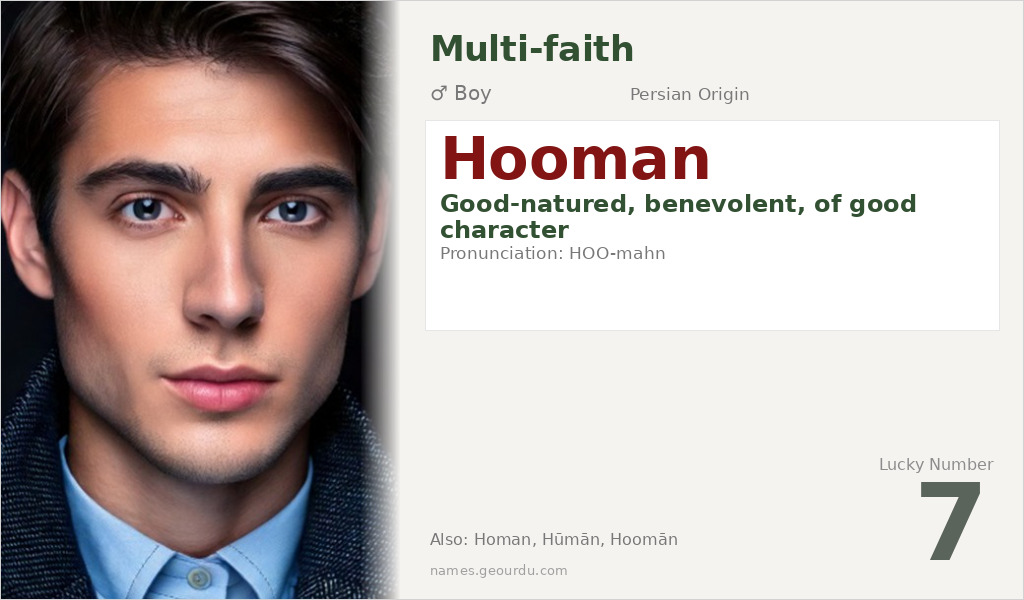
| 📛 Name | Hooman |
| 💎 Meaning | Good-natured, benevolent, of good character |
| 👤 Gender | Boy |
| 🕌 Religion | Multi-faith |
| 🌍 Origin | Persian |
| 🗣 Pronunciation | HOO-mahn |
| ✍️ Urdu | ہومان |
| ✍️ Arabic | هومان |
| 🔢 Numerology | 7 |
| ✨ Spellings | Homan, Hūmān, Hoomān, Houmān |
Origin & Cultural Significance
Hooman originates from ancient Persian culture and Zoroastrian tradition, dating back over two millennia. The name’s philosophical roots in the Avestan concept of ‘good thought’ reflect the ethical framework of pre-Islamic Persian civilization. While maintaining its Persian identity, the name has been adopted by Muslim communities in Iran, Afghanistan, Tajikistan, and the Persian diaspora, demonstrating cultural continuity across religious boundaries. The name’s literary prominence in the Shahnameh—composed during the Islamic period but celebrating pre-Islamic Persian heritage—showcases how traditional Persian names persisted through cultural transitions. Today, Hooman remains a popular choice in Iran and among Persian communities worldwide, valued for its historical depth and positive meaning.
Personality Traits
Those named Hooman are often associated with intellectual depth and moral integrity. Drawing from the name’s meaning of ‘good thought,’ they tend to be reflective individuals who prioritize ethical considerations in decision-making. Their benevolent nature typically manifests as kindness toward others and a desire to contribute positively to their communities. While they may appear reserved initially, Hooman’s often possess strong convictions and a quiet determination that earns them respect.
Similar Names
If you like Hooman, consider: Hormoz, Farhad, Kaveh, Rostam, Sohrab
Famous People Named Hooman
- Hooman Majd — Iranian-American journalist and author known for his books on Iran
- Hooman Khalatbari — Iranian footballer who played for Persepolis and the Iranian national team
Frequently Asked Questions About Hooman
What does Hooman mean?
Hooman means 'good-natured,' 'benevolent,' or 'of good character' in Persian. It derives from the Avestan 'hū-mata' meaning 'good thought,' a central concept in Zoroastrian philosophy.
Is Hooman a boy or girl name?
Hooman is traditionally and predominantly a masculine name in Persian culture. While names can sometimes cross gender boundaries, Hooman is overwhelmingly used for boys in all regions where it appears.
What is the origin of Hooman?
Hooman originates from Persian language and culture, with roots in ancient Zoroastrian tradition. The name appears in the 10th-century Persian epic Shahnameh and has been used continuously in Iranian and Persian-speaking communities for centuries.





