
Table of Contents
Hooshmand is a distinguished Persian name that carries centuries of cultural heritage. Meaning ‘wise’ or ‘intelligent,’ this name reflects the high value Persian-speaking cultures place on wisdom and intellect. Used across Iran, Afghanistan, Pakistan, and other regions influenced by Persian civilization, Hooshmand represents both traditional values and timeless virtues. Its elegant construction and profound meaning make it a meaningful choice for parents seeking a name with depth and cultural resonance.
Meaning of Hooshmand
Hooshmand is a compound Persian name with clear etymological roots. The first component ‘hoosh’ (هوش) derives from Middle Persian ‘hōš’ meaning ‘intelligence, mind, consciousness,’ which itself comes from the Avestan root ‘haos’ meaning ‘to perceive, understand.’ The second component ‘mand’ (مند) is a productive suffix in Persian that creates adjectives meaning ‘possessing’ or ‘endowed with,’ related to the verb ‘mandan’ (to remain, to have). Thus, Hooshmand literally means ‘one who possesses intelligence’ or ‘endowed with wisdom.’ This construction follows a common Persian naming pattern seen in names like Bahramand (possessing glory) and Mehrmand (possessing love). The name appears in classical Persian literature and continues in modern usage across Persian-influenced cultures.
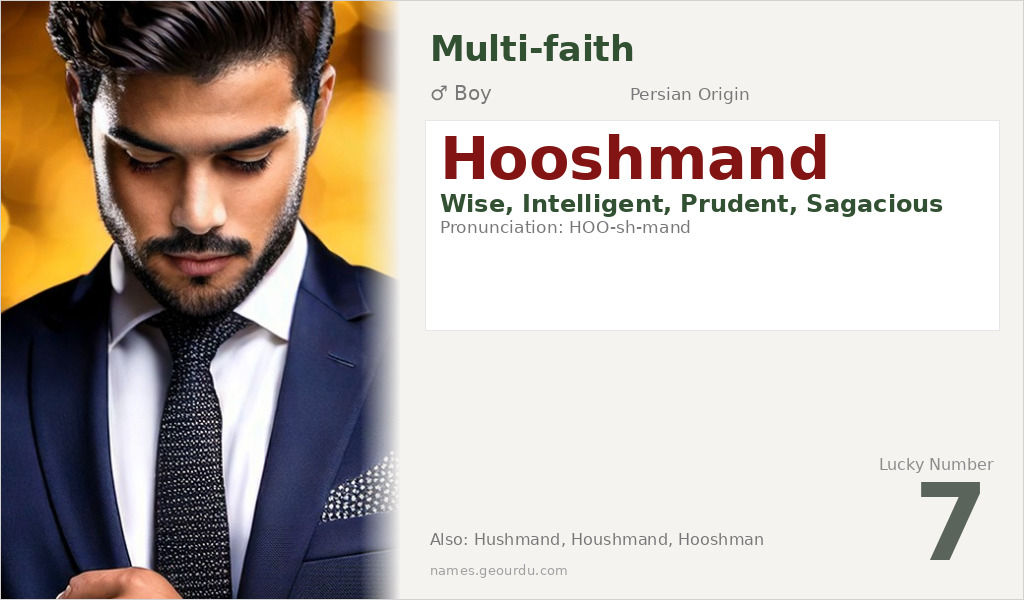
| 📛 Name | Hooshmand |
| 💎 Meaning | Wise, Intelligent, Prudent, Sagacious |
| 👤 Gender | Boy |
| 🕌 Religion | Multi-faith |
| 🌍 Origin | Persian |
| 🗣 Pronunciation | HOO-sh-mand |
| ✍️ Urdu | ہوشمند |
| ✍️ Arabic | هوشمند |
| 🔢 Numerology | 7 |
| ✨ Spellings | Hushmand, Houshmand, Hooshman, Hushman |
Origin & Cultural Significance
Hooshmand originates from Persian culture, specifically from the Persian language that has influenced numerous regions for over a millennium. The name reflects the intellectual traditions of Persian civilization, where wisdom and learning were highly valued virtues. While commonly used in Muslim communities in Iran, Afghanistan, Pakistan, and Tajikistan, it’s important to note that the name predates Islam and has been used by Zoroastrians and other religious groups in Persian-speaking areas. The name’s usage spread through Persian literary and administrative influence across South Asia and Central Asia, becoming incorporated into Urdu, Pashto, and other languages. Today, it remains popular in Persian-speaking communities worldwide while maintaining its classical linguistic structure.
Personality Traits
Those named Hooshmand are often characterized by their thoughtful nature and intellectual curiosity. They tend to approach life with careful consideration, weighing options before making decisions. Their natural inclination toward wisdom makes them valuable in situations requiring judgment and insight. While they may appear reserved at first, their depth of understanding and analytical abilities often earn them respect in both personal and professional spheres.
Similar Names
If you like Hooshmand, consider: Danish (Persian/Urdu: wise, knowledgeable), Hakeem (Arabic: wise, physician), Aqil (Arabic: intelligent, rational), Farasat (Persian/Urdu: insight, discernment), Zeki (Turkish: intelligent, clever)
Famous People Named Hooshmand
- Hooshmand Aghili — Iranian singer and composer known as the 'Sultan of Persian Pop'
- Hooshmand Vahdat — Iranian poet and literary figure
Frequently Asked Questions About Hooshmand
What does Hooshmand mean?
Hooshmand means 'wise, intelligent, prudent, or sagacious.' It's a Persian compound name from 'hoosh' (intelligence) and 'mand' (possessing), literally translating to 'possessing intelligence.'
Is Hooshmand a boy or girl name?
Hooshmand is traditionally and predominantly a masculine name used for boys in Persian-speaking cultures and regions influenced by Persian naming traditions.
What is the origin of Hooshmand?
Hooshmand originates from the Persian language and culture. It has been used for centuries in Persian-speaking regions including Iran, Afghanistan, and parts of Central and South Asia, with roots in Middle Persian and Avestan linguistic traditions.





