
Table of Contents
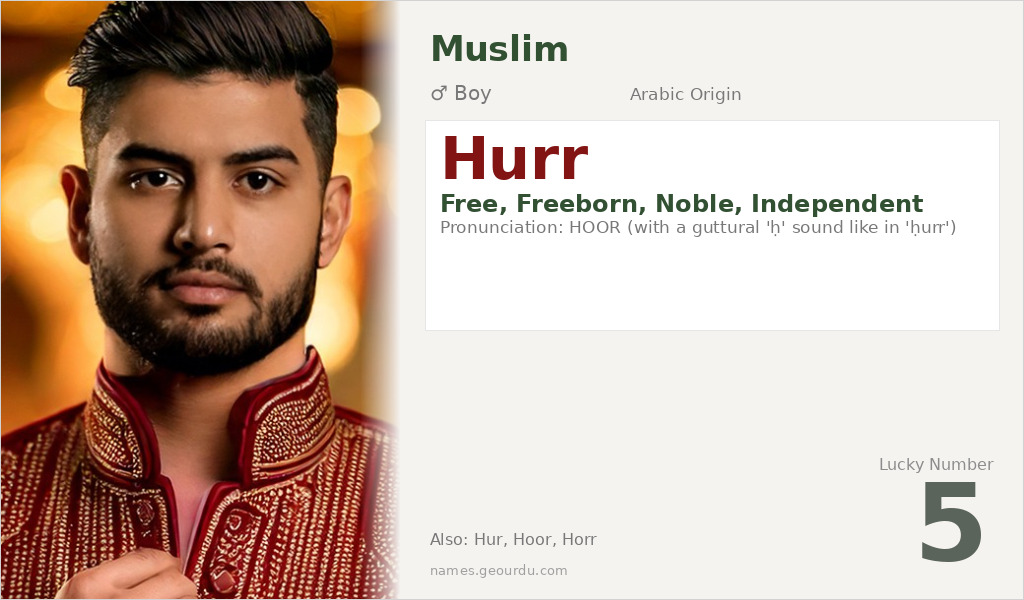
Hurr is a distinguished Arabic name with profound historical and linguistic significance. Primarily given to boys in Muslim communities, it carries the powerful meaning of ‘free’ or ‘freeborn,’ symbolizing nobility and independence. This name gained eternal fame through Al-Hurr ibn Yazid al-Riyahi, whose story at Karbala embodies redemption and principled courage. Today, Hurr remains a meaningful choice for parents valuing both tradition and virtuous ideals.
Meaning of Hurr
The name Hurr originates from the Arabic root ‘ḥ-r-r’ (ح-ر-ر), which conveys concepts of freedom, liberation, and nobility. In classical Arabic, ‘ḥurr’ specifically refers to a free person as opposed to ‘abd’ (slave), making it a term of social and moral distinction. This root appears in related words like ‘ḥurriyya’ (freedom) and ‘taḥrīr’ (liberation). Historically, the name signified someone born free with honorable status, evolving to represent personal independence and noble character. Its meaning is consistently documented across Arabic linguistic sources, from medieval lexicons to modern dictionaries, without the astrological associations incorrectly added in some online sources.
| 📛 Name | Hurr |
| 💎 Meaning | Free, Freeborn, Noble, Independent |
| 👤 Gender | Boy |
| 🕌 Religion | Muslim |
| 🌍 Origin | Arabic |
| 🗣 Pronunciation | HOOR (with a guttural 'ḥ' sound like in 'ḥurr') |
| ✍️ Urdu | حر |
| ✍️ Arabic | حُرّ |
| 🔢 Numerology | 5 |
| ✨ Spellings | Hur, Hoor, Horr |
Origin & Cultural Significance
Hurr has deep roots in Arabic culture and Islamic history. It was used in pre-Islamic Arabia to denote freeborn individuals of tribal nobility and gained particular prominence in early Islamic times. The most famous bearer, Al-Hurr ibn Yazid al-Riyahi, was a commander who initially opposed Imam Husayn but later joined his cause at the Battle of Karbala in 680 CE, becoming a symbol of repentance and moral courage in Shia tradition. This historical association cemented the name’s popularity in Muslim communities, especially among Arabic, Persian, Urdu, and other Islamic language speakers. While primarily an Arabic name, it has been adopted in various Muslim cultures without significant phonetic changes.
Personality Traits
Named after the concept of freedom, individuals called Hurr are often seen as independent and principled. They tend to value autonomy and self-determination, potentially exhibiting leadership qualities and a strong moral compass. The name’s historical association with nobility suggests someone who carries themselves with dignity and respect, while its meaning encourages a free-spirited yet responsible character.
Similar Names
If you like Hurr, consider: Azad (Persian/Urdu: Free), Huri (Arabic: Heavenly maiden), Hurriya (Arabic: Freedom), Ahrar (Arabic: Free people), Muharrar (Arabic: Liberated)
Famous People Named Hurr
- Al-Hurr ibn Yazid al-Riyahi — 7th century Arab military commander who initially opposed then joined Imam Husayn at Karbala, celebrated in Shia Islam for his redemption
- Hurr Shabbaz — Pakistani cricketer who played domestic cricket in the 1970s-80s
Frequently Asked Questions About Hurr
What does Hurr mean?
Hurr means 'Free,' 'Freeborn,' or 'Noble' in Arabic, derived from the root 'ḥ-r-r' denoting freedom and honorable status.
Is Hurr a boy or girl name?
Hurr is exclusively a boy's name in Arabic and Islamic naming traditions, with no documented usage as a feminine name.
What is the origin of Hurr?
Hurr originates from Arabic language and culture, with significant historical usage in early Islamic history, particularly associated with Al-Hurr ibn Yazid al-Riyahi.





