
Table of Contents
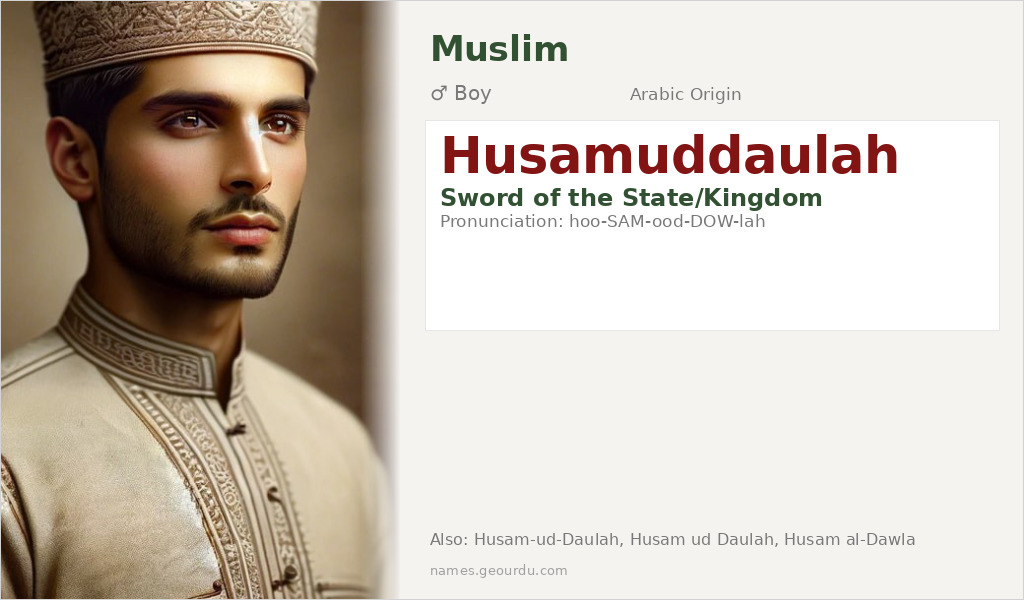
Husamuddaulah is a distinguished Arabic name with deep historical roots in Islamic civilization. Combining martial symbolism with political authority, this name reflects the ideal of warrior-statesmen who protected and governed their realms. While less common today, it remains a powerful choice with rich cultural heritage. Understanding its components reveals insights into classical Arabic naming traditions and values.
Meaning of Husamuddaulah
Husamuddaulah derives from two Arabic words: ‘Husam’ (حسام) meaning ‘sword’ or ‘sharp blade’, and ‘ud-Daulah’ (الدولة) meaning ‘of the state’ or ‘of the kingdom’. The name literally translates to ‘Sword of the State’, symbolizing both military protection and governmental authority. This compound structure follows classical Arabic naming patterns where honorific titles often combined personal attributes with political roles. The ‘ud-Daulah’ component was particularly common during the Abbasid and later Islamic periods as a formal title for rulers and high officials. Linguistically, ‘Husam’ comes from the root Ḥ-S-M relating to cutting or dividing, while ‘Dawlah’ refers to state, dynasty, or political power.
| 📛 Name | Husamuddaulah |
| 💎 Meaning | Sword of the State/Kingdom |
| 👤 Gender | Boy |
| 🕌 Religion | Muslim |
| 🌍 Origin | Arabic |
| 🗣 Pronunciation | hoo-SAM-ood-DOW-lah |
| ✍️ Urdu | حسام الدولہ |
| ✍️ Arabic | حسام الدولة |
| 🔢 Numerology | |
| ✨ Spellings | Husam-ud-Daulah, Husam ud Daulah, Husam al-Dawla, Husamuddawlah |
Origin & Cultural Significance
Husamuddaulah originated in the Arabic-speaking Islamic world during the medieval period, particularly popular among military aristocracy and ruling classes. The name reflects the fusion of martial and administrative ideals valued in Islamic governance traditions. It was most commonly used as an honorific title (laqab) rather than a given name at birth, awarded to commanders and rulers for their service. Historical records show variations of this name among Kurdish, Persian, and Arab leaders during the 10th-13th centuries. The name’s usage declined with changing naming conventions but remains preserved in historical texts and genealogical records.
Personality Traits
Those named Husamuddaulah are traditionally associated with protective leadership and decisive action. The name suggests someone who combines strategic thinking with practical implementation, capable of both defending and administering. Historically, bearers of this name were expected to demonstrate courage in battle alongside wisdom in governance. While modern interpretations vary, the name continues to evoke qualities of strength, responsibility, and commitment to community welfare.
Similar Names
If you like Husamuddaulah, consider: Husam, Husamuddin, Saifuddaulah, Nasiruddaulah, Imaduddaulah
Famous People Named Husamuddaulah
- Husam al-Din — 12th-century Kurdish military commander and ruler of Homs, Syria
- Husam al-Dawla — historical title used by various Islamic rulers including Abu'l-Hasan Ali ibn al-Husayn, a 10th-century Buyid ruler
Frequently Asked Questions About Husamuddaulah
What does Husamuddaulah mean?
Husamuddaulah means 'Sword of the State' or 'Sword of the Kingdom' in Arabic. It combines 'Husam' (sword) with 'ud-Daulah' (of the state).
Is Husamuddaulah a boy or girl name?
Husamuddaulah is exclusively a boy's name in Arabic and Islamic naming traditions. The martial and political connotations make it historically masculine.
What is the origin of Husamuddaulah?
Husamuddaulah originates from classical Arabic and was particularly used during the Islamic Golden Age as an honorific title for military commanders and rulers in Arab, Persian, and Kurdish societies.





