
Table of Contents
Husnain is a profoundly meaningful Arabic name with deep roots in Islamic history and tradition. As a compound name referencing two of the most revered figures in Islam, it carries both linguistic elegance and spiritual significance. Popular primarily among Muslim communities, particularly in South Asia and the Middle East, this name represents a connection to early Islamic heritage. Parents choosing Husnain often seek to honor religious tradition while bestowing a name with historical resonance.
Meaning of Husnain
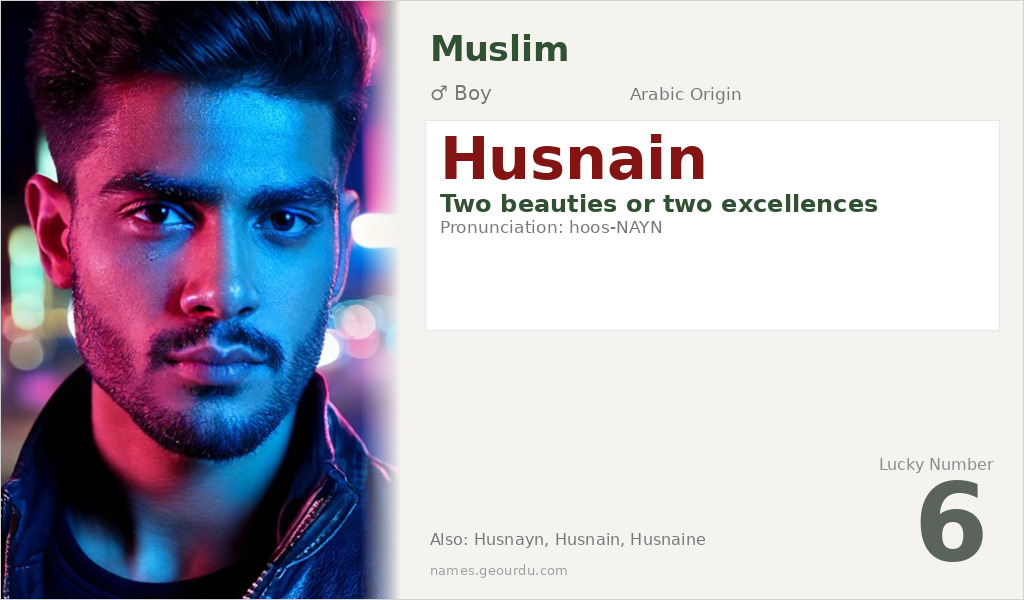
Husnain derives from classical Arabic, combining ‘Husn’ (حُسْن), which means beauty, excellence, or goodness, with the dual suffix ‘-ain’ (ـَيْن) indicating two. The complete meaning is therefore ‘two beauties’ or ‘two excellences.’ This specific dual form is significant because it refers to the two grandsons of Prophet Muhammad: Hasan ibn Ali and Husayn ibn Ali. In Islamic contexts, particularly within Shia tradition, these two figures are collectively honored as ‘Al-Hasanayn’ or simply ‘Husnain.’ The name thus functions as a tribute to both individuals simultaneously, embodying their shared virtues and historical importance. Linguistically, it follows Arabic’s precise grammatical structure for dual nouns, making it both semantically clear and phonetically harmonious.
| 📛 Name | Husnain |
| 💎 Meaning | Two beauties or two excellences |
| 👤 Gender | Boy |
| 🕌 Religion | Muslim |
| 🌍 Origin | Arabic |
| 🗣 Pronunciation | hoos-NAYN |
| ✍️ Urdu | حسنین |
| ✍️ Arabic | حُسْنَيْن |
| 🔢 Numerology | 6 |
| ✨ Spellings | Husnayn, Husnain, Husnaine, Husnen |
Origin & Cultural Significance
Husnain originates from 7th-century Arabic within the context of early Islamic history. The name gained prominence specifically as an honorific reference to Hasan and Husayn, the sons of Fatimah (daughter of Prophet Muhammad) and Ali ibn Abi Talib. While the individual names Hasan and Husayn were common, the combined form Husnain emerged as a way to venerate both brothers together, particularly in Shia Islam where they are considered the second and third Imams. The name spread through Islamic expansion, becoming established in Persian, Urdu, and other languages influenced by Arabic. Today, it remains most prevalent in Muslim-majority regions including Pakistan, India, Iran, and Arab countries, often chosen by families with Shia affiliations or those wishing to honor early Islamic figures.
Personality Traits
Those named Husnain are often perceived as carrying the legacy of their namesakes, which may influence personality expectations. They might be seen as individuals with strong moral convictions, family loyalty, and a sense of justice. The dual nature of the name suggests someone who can balance different qualities—perhaps combining strength with compassion, or tradition with modernity. While personality traits vary individually, the name’s historical weight may inspire confidence and spiritual awareness in those who bear it.
Similar Names
If you like Husnain, consider: Hasan, Husayn, Hussain, Hassan, Hussein
Famous People Named Husnain
- Husnain Haider — Pakistani cricketer who played for Lahore Blues
- Husnain Bokhari — Pakistani field hockey player who competed in the 1960 Summer Olympics
Frequently Asked Questions About Husnain
What does Husnain mean?
Husnain means 'two beauties' or 'two excellences' in Arabic. It specifically refers to the two grandsons of Prophet Muhammad: Hasan and Husayn.
Is Husnain a boy or girl name?
Husnain is exclusively a boy's name in all cultural contexts where it is used, reflecting its reference to male historical figures.
What is the origin of Husnain?
Husnain originates from Arabic and emerged in early Islamic history as a combined reference to Hasan and Husayn, the grandsons of Prophet Muhammad.





