
Table of Contents
Hussein is a profoundly significant name in the Islamic world, carrying both linguistic beauty and deep historical resonance. As the diminutive of Hasan, meaning ‘good’ or ‘beautiful’, it has been borne by religious figures, royalty, and artists across centuries. This name embodies virtues of excellence and morality, making it a popular choice for boys in Muslim communities globally. Its legacy continues to inspire parents seeking a name with cultural depth and positive connotations.
Meaning of Hussein
Hussein originates from the Arabic root Ḥ-S-N (ح-س-ن), which conveys meanings of goodness, beauty, and virtue. Specifically, it is the diminutive form of Hasan, translating to ‘little Hasan’ or ‘the good one’, emphasizing endearment and moral excellence. In classical Arabic, the name is associated with high praise and ethical perfection, reflecting ideals valued in Islamic teachings. The name gained monumental importance through Hussein ibn Ali, the grandson of Prophet Muhammad, whose martyrdom at Karbala cemented its place in Shia Islam as a symbol of sacrifice and righteousness. Linguistically, it has spread to Persian, Turkish, Urdu, and other languages, often retaining its original meaning while adapting to local phonetics.
| 📛 Name | Hussein |
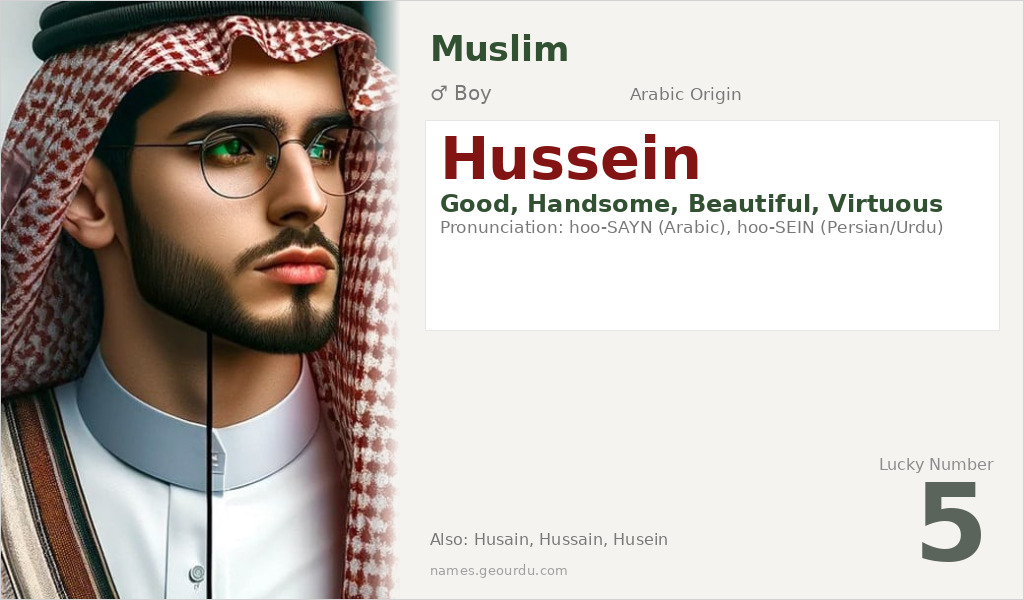
| 💎 Meaning | Good, Handsome, Beautiful, Virtuous |
| 👤 Gender | Boy |
| 🕌 Religion | Muslim |
| 🌍 Origin | Arabic |
| 🗣 Pronunciation | hoo-SAYN (Arabic), hoo-SEIN (Persian/Urdu) |
| ✍️ Urdu | حسین |
| ✍️ Arabic | حسين |
| 🔢 Numerology | 5 |
| ✨ Spellings | Husain, Hussain, Husein, Husayn, Hossein, Huseyin |
Origin & Cultural Significance
Hussein has its roots in pre-Islamic Arabic, where the root Ḥ-S-N was used to describe aesthetic and moral qualities. With the advent of Islam, the name gained religious significance, most notably through Hussein ibn Ali, born in 626 CE, whose legacy as the third Shia Imam has made the name especially revered in Shia communities. Over centuries, it spread across the Muslim world through cultural exchange, conquests, and migration, becoming common in regions from the Middle East to South Asia. In modern times, it is used by diverse ethnic groups, including Arabs, Persians, Turks, Kurds, and South Asians, often symbolizing a connection to Islamic heritage and values.
Personality Traits
Those named Hussein are often seen as natural leaders with a strong moral compass, influenced by the name’s associations with virtue and historical figures of integrity. They may exhibit traits such as empathy, resilience, and a commitment to justice, mirroring the qualities attributed to Hussein ibn Ali. In social settings, they tend to be charismatic and persuasive, able to inspire others while maintaining a sense of humility and purpose.
Similar Names
If you like Hussein, consider: Hasan, Hassan, Husain, Hussain, Hossein
Famous People Named Hussein
- Hussein ibn Ali — grandson of Prophet Muhammad and third Shia Imam, martyred at Karbala
- King Hussein of Jordan — long-reigning monarch of Jordan from 1952 to 1999
- Hussein Chalayan — Turkish-Cypriot fashion designer known for innovative designs
Frequently Asked Questions About Hussein
What does Hussein mean?
Hussein means 'good, handsome, virtuous' in Arabic, derived from the root Ḥ-S-N. It is the diminutive of Hasan, meaning 'little Hasan' or 'the good one'.
Is Hussein a boy or girl name?
Hussein is exclusively a boy's name in Arabic and Islamic naming traditions, though similar feminine forms like Husna exist.
What is the origin of Hussein?
Hussein originates from Arabic, with deep roots in Islamic history, particularly through Hussein ibn Ali, and has spread to Persian, Turkish, Urdu, and other cultures.





