
Table of Contents
Imram is a name that bridges religious traditions, carrying profound historical and spiritual significance. With roots in ancient Hebrew scripture and prominent mention in Islamic texts, this name has been borne by important patriarchal figures across Abrahamic faiths. Today, it remains a popular choice for boys in Muslim, Christian, and Jewish communities worldwide, symbolizing leadership, nobility, and spiritual heritage.
Meaning of Imram
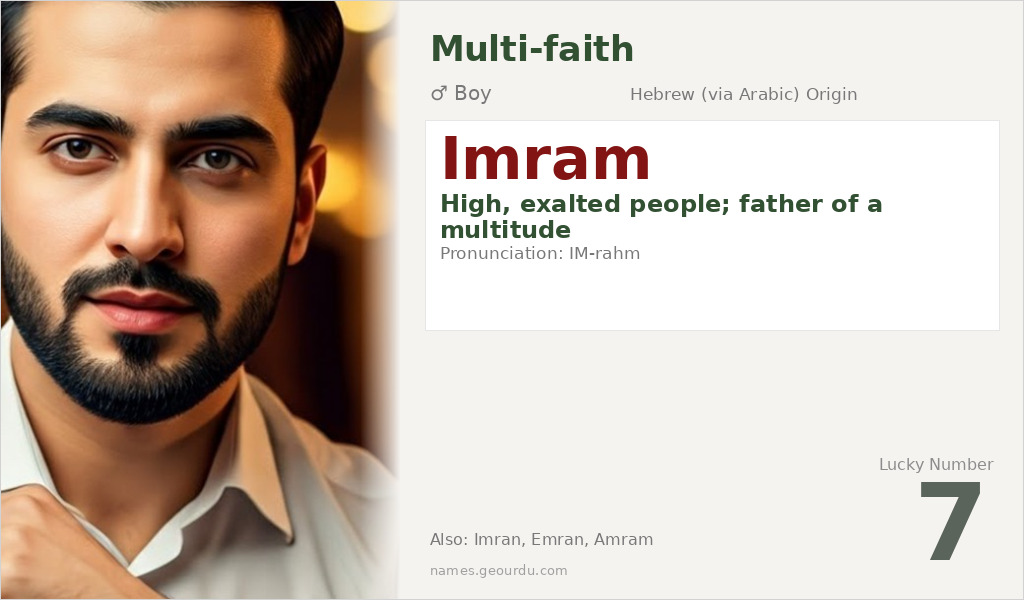
The name Imram derives from the Hebrew name Amram (עַמְרָם), meaning ‘high, exalted people’ or ‘father of a multitude’. It is composed of two Hebrew elements: ‘am’ (עַם), meaning ‘people’ or ‘nation’, and ‘ram’ (רָם), meaning ‘high’, ‘exalted’, or ‘lofty’. In the Arabic adaptation, it became Imran (عمران), maintaining the same core meaning while adapting to Arabic phonology. This name appears in the Hebrew Bible as the father of Moses, Aaron, and Miriam, and in the Quran as the father of Maryam (Mary), mother of Jesus. The linguistic journey from Hebrew to Arabic demonstrates how Semitic languages share common roots while developing distinct cultural expressions.
| 📛 Name | Imram |
| 💎 Meaning | High, exalted people; father of a multitude |
| 👤 Gender | Boy |
| 🕌 Religion | Multi-faith |
| 🌍 Origin | Hebrew (via Arabic) |
| 🗣 Pronunciation | IM-rahm |
| ✍️ Urdu | عمران |
| ✍️ Arabic | عمران |
| 🔢 Numerology | 7 |
| ✨ Spellings | Imran, Emran, Amram, Omran |
Origin & Cultural Significance
Imram originates from ancient Hebrew, specifically from the Torah where Amram appears as a Levite and the father of three key Biblical figures. The name entered Islamic tradition through the Quran, where Imran is mentioned as the father of Maryam in Surah Al Imran. This dual religious significance has made the name popular across the Middle East, South Asia, and among diaspora communities worldwide. In Pakistan, India, Bangladesh, and Arab nations, variations like Imran are particularly common. The name’s cross-cultural appeal stems from its association with righteous, protective father figures in both religious narratives, making it a symbol of faith, leadership, and continuity across generations.
Personality Traits
Those named Imram often embody the leadership qualities associated with their namesakes. They tend to be principled individuals with strong family values and community orientation. The name’s historical weight may inspire a sense of responsibility and spiritual depth, while its cross-cultural resonance suggests adaptability and broad-mindedness. Many Imrams are drawn to roles where they can guide, protect, or inspire others, reflecting the paternal symbolism embedded in the name’s etymology.
Similar Names
If you like Imram, consider: Ibrahim, Ismail, Yaqub, Yusuf, Harun
Famous People Named Imram
- Imran Khan — Former Prime Minister of Pakistan and cricket legend
- Imran Abbas — Pakistani actor and model known for his work in television and film
Frequently Asked Questions About Imram
What does Imram mean?
Imram means 'high, exalted people' or 'father of a multitude' in Hebrew. It is the Arabic form of the Biblical name Amram.
Is Imram a boy or girl name?
Imram is exclusively a masculine name in all cultural contexts where it is used, reflecting its association with patriarchal figures in religious texts.
What is the origin of Imram?
Imram originates from Hebrew (Amram) and was adopted into Arabic as Imran. It has significant presence in both Judeo-Christian and Islamic traditions, particularly in the Middle East and South Asia.





