
Table of Contents
Inayat Ur Rahman is a profoundly meaningful Arabic name that carries significant spiritual weight in Islamic tradition. Combining ‘Inayat’ (grace/favor) with ‘Ar-Rahman’ (The Most Gracious), this name beautifully expresses devotion to divine benevolence. Popular among Muslim families worldwide, it represents both a blessing and an aspiration for the child to embody merciful qualities. This comprehensive guide explores the name’s etymology, cultural significance, and practical considerations for parents.
Meaning of Inayat Ur Rahman
The name Inayat Ur Rahman derives entirely from classical Arabic with deep Islamic theological roots. ‘Inayat’ (عناية) originates from the triliteral root ‘ayn-nun-ya’ which conveys concepts of care, favor, grace, benevolence, and special attention. In Islamic context, it often refers to divine grace or Allah’s special favor upon believers. ‘Ar-Rahman’ (الرحمن) is the second of Allah’s 99 names, mentioned prominently in the Quran’s opening chapter, meaning ‘The Most Gracious’ or ‘The All-Merciful.’ When combined, the name creates a powerful devotional statement meaning ‘Grace of The Most Gracious’ or ‘Favor of The All-Merciful.’ This construction follows a common Arabic naming pattern where attributes are paired with divine names to create meaningful theophoric names.
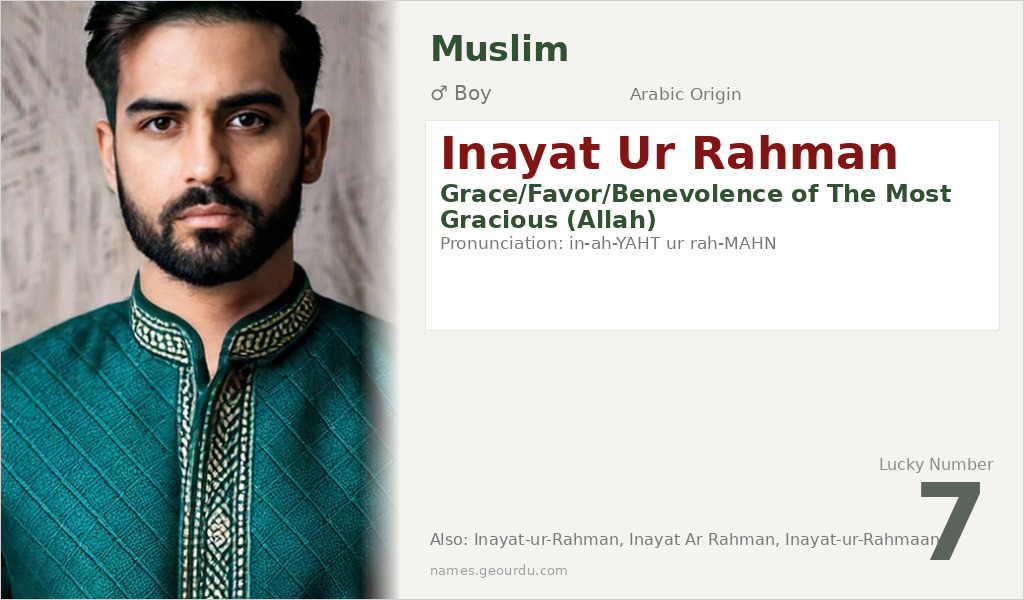
| 📛 Name | Inayat Ur Rahman |
| 💎 Meaning | Grace/Favor/Benevolence of The Most Gracious (Allah) |
| 👤 Gender | Boy |
| 🕌 Religion | Muslim |
| 🌍 Origin | Arabic |
| 🗣 Pronunciation | in-ah-YAHT ur rah-MAHN |
| ✍️ Urdu | عنایت الرحمن |
| ✍️ Arabic | عناية الرحمن |
| 🔢 Numerology | 7 |
| ✨ Spellings | Inayat-ur-Rahman, Inayat Ar Rahman, Inayat-ur-Rahmaan, Inayat ur Rehman |
Origin & Cultural Significance
Inayat Ur Rahman originates from classical Arabic and Islamic naming traditions, particularly prevalent in South Asia, the Middle East, and among Muslim communities worldwide. The name gained popularity through Islamic scholarship and cultural exchange, with ‘Inayat’ appearing in various Islamic texts as a term for divine grace and favor. While the components are purely Arabic, the specific compound form ‘Inayat Ur Rahman’ became particularly common in Urdu-speaking regions, where Persian and Arabic influences merged in Muslim naming conventions. The name reflects the Islamic practice of giving children names with positive meanings and spiritual significance, often incorporating Allah’s attributes as a constant reminder of divine qualities.
Personality Traits
Those named Inayat Ur Rahman are often associated with compassionate, spiritually aware personalities. The name’s meaning suggests individuals who may naturally exhibit mercy, kindness, and a nurturing disposition toward others. They might be perceived as gracious in their interactions and inclined toward service-oriented or caregiving roles. The spiritual dimension of the name could indicate a person with deep faith values and a tendency to seek meaning beyond material concerns.
Similar Names
If you like Inayat Ur Rahman, consider: Inayatullah, Rahman, Inam, Fazlur Rahman, Karim ur Rahman
Famous People Named Inayat Ur Rahman
- Inayat-ur-Rehman — Pakistani politician and former member of the National Assembly of Pakistan
- Inayat ur Rahman — Notable figure in Islamic scholarship and community leadership in South Asia
Frequently Asked Questions About Inayat Ur Rahman
What does Inayat Ur Rahman mean?
Inayat Ur Rahman means 'Grace/Favor/Benevolence of The Most Gracious' in Arabic. It combines 'Inayat' (grace/favor) with 'Ar-Rahman' (The Most Gracious), one of Allah's 99 names in Islam.
Is Inayat Ur Rahman a boy or girl name?
Inayat Ur Rahman is exclusively a boy's name in Islamic naming tradition. While 'Inayat' alone can sometimes be unisex in certain regions, the full compound form with 'Ur Rahman' is traditionally masculine.
What is the origin of Inayat Ur Rahman?
The name originates from classical Arabic and Islamic theology. Both components are Arabic words with deep roots in Quranic language and Islamic scholarship, though the specific compound form became particularly popular in South Asian Muslim communities.





