
Table of Contents
Indra is one of the most significant names in Hindu mythology, belonging to the king of the gods and lord of the heavens. With roots in ancient Sanskrit, this powerful name carries centuries of cultural and religious significance. While traditionally masculine, modern usage has seen some variation in gender assignment across different cultures.
Meaning of Indra
The name Indra originates from the Sanskrit language, specifically from the root ‘ind’ meaning ‘drop’ (referring to rain or soma, the ritual drink) combined with the suffix ‘-ra’ indicating possession. Thus, the literal meaning is ‘possessor of drops’ or ‘lord of rain’. In Vedic literature, Indra is celebrated as the god who brings rain and controls the weather. The name appears extensively in the Rigveda, where Indra is described as wielding the thunderbolt (vajra) and defeating the drought-causing demon Vritra. This etymology reflects his primary role as a rain-bringer and fertility deity in ancient Indian religion.
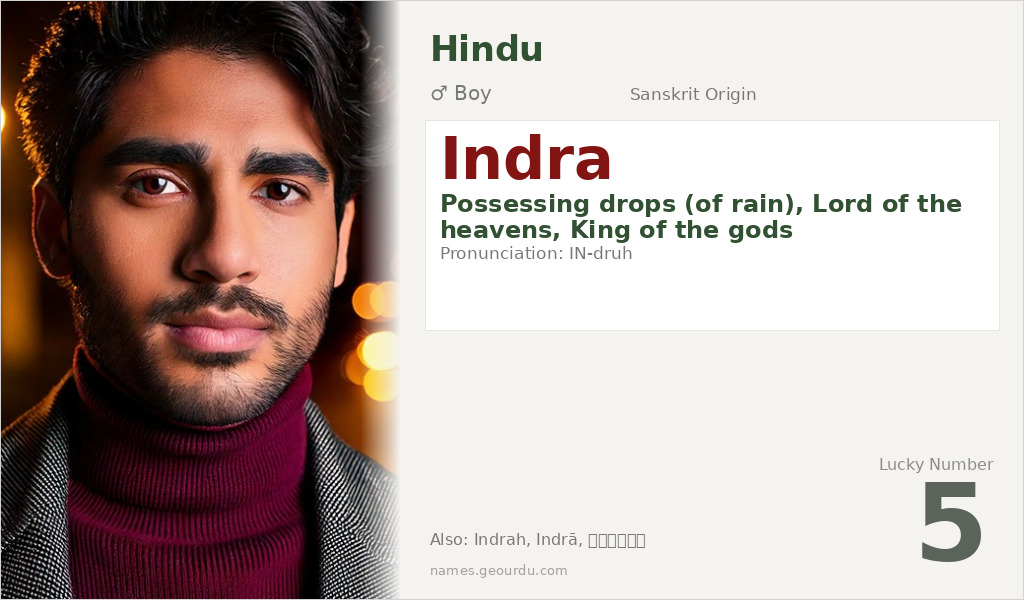
| 📛 Name | Indra |
| 💎 Meaning | Possessing drops (of rain), Lord of the heavens, King of the gods |
| 👤 Gender | Boy |
| 🕌 Religion | Hindu |
| 🌍 Origin | Sanskrit |
| 🗣 Pronunciation | IN-druh |
| ✍️ Urdu | اندرا |
| ✍️ Arabic | إندرا |
| 🔢 Numerology | 5 |
| ✨ Spellings | Indrah, Indrā, इन्द्र |
Origin & Cultural Significance
Indra has its origins in ancient Vedic religion dating back to approximately 1500 BCE. As the most important deity in the Rigveda, Indra was worshipped as the king of the gods, ruler of Svarga (heaven), and god of rain, thunder, and war. The name spread through Hindu, Buddhist, and Jain traditions across South and Southeast Asia. In Buddhism, Indra appears as Śakra or Sakka, while in Jainism he is one of the 64 Indras. The name has been used historically in India and continues in modern times, though less commonly than during the Vedic period when it was among the most important theophoric names.
Personality Traits
Those named Indra often embody qualities associated with the mythological figure—leadership, strength, and protective instincts. They tend to be confident individuals who take charge in difficult situations and inspire others with their determination. While they can be competitive and ambitious, they also typically show generosity and loyalty to those in their circle, much like the Vedic god who distributed wealth and protected his devotees.
Similar Names
If you like Indra, consider: Varuna, Agni, Surya, Vayu, Kubera
Famous People Named Indra
- Indra Nooyi — Indian-American business executive, former CEO of PepsiCo
- Indra Kumar — Indian film director known for Bollywood comedies
Frequently Asked Questions About Indra
What does Indra mean?
Indra means 'possessor of drops' in Sanskrit, specifically referring to rain or soma. In Hindu mythology, he is the king of the gods and lord of the heavens.
Is Indra a boy or girl name?
Traditionally, Indra is a masculine name in Hinduism, referring to the male king of the gods. However, in some modern contexts and other cultures, it has been used for girls, though this is not the historical or religious norm.
What is the origin of Indra?
Indra originates from Sanskrit and Vedic religion, dating back to approximately 1500 BCE. It is one of the oldest and most significant names in Hindu mythology, appearing extensively in the Rigveda.





