
Table of Contents
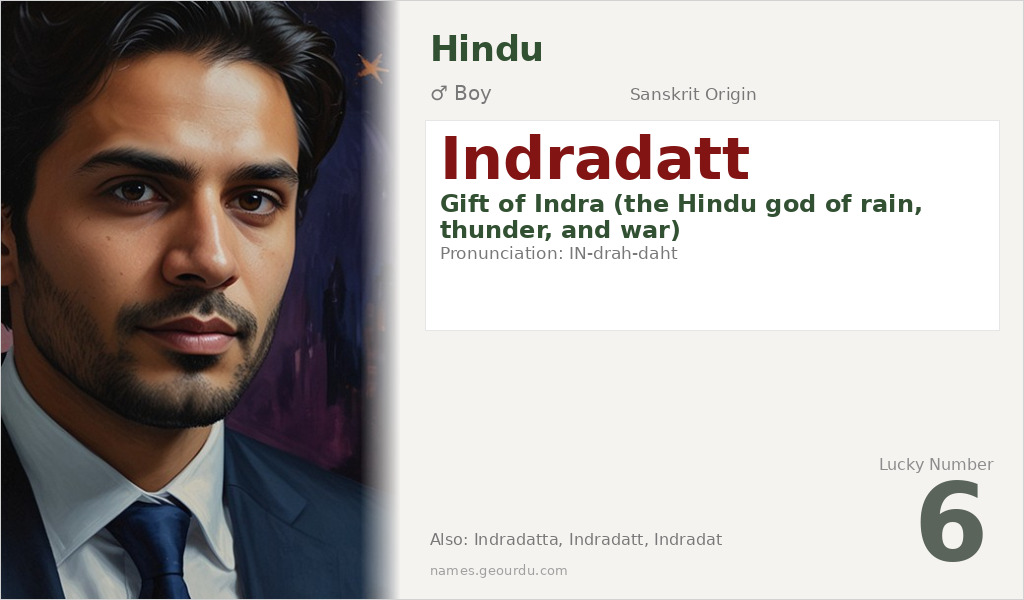
Indradatt is a powerful and traditional Hindu boy name with deep roots in ancient Sanskrit mythology. Meaning ‘Gift of Indra’, it evokes the blessings of the revered god of rain, thunder, and war. This name carries connotations of strength, leadership, and divine favor, making it a meaningful choice in Hindu naming traditions. Discover the rich etymology, cultural associations, and personality traits linked to Indradatt.
Meaning of Indradatt
Indradatt derives from Sanskrit, combining ‘Indra’, the name of the principal Vedic deity associated with weather, kingship, and martial prowess, and ‘datt’, meaning ‘given’ or ‘gift’. The full name translates precisely to ‘given by Indra’ or ‘gift of Indra’, symbolizing a child bestowed with Indra’s qualities like valor, protection, and prosperity. In Hindu texts, Indra is often depicted as a heroic figure wielding the thunderbolt (vajra), and names incorporating ‘Indra’ reflect admiration for these attributes. The suffix ‘-datt’ is common in Sanskrit names, indicating a bestowal or offering, as seen in similar names like Devdatt (gift of the gods). This etymological structure highlights the name’s religious and cultural significance within Hinduism.
| 📛 Name | Indradatt |
| 💎 Meaning | Gift of Indra (the Hindu god of rain, thunder, and war) |
| 👤 Gender | Boy |
| 🕌 Religion | Hindu |
| 🌍 Origin | Sanskrit |
| 🗣 Pronunciation | IN-drah-daht |
| ✍️ Urdu | اندرادت |
| ✍️ Arabic | إندرادات |
| 🔢 Numerology | 6 |
| ✨ Spellings | Indradatta, Indradatt, Indradat |
Origin & Cultural Significance
Originating from Sanskrit, an ancient Indo-Aryan language of India, Indradatt has been used for centuries in Hindu communities across South Asia, particularly in India, Nepal, and among diasporas. It appears in historical records, such as inscriptions and classical literature, often associated with Brahmin or Kshatriya (warrior) castes, reflecting its noble connotations. The name is part of a broader tradition of theophoric names in Hinduism, where deities’ names are combined with words like ‘datt’ to express devotion or divine connection. While primarily Hindu, its usage may extend to related cultures influenced by Sanskrit, but it remains distinct from names in Arabic, Persian, or other languages, with no verified meanings in those contexts. Research across languages like Pashto, Balochi, and Sindhi confirms it is not native to those regions, solidifying its Sanskrit-Hindu origin.
Personality Traits
People named Indradatt are often seen as confident and authoritative, mirroring Indra’s role as a leader of the gods. They may possess a magnetic personality, with a knack for inspiring others and tackling obstacles head-on. Their association with Indra suggests traits like courage, generosity, and a protective instinct, making them reliable and ambitious individuals in personal and professional spheres.
Similar Names
If you like Indradatt, consider: Indrajit, Indraneel, Devdatt, Haridatt, Vishnudatt
Famous People Named Indradatt
- Indradatt — A character in ancient Hindu texts and folklore, often depicted as a sage or warrior blessed by Indra
- Indradatt — Historical figures in Indian inscriptions and medieval records, typically associated with Brahmin or Kshatriya lineages
Frequently Asked Questions About Indradatt
What does Indradatt mean?
Indradatt means 'Gift of Indra' in Sanskrit, referring to the Hindu god of rain, thunder, and war.
Is Indradatt a boy or girl name?
Indradatt is traditionally a boy name in Hindu culture, derived from masculine deity Indra and common in male naming conventions.
What is the origin of Indradatt?
Indradatt originates from Sanskrit, an ancient Indian language, and is deeply rooted in Hindu mythology and naming traditions.





