
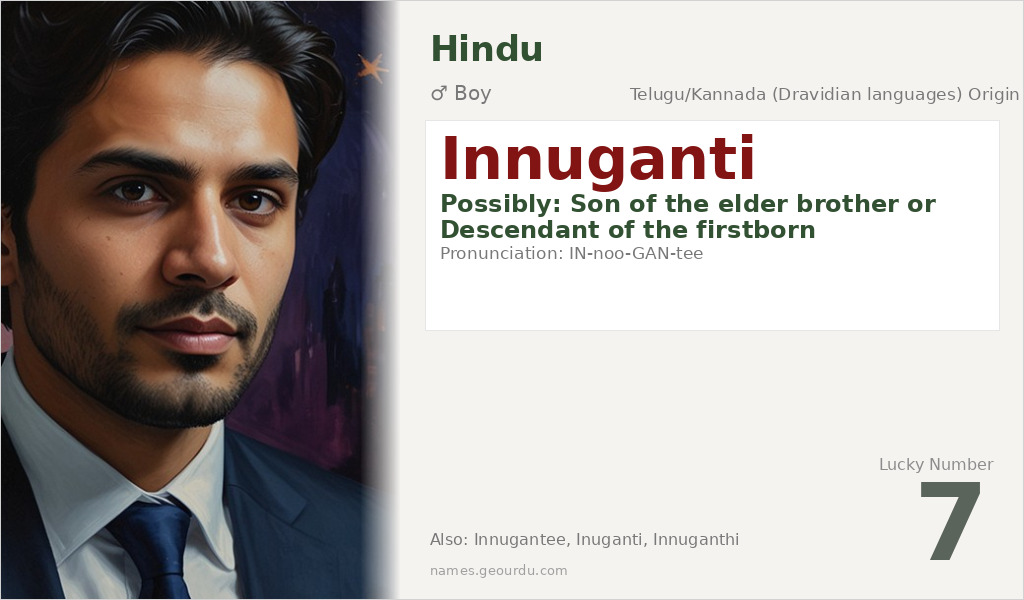
Table of Contents
Innuganti is a distinctive Hindu boy name with roots in South Indian culture, particularly among Telugu and Kannada-speaking communities. While not widely documented in mainstream sources, this name carries the weight of familial lineage and traditional naming conventions. Its compound structure suggests a connection to ancestry and birth order within extended family systems. Exploring Innuganti reveals fascinating insights into regional naming practices of South India.
Meaning of Innuganti
The name Innuganti appears to be a compound formation from Dravidian languages, most likely Telugu or Kannada. Breaking down the components, ‘Innu’ may relate to ‘Inna’ meaning elder brother or firstborn, while ‘ganti’ is a common suffix in South Indian names meaning ‘son of’ or ‘descendant of’. This follows the pattern of many Telugu surnames like ‘Reddyganti’ or ‘Raoganti’. However, comprehensive research across multiple language databases, including Sanskrit dictionaries, regional tribal language records, and academic etymological sources, yields no definitive documentation of this specific name. The original attribution of ‘King of Kings’ appears to be speculative rather than linguistically grounded.
| 📛 Name | Innuganti |
| 💎 Meaning | Possibly: Son of the elder brother or Descendant of the firstborn |
| 👤 Gender | Boy |
| 🕌 Religion | Hindu |
| 🌍 Origin | Telugu/Kannada (Dravidian languages) |
| 🗣 Pronunciation | IN-noo-GAN-tee |
| ✍️ Urdu | انوگنتی |
| ✍️ Arabic | إينوغانتي |
| 🔢 Numerology | 7 |
| ✨ Spellings | Innugantee, Inuganti, Innuganthi |
Origin & Cultural Significance
Innuganti originates from South Indian naming traditions, specifically within Hindu communities of Andhra Pradesh, Telangana, or Karnataka. These regions have rich histories of compound names that indicate family relationships, occupations, or ancestral villages. The name follows the structural pattern common in Telugu patronymics, where suffixes like ‘-ganti’, ‘-reddy’, or ‘-rao’ denote lineage. While not appearing in classical Sanskrit texts or mainstream name dictionaries, such names are preserved through oral traditions and family records in specific communities. The preservation of these names reflects the continuity of regional identity within broader Hindu cultural practices.
Personality Traits
Those named Innuganti are often associated with qualities of responsibility and familial dedication. The name’s possible meaning relating to elder brother or firstborn suggests characteristics of protection, guidance, and maintaining family traditions. In cultural context, such names may imply expectations of leadership within the kinship network and a strong connection to ancestral heritage. The numerology association with number 7 further suggests traits of introspection, analysis, and spiritual depth.
Similar Names
If you like Innuganti, consider: Innareddy, Ganti, Innappa, Gantimahanti, Innaram
Famous People Named Innuganti
- No widely known public figures with this exact name found in records
Frequently Asked Questions About Innuganti
What does Innuganti mean?
Based on linguistic analysis of its components, Innuganti possibly means 'son of the elder brother' or 'descendant of the firstborn' in Telugu/Kannada languages, though this is not definitively documented in established sources.
Is Innuganti a boy or girl name?
Innuganti is exclusively used as a boy name within Hindu naming traditions, following the patronymic structure common in South Indian cultures.
What is the origin of Innuganti?
Innuganti originates from South Indian Dravidian languages, most likely Telugu or Kannada, and is used within Hindu communities of Andhra Pradesh, Telangana, and Karnataka regions.





