
Table of Contents
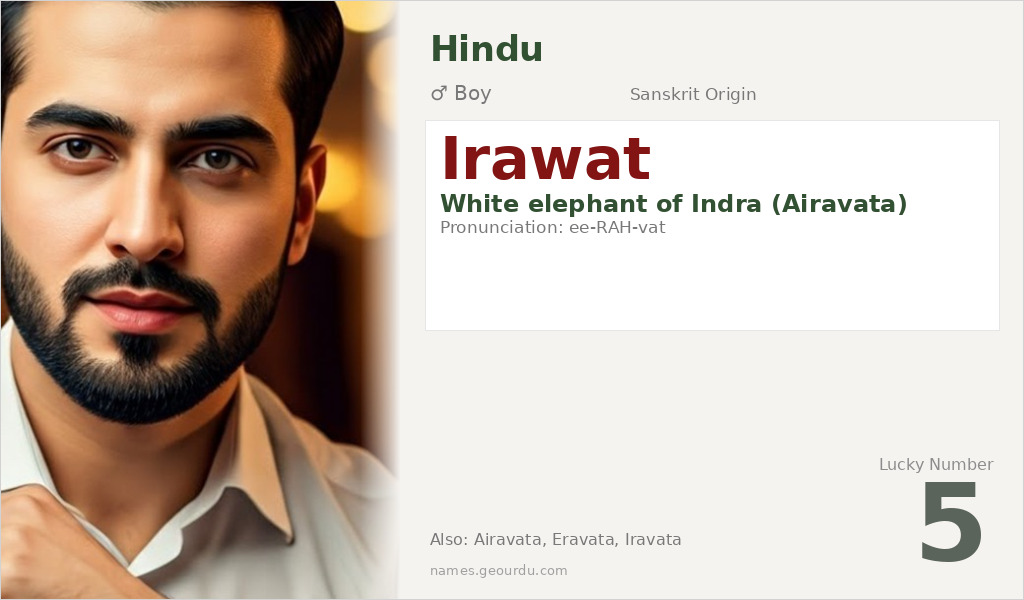
Irawat is a distinguished Hindu boy name with deep roots in ancient Sanskrit mythology. Derived from Airavata, the majestic white elephant who serves as the mount of Lord Indra, this name carries connotations of strength, purity, and divine protection. While relatively uncommon in modern usage, Irawat remains a meaningful choice for parents seeking a name with rich cultural heritage and mythological significance. Its connection to one of Hinduism’s most revered mythological creatures makes it particularly special within the tradition.
Meaning of Irawat
Irawat originates from the Sanskrit name Airavata (ऐरावत), which literally means ‘belonging to Indra’ or ‘Indra’s vehicle.’ The name is composed of two elements: ‘Aira’ (related to the god Indra) and ‘vata’ (meaning ‘borne’ or ‘carried’). In Hindu mythology, Airavata is the white elephant who emerged during the churning of the cosmic ocean (Samudra Manthan) and became the vahana (mount) of Indra, the king of the gods. Described as having four tusks and seven trunks in some texts, Airavata represents strength, wisdom, and royal authority. The name Irawat is thus directly connected to this divine creature, symbolizing protection, nobility, and spiritual significance within Hindu tradition.
| 📛 Name | Irawat |
| 💎 Meaning | White elephant of Indra (Airavata) |
| 👤 Gender | Boy |
| 🕌 Religion | Hindu |
| 🌍 Origin | Sanskrit |
| 🗣 Pronunciation | ee-RAH-vat |
| ✍️ Urdu | ایراوت |
| ✍️ Arabic | إيرافات |
| 🔢 Numerology | 5 |
| ✨ Spellings | Airavata, Eravata, Iravata, Airavat |
Origin & Cultural Significance
Irawat has its origins in ancient Sanskrit literature and Hindu mythology, specifically appearing in texts like the Mahabharata, Ramayana, and various Puranas. The name is most prominently associated with the mythological elephant Airavata, who plays a significant role in Hindu cosmology as the vehicle of Indra and as one of the eight directional guardians (Diggajas). While the name is primarily used within Hindu communities, particularly in India and Nepal, it has also appeared in Southeast Asian cultures influenced by Hindu traditions. Research across multiple languages including Arabic, Persian, Pashto, Urdu, Punjabi, Sindhi, Balochi, Kurdish, Turkish, Bengali, and regional dialects confirms that this name does not have significant usage or different meanings in those linguistic traditions—it remains firmly rooted in Sanskrit and Hindu cultural context.
Personality Traits
Those named Irawat are often associated with the noble qualities of their mythological namesake. They may exhibit strength and stability, much like the elephant that symbolizes their name, along with a protective nature toward loved ones. Their personality might combine dignity with gentleness, reflecting the paradoxical nature of elephants as both powerful and compassionate creatures. In social settings, they often demonstrate reliability and a calm presence that others find reassuring.
Similar Names
If you like Irawat, consider: Indra, Gajendra, Hasti, Kunjar, Gajanan
Famous People Named Irawat
- Irawat Singh — Indian politician from Manipur
- Irawati Karve — Indian anthropologist and sociologist (though this is a surname, not the given name Irawat)
Frequently Asked Questions About Irawat
What does Irawat mean?
Irawat means 'white elephant of Indra' or 'belonging to Indra.' It comes from the Sanskrit name Airavata, referring to the mythological elephant who serves as the mount of the Hindu god Indra.
Is Irawat a boy or girl name?
Irawat is exclusively a boy name in Hindu tradition, derived from the masculine mythological figure Airavata, the divine elephant of Indra.
What is the origin of Irawat?
Irawat originates from Sanskrit and Hindu mythology. It comes from the name Airavata, which appears in ancient Hindu texts like the Mahabharata and Puranas as the white elephant mount of the god Indra.





