
Table of Contents
Isfand Yar is a name steeped in Persian epic tradition, carrying the weight of legendary heroism and cultural heritage. While often used in Muslim communities, its origins predate Islam and connect to ancient Zoroastrian calendar traditions. This compound name combines temporal and heroic elements that have resonated across Persian-speaking regions for centuries.
Meaning of Isfand Yar
The name Isfand Yar is composed of two Persian elements with specific meanings. ‘Isfand’ (اسفند) refers to the twelfth month of the Persian solar calendar, Esfand, which falls in February-March. This month is named after the sacred plant Esfand (Peganum harmala or wild rue), traditionally used for purification and protection against evil in Zoroastrian and folk practices. ‘Yar’ (یار) means companion, friend, helper, or hero. Thus, the complete name literally translates to ‘Hero of Esfand’ or ‘Companion of Esfand,’ suggesting someone connected to this protective, transitional time of year. The name appears most famously as Isfandiyar in Ferdowsi’s 10th-century epic Shahnameh, where the character embodies heroic virtues and tragic destiny.
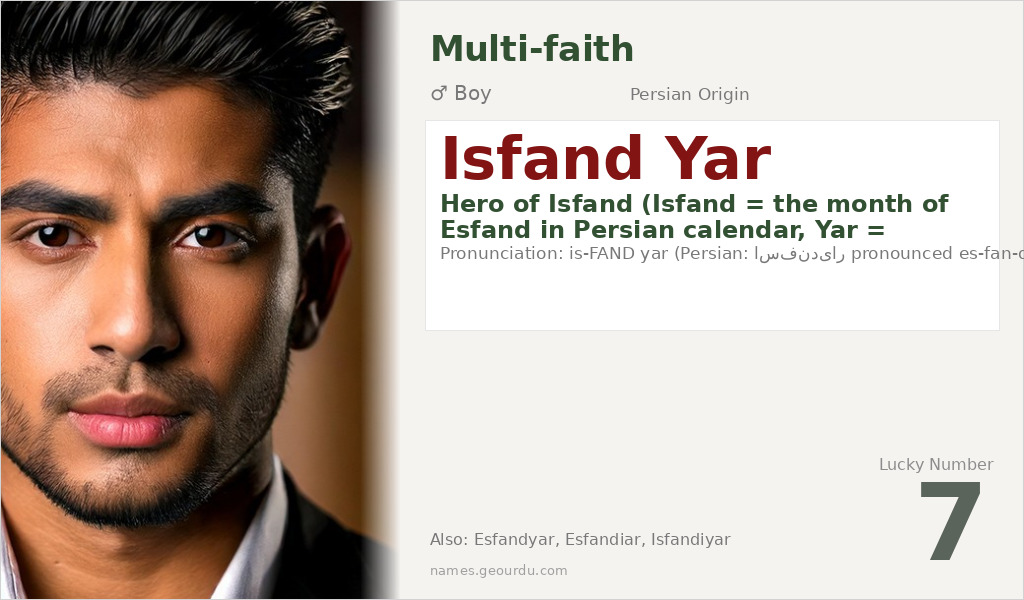
| 📛 Name | Isfand Yar |
| 💎 Meaning | Hero of Isfand (Isfand = the month of Esfand in Persian calendar, Yar = companion/friend/hero) |
| 👤 Gender | Boy |
| 🕌 Religion | Multi-faith |
| 🌍 Origin | Persian |
| 🗣 Pronunciation | is-FAND yar (Persian: اسفندیار pronounced es-fan-dee-YAR) |
| ✍️ Urdu | اسفندیار |
| ✍️ Arabic | إسفنديار |
| 🔢 Numerology | 7 |
| ✨ Spellings | Esfandyar, Esfandiar, Isfandiyar, Esfandiyar, Isfandiar |
Origin & Cultural Significance
Isfand Yar originates from Persian literature and mythology, with its most prominent appearance in Ferdowsi’s Shahnameh (Book of Kings), completed around 1010 CE. The character Isfandiyar is a legendary prince of the Kayanian dynasty, son of King Goshtasp, known for his seven labors and eventual martyrdom. While the name is used in various Persian-speaking communities including Iran, Afghanistan, Tajikistan, and among diaspora populations, it also appears in Pashto and Balochi cultures with similar heroic connotations. The name’s connection to the Esfand month reflects pre-Islamic Zoroastrian calendar traditions, though it has been adopted by Muslim, Baháʼí, and other communities in the region. Its usage extends beyond religious boundaries as a cultural name celebrating Persian epic heritage.
Personality Traits
Those named Isfand Yar are often associated with heroic qualities drawn from the legendary figure in Persian literature. They may exhibit strong protective instincts, loyalty to family and tradition, and a sense of noble purpose. The connection to the Esfand month suggests qualities of transition, purification, and spiritual resilience. Like the epic hero, they might face challenges with determination and principle, though potentially with a tragic or sacrificial dimension to their character.
Similar Names
If you like Isfand Yar, consider: Rostam, Sohrab, Bahram, Jamshid, Keykhosrow
Famous People Named Isfand Yar
- Isfandiyar — Legendary Persian prince and hero in Ferdowsi's Shahnameh, known for his seven labors and tragic fate
- Esfandiar Bahram — 20th century Iranian footballer who played for the Iran national team
Frequently Asked Questions About Isfand Yar
What does Isfand Yar mean?
Isfand Yar means 'Hero of Esfand' in Persian, combining 'Isfand' (the twelfth month of the Persian calendar) and 'Yar' (companion/hero).
Is Isfand Yar a boy or girl name?
Isfand Yar is exclusively a masculine name, derived from a male heroic figure in Persian epic literature.
What is the origin of Isfand Yar?
The name originates from Persian epic tradition, specifically from the character Isfandiyar in Ferdowsi's 10th-century Shahnameh (Book of Kings).





