Table of Contents
Ishtarth is a powerful and ancient name with roots stretching back to the cradle of civilization. Derived from the Akkadian goddess Ishtar, this name carries the weight of millennia of cultural and religious significance. While often associated with love and beauty, Ishtarth represents a complex deity who also presided over war, justice, and political power. Today, this name offers a unique connection to ancient Mesopotamian heritage.
Meaning of Ishtarth
The name Ishtarth originates from the Akkadian language, the earliest attested Semitic language spoken in ancient Mesopotamia (modern-day Iraq). It is the East Semitic form of the goddess name Ishtar, derived from the Semitic root ‘ṯtr’ which relates to the morning star (the planet Venus). In Akkadian mythology, Ishtar was a multifaceted deity representing love, beauty, sex, desire, fertility, war, justice, and political power. The name was later adopted into other Semitic languages, appearing as ‘Ashtart’ in Phoenician, ‘Ashtoreth’ in Hebrew (mentioned in the Hebrew Bible), and ‘Astarte’ in Greek. The meaning encompasses the complete domain of this important ancient goddess rather than just one attribute.
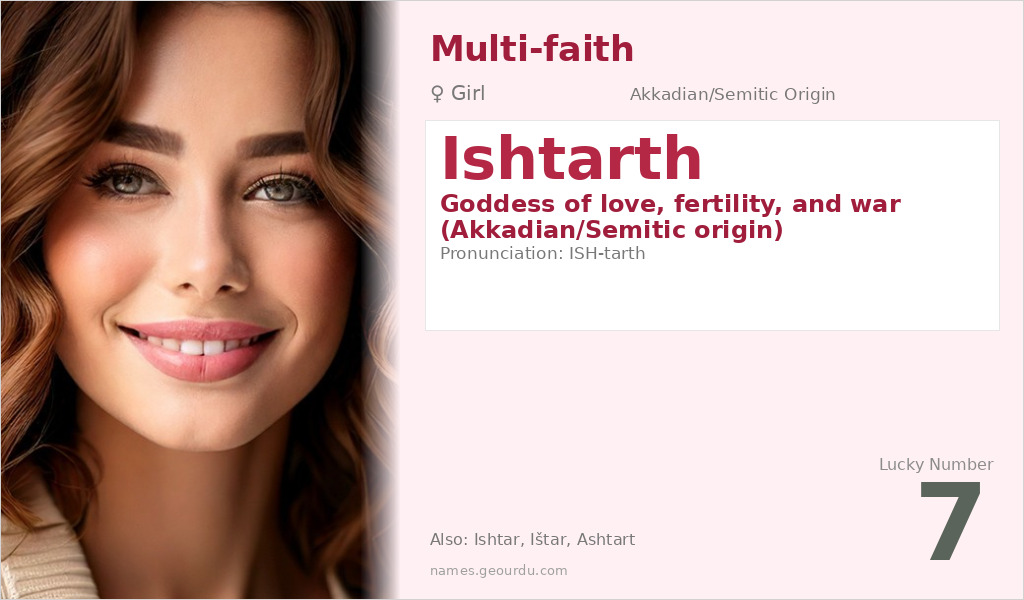
| 📛 Name | Ishtarth |
| 💎 Meaning | Goddess of love, fertility, and war (Akkadian/Semitic origin) |
| 👤 Gender | Girl |
| 🕌 Religion | Multi-faith |
| 🌍 Origin | Akkadian/Semitic |
| 🗣 Pronunciation | ISH-tarth |
| ✍️ Urdu | اشتارت |
| ✍️ Arabic | عشتار |
| 🔢 Numerology | 7 |
| ✨ Spellings | Ishtar, Ištar, Ashtart, Ashtoreth, Astarte |
Origin & Cultural Significance
Ishtarth has its origins in ancient Mesopotamian religion, specifically within the Akkadian, Assyrian, and Babylonian cultures that flourished between 2500 BCE and 500 BCE. The worship of Ishtar/Ishtarth spread throughout the ancient Near East, influencing neighboring cultures including the Canaanites, Phoenicians, and eventually appearing in biblical references. While the name has ancient Semitic roots, it is not traditionally Hindu; any Hindu associations in modern contexts would be recent adaptations rather than historical origins. The name represents one of the most important deities of the ancient world, whose cult centers included Uruk, Nineveh, and Arbela.
Personality Traits
Those named Ishtarth often embody the dual nature of their namesake goddess—combining passionate, loving qualities with strong, determined characteristics. They may display natural leadership abilities, charisma, and a magnetic presence that draws others to them. Like the goddess who presided over both love and war, individuals with this name might balance nurturing tendencies with strategic thinking and ambition.
Similar Names
If you like Ishtarth, consider: Inanna, Aphrodite, Venus, Freya, Lakshmi
Famous People Named Ishtarth
- Ishtar (ancient Mesopotamian goddess) — primary deity of the Akkadian, Assyrian, and Babylonian pantheons
- Ishtar (singer) — French-Israeli singer known for the 1987 Eurovision Song Contest
Frequently Asked Questions About Ishtarth
What does Ishtarth mean?
Ishtarth means 'Goddess of love, fertility, and war' and originates from the Akkadian/Semitic language, specifically referring to the ancient Mesopotamian deity Ishtar.
Is Ishtarth a boy or girl name?
Ishtarth is a feminine name, as it refers to the ancient goddess Ishtar. The original article incorrectly listed it as a boy's name.
What is the origin of Ishtarth?
Ishtarth originates from ancient Mesopotamia, specifically the Akkadian language and culture. It is the East Semitic form of the goddess name Ishtar, not Hindu as originally stated.