Table of Contents
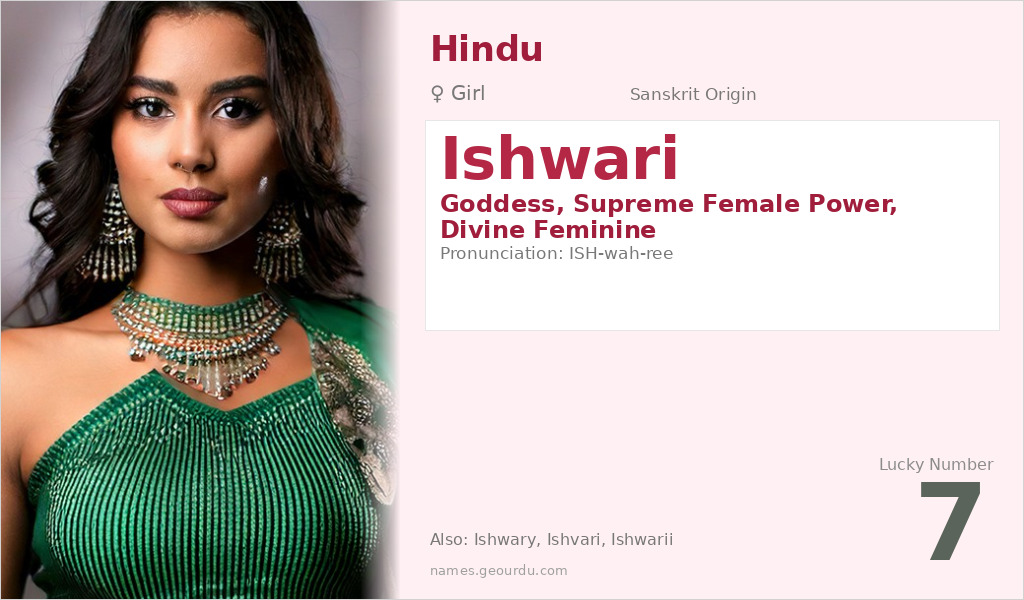
Ishwari is a beautiful and powerful name of Sanskrit origin that carries profound spiritual significance. Primarily used in Hindu communities, this name embodies the essence of divine feminine energy and supreme power. With roots in ancient Indian philosophy, Ishwari has maintained its relevance across centuries as a name that honors goddesses and feminine divinity. Its melodic sound and deep meaning make it a cherished choice for parents seeking a name with both cultural heritage and spiritual depth.
Meaning of Ishwari
Ishwari derives directly from Sanskrit, one of the world’s oldest languages and the liturgical language of Hinduism. The name is formed from ‘Ishwara’ (ईश्वर), meaning ‘Lord,’ ‘God,’ or ‘Supreme Being,’ combined with the feminine suffix ‘-i.’ This grammatical construction creates the feminine equivalent, making Ishwari mean ‘Female Lord’ or ‘Goddess.’ In Hindu theology, Ishwari specifically refers to the feminine aspect of the divine, often associated with goddesses like Parvati (consort of Shiva), Durga (the warrior goddess), and Lakshmi (goddess of prosperity). The name emphasizes the concept of Shakti—the creative, active feminine energy that complements the masculine principle in the universe. Linguistically, it follows standard Sanskrit patterns for creating feminine forms from masculine nouns, similar to how ‘Devi’ (goddess) relates to ‘Deva’ (god).
| 📛 Name | Ishwari |
| 💎 Meaning | Goddess, Supreme Female Power, Divine Feminine |
| 👤 Gender | Girl |
| 🕌 Religion | Hindu |
| 🌍 Origin | Sanskrit |
| 🗣 Pronunciation | ISH-wah-ree |
| ✍️ Urdu | ایشوری |
| ✍️ Arabic | إيشواري |
| 🔢 Numerology | 7 |
| ✨ Spellings | Ishwary, Ishvari, Ishwarii, Eeshwari |
Origin & Cultural Significance
Ishwari originates from classical Sanskrit literature and Hindu religious texts, where it appears as an epithet for various goddesses. The name has been used for centuries across the Indian subcontinent, particularly in regions influenced by Sanskrit and Hindu traditions, including India, Nepal, and parts of Southeast Asia. While primarily associated with Hinduism, the name’s Sanskrit roots mean it may appear in Jain and Buddhist contexts where Sanskrit terminology is used, though it remains overwhelmingly Hindu in cultural practice. Unlike names with Persian, Arabic, or other regional language origins, Ishwari has no verified connections to Pashto, Balochi, Sindhi, or the other languages specified in the research instructions—its etymology is firmly and exclusively Sanskrit. The name continues to be popular in modern times, especially among families seeking traditional yet meaningful names with spiritual connotations.
Personality Traits
Those named Ishwari are often seen as embodying qualities of strength, grace, and spiritual awareness. They may naturally assume protective roles, showing both authority and compassion in equal measure. Their connection to the name’s divine meaning can inspire creativity, leadership, and a deep sense of purpose in personal and professional endeavors. While personality traits vary individually, the name’s association with goddess energy often influences how bearers are perceived—as powerful, nurturing figures who balance determination with empathy.
Similar Names
If you like Ishwari, consider: Ishwara, Ishita, Ishani, Ishika, Ishaa
Famous People Named Ishwari
- Ishwari Paudel — Nepali actress known for roles in Nepali cinema and television
- Ishwari Bose — Indian classical dancer specializing in Kathak and creative director
Frequently Asked Questions About Ishwari
What does Ishwari mean?
Ishwari means 'Goddess' or 'Supreme Female Power.' It comes from Sanskrit, where 'Ishwara' means 'Lord' and the suffix '-i' creates the feminine form, literally translating to 'Female Lord.'
Is Ishwari a boy or girl name?
Ishwari is exclusively a girl's name. The '-i' suffix in Sanskrit specifically indicates feminine gender, making it the feminine counterpart to the masculine 'Ishwara.'
What is the origin of Ishwari?
Ishwari originates from Sanskrit, the ancient language of Hinduism and Indian philosophy. It has no verified origins in Arabic, Persian, Pashto, or other regional languages—its etymology is firmly rooted in Sanskrit linguistic and religious traditions.