Table of Contents
Iswar (also spelled Ishwar) is a profound Sanskrit name that carries immense spiritual weight in Hindu tradition. Meaning ‘God’, ‘Lord’, or ‘Supreme Being’, this name connects the bearer to concepts of divine authority and cosmic rulership. Popular across India and among Hindu communities worldwide, Iswar represents both religious devotion and philosophical depth. The name’s resonance extends beyond mere nomenclature into the realm of spiritual identity.
Meaning of Iswar
The name Iswar originates from the Sanskrit word ‘ईश्वर’ (īśvara), which is composed of the root ‘īś’ meaning ‘to own, possess, rule, or command’ combined with the suffix ‘-vara’ denoting excellence or superiority. Literally translated, it means ‘the excellent ruler’ or ‘supreme controller’. In Hindu scriptures, Ishvara refers specifically to the personal aspect of Brahman (the ultimate reality) who governs the universe with omniscience and omnipotence. The term appears in ancient texts like the Yoga Sutras of Patanjali where Ishvara is defined as a special purusha (consciousness) untouched by afflictions. This name thus encapsulates not just power, but divine sovereignty and spiritual perfection.
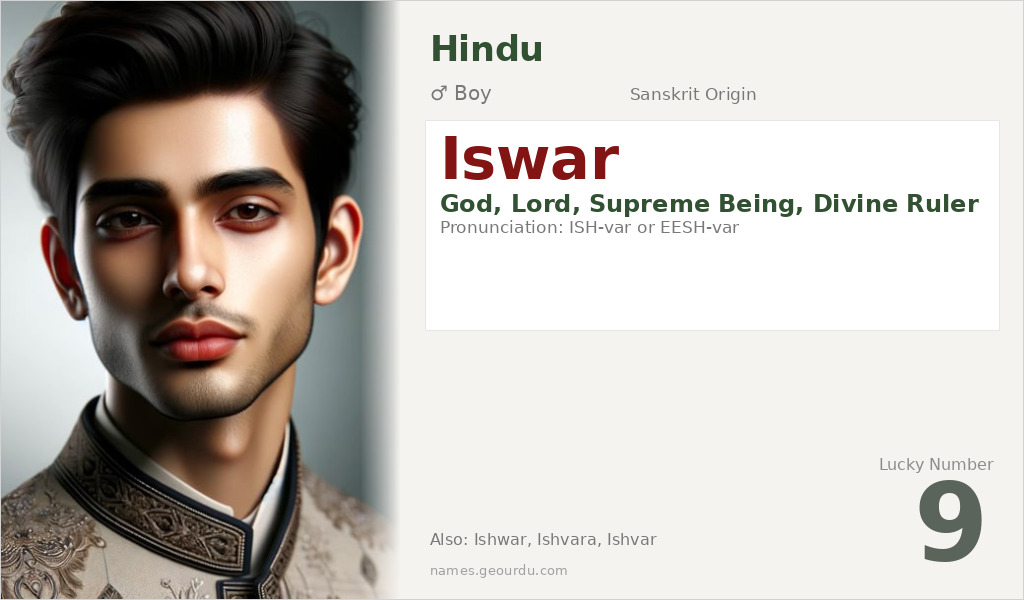
| 📛 Name | Iswar |
| 💎 Meaning | God, Lord, Supreme Being, Divine Ruler |
| 👤 Gender | Boy |
| 🕌 Religion | Hindu |
| 🌍 Origin | Sanskrit |
| 🗣 Pronunciation | ISH-var or EESH-var |
| ✍️ Urdu | ایشور |
| ✍️ Arabic | إيشوار |
| 🔢 Numerology | 9 |
| ✨ Spellings | Ishwar, Ishvara, Ishvar, Eeshwar, Eshwar |
Origin & Cultural Significance
Iswar has its origins in ancient Sanskrit literature and Hindu philosophical systems. The concept of Ishvara developed significantly in the post-Vedic period, particularly in schools like Yoga, Vedanta, and Shaivism. In South India, the name is particularly common among Tamil and Telugu communities, often spelled as ‘Ishvar’. The name spread throughout the Indian subcontinent and to Southeast Asia with Hindu cultural expansion. Today, it remains a popular choice for boys in Hindu families seeking a name with strong theological and philosophical connotations, reflecting devotion to the divine principle that governs existence.
Personality Traits
Those named Iswar are often perceived as natural leaders with a calm, authoritative presence. They tend to approach life with philosophical depth and spiritual curiosity, valuing principles over pragmatism. While sometimes seen as serious or contemplative, they possess an inner strength that helps them navigate challenges with resilience. Their name’s meaning often inspires them to seek higher purposes and ethical living.
Similar Names
If you like Iswar, consider: Ishaan, Ishant, Ishita, Ishani, Ishwara
Famous People Named Iswar
- Ishwar Chandra Vidyasagar — 19th century Indian educator and social reformer from Bengal
- Ishwar Singh — Indian politician and former Member of Parliament
Frequently Asked Questions About Iswar
What does Iswar mean?
Iswar means 'God', 'Lord', or 'Supreme Being' in Sanskrit. It comes from the root 'īś' meaning 'to rule' and denotes divine sovereignty and authority.
Is Iswar a boy or girl name?
Iswar is exclusively a boy's name in Hindu naming traditions. The feminine equivalent would be Ishvari, which means 'goddess' or 'divine feminine'.
What is the origin of Iswar?
Iswar originates from Sanskrit, the ancient language of Hindu scriptures. It has deep roots in Hindu philosophy, particularly in Yoga and Vedanta traditions where Ishvara represents the personal aspect of the supreme reality.