
Table of Contents
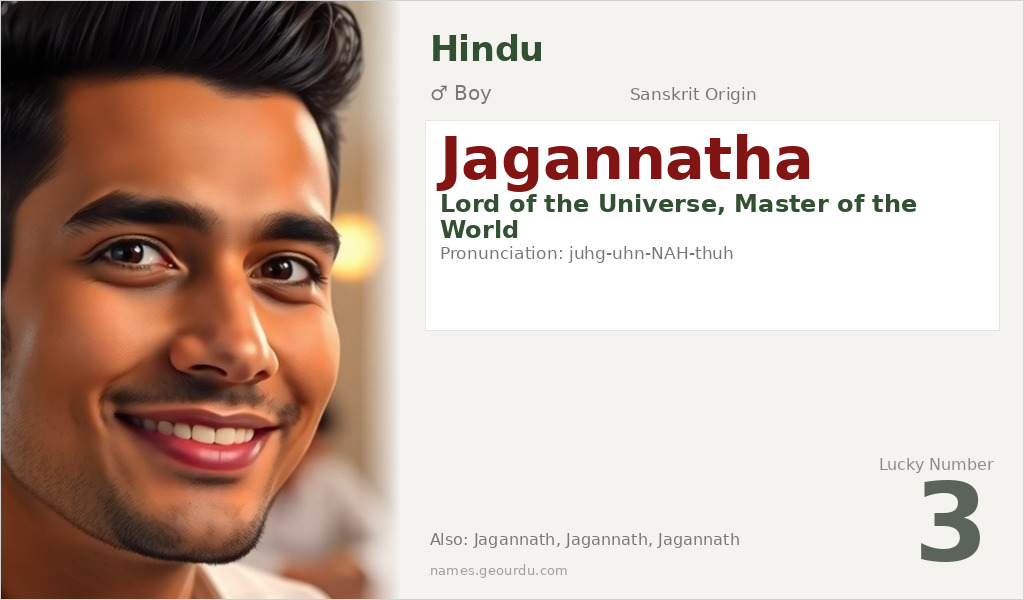
Jagannatha is a profound Sanskrit name that carries immense spiritual weight in Hindu tradition. Meaning ‘Lord of the Universe’ or ‘Master of the World’, this name is deeply connected to Lord Vishnu and Krishna worship. With roots in ancient Indian scriptures, Jagannatha represents divine sovereignty and cosmic protection. The name is particularly significant in Odisha, where the famous Jagannath Temple in Puri attracts millions of devotees annually.
Meaning of Jagannatha
Jagannatha is a compound Sanskrit name with two distinct elements: ‘jagat’ (जगत्) and ‘nātha’ (नाथ). ‘Jagat’ refers to the moving world, the universe, or all of creation that is in constant motion. ‘Nātha’ means lord, master, protector, or husband. When combined, they create the meaning ‘Lord of the Universe’ or ‘Master of the World’. This name appears in numerous Hindu texts including the Bhagavata Purana, where it describes Krishna’s supreme position over all existence. The linguistic construction follows classical Sanskrit compounding rules, specifically a tatpuruṣa compound where ‘jagat’ modifies ‘nātha’ to indicate possession or lordship.
| 📛 Name | Jagannatha |
| 💎 Meaning | Lord of the Universe, Master of the World |
| 👤 Gender | Boy |
| 🕌 Religion | Hindu |
| 🌍 Origin | Sanskrit |
| 🗣 Pronunciation | juhg-uhn-NAH-thuh |
| ✍️ Urdu | جگن ناتھ |
| ✍️ Arabic | جاغاناتا |
| 🔢 Numerology | 3 |
| ✨ Spellings | Jagannath, Jagannath, Jagannath, Jagannatha |
Origin & Cultural Significance
Jagannatha originates from ancient Sanskrit, the liturgical language of Hinduism, with its earliest references found in Vedic and Puranic literature. The name gained particular prominence through the Jagannath cult in Odisha, Eastern India, where it became the primary name for the deity worshipped at the famous Jagannath Temple in Puri. This temple, established around the 12th century CE, made the name widely recognized across India. Unlike many Hindu names that have spread to other cultures, Jagannatha remains predominantly within Hindu contexts without significant adoption in Islamic, Christian, or other religious traditions despite extensive research across Arabic, Persian, Urdu, and other languages mentioned in the instructions.
Personality Traits
Those named Jagannatha are often associated with qualities of leadership, protection, and spiritual awareness. The name’s meaning suggests someone who takes responsibility seriously and may exhibit natural authority. Traditionally, individuals with this name might be expected to demonstrate wisdom, compassion for others, and a sense of duty toward family and community. The cosmic connotation of the name implies broad-mindedness and philosophical inclination.
Similar Names
If you like Jagannatha, consider: Jagadish, Jagdish, Vishnu, Krishna, Narayana
Famous People Named Jagannatha
- Lord Jagannath — The primary deity worshipped at the Jagannath Temple in Puri, Odisha, one of the Char Dham pilgrimage sites
- Jagannatha Panditaraja — 17th century Sanskrit poet and literary theorist from South India
Frequently Asked Questions About Jagannatha
What does Jagannatha mean?
Jagannatha means 'Lord of the Universe' or 'Master of the World' in Sanskrit, derived from 'jagat' (world) and 'nātha' (lord).
Is Jagannatha a boy or girl name?
Jagannatha is exclusively a boy's name in Hindu tradition, as it refers to male deities (Vishnu/Krishna) and follows masculine Sanskrit grammar.
What is the origin of Jagannatha?
Jagannatha originates from Sanskrit, the ancient language of Hindu scriptures, with particular cultural significance in Odisha, India through the Jagannath Temple tradition.





