
Table of Contents
Jankin is a fascinating medieval name that transports us back to the world of Chaucer and Middle English. This charming diminutive of John carries the profound meaning ‘God is gracious’ and offers a unique historical alternative to more common forms like Jack or Johnny. While rarely used today, Jankin represents an important piece of naming history that connects modern English to its medieval roots.
Meaning of Jankin
The name Jankin derives from the Hebrew name Yochanan (יוֹחָנָן), which combines ‘Yah’ (a shortened form of Yahweh, meaning God) and ‘chanan’ (meaning to be gracious or merciful). This gives the core meaning ‘God is gracious’. Through Greek (Iōannēs) and Latin (Iohannes), the name entered European languages. In Middle English (approximately 1150-1500 CE), Jankin emerged as a popular diminutive or pet form of John, using the ‘-kin’ suffix common in medieval English names (similar to Watkin from Walter or Perkin from Peter). The name appears in Geoffrey Chaucer’s ‘The Canterbury Tales’ (written 1387-1400), where Jankin is a student character in the Miller’s Tale, demonstrating its common usage in medieval England.
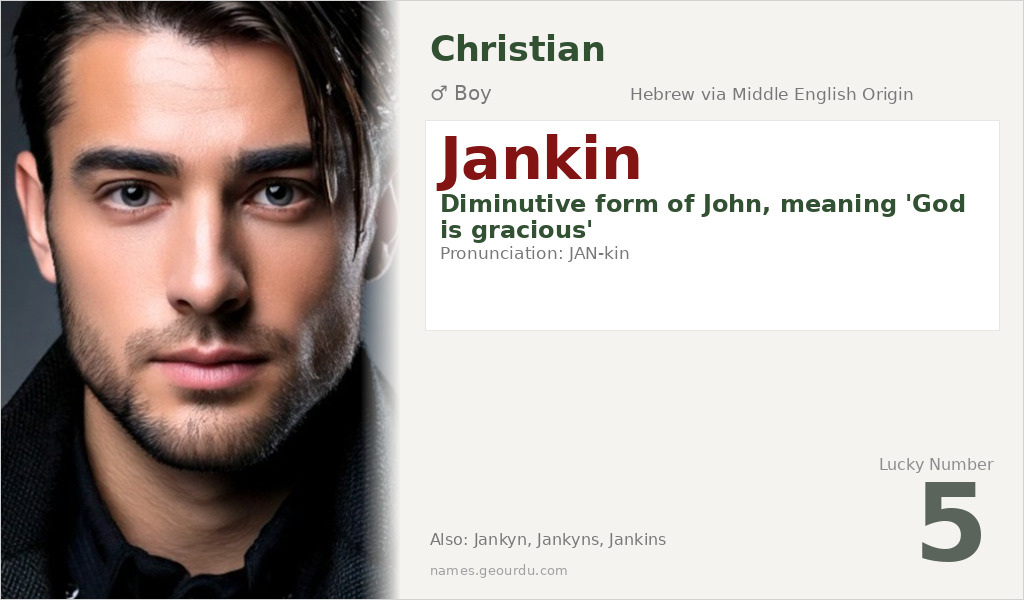
| 📛 Name | Jankin |
| 💎 Meaning | Diminutive form of John, meaning 'God is gracious' |
| 👤 Gender | Boy |
| 🕌 Religion | Christian |
| 🌍 Origin | Hebrew via Middle English |
| 🗣 Pronunciation | JAN-kin |
| ✍️ Urdu | جینکن |
| ✍️ Arabic | جانكين |
| 🔢 Numerology | 5 |
| ✨ Spellings | Jankyn, Jankyns, Jankins |
Origin & Cultural Significance
Jankin originated in medieval England as a diminutive form of John, which was one of the most popular names in Christian Europe due to John the Baptist and John the Apostle. The ‘-kin’ suffix was commonly added to names in Middle English to create affectionate or familiar forms. While the name has Hebrew origins through John, its specific form Jankin is distinctly English and reflects naming practices of the 12th-15th centuries. The name fell out of common use after the Middle English period but remains historically significant as evidence of medieval naming conventions. It represents how biblical names were adapted and personalized in different cultural contexts.
Personality Traits
In medieval literature, characters named Jankin were often portrayed as clever, quick-witted, and sometimes mischievous. The name suggests someone with intelligence and resourcefulness, able to think on their feet. While maintaining the traditional, faithful connotations of its root name John, Jankin carries a more playful, approachable quality that might appeal to parents seeking a name with historical depth but informal charm.
Similar Names
If you like Jankin, consider: John, Jack, Jonathan, Jan, Janko
Famous People Named Jankin
- Jankin (character) — A character in Geoffrey Chaucer's 'The Canterbury Tales' (Miller's Tale), representing a medieval student
- Jankin de Ask — 14th century English landowner mentioned in historical records
Frequently Asked Questions About Jankin
What does Jankin mean?
Jankin means 'God is gracious.' It is a medieval English diminutive form of the name John, which originates from the Hebrew name Yochanan.
Is Jankin a boy or girl name?
Jankin is historically a masculine name, used as a diminutive for boys named John in medieval England. There are no records of it being used for girls in historical contexts.
What is the origin of Jankin?
Jankin originated in medieval England as a pet form of John. While John has Hebrew origins, the specific form Jankin developed in Middle English during the 12th-15th centuries.





