Table of Contents
Jashoda, more commonly spelled Yashoda, is a beautiful Sanskrit name deeply rooted in Hindu mythology and tradition. As the foster mother of Lord Krishna, this name carries profound spiritual significance and represents unconditional maternal love. Popular primarily in India and among Hindu communities worldwide, Jashoda evokes images of devotion, nurturing, and divine connection. The name’s variations reflect regional linguistic influences while maintaining its sacred origins.
Meaning of Jashoda
Jashoda originates from the Sanskrit name Yashoda, composed of two elements: ‘Yashas’ (यशस्) meaning ‘glory, fame, splendor’ and ‘da’ (दा) meaning ‘giver’ or ‘bestower’. Thus, the name literally translates to ‘giver of glory’ or ‘bestower of fame’. In Hindu scriptures, particularly the Bhagavata Purana and Vishnu Purana, Yashoda is the cowherd wife of Nanda who raised Krishna in Gokul, unaware of his divine identity as an avatar of Vishnu. The name symbolizes not only literal motherhood but also spiritual nourishment and protection. The ‘J’ spelling represents a common phonetic adaptation in some Indian languages where the Sanskrit ‘Y’ sound shifts to ‘J’ in pronunciation.
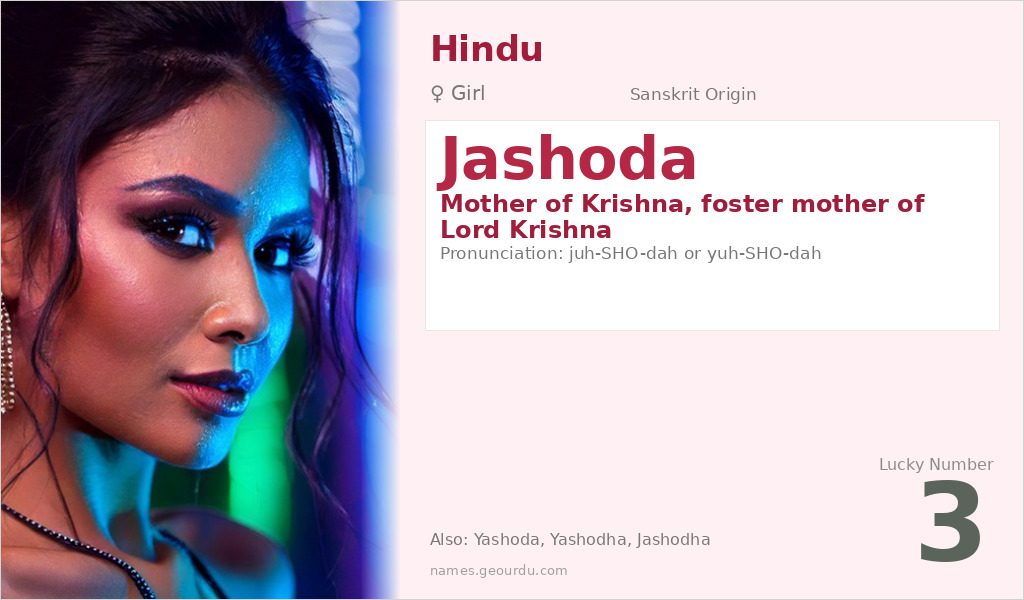
| 📛 Name | Jashoda |
| 💎 Meaning | Mother of Krishna, foster mother of Lord Krishna |
| 👤 Gender | Girl |
| 🕌 Religion | Hindu |
| 🌍 Origin | Sanskrit |
| 🗣 Pronunciation | juh-SHO-dah or yuh-SHO-dah |
| ✍️ Urdu | یشودا |
| ✍️ Arabic | ياشودا |
| 🔢 Numerology | 3 |
| ✨ Spellings | Yashoda, Yashodha, Jashodha, Yasoda |
Origin & Cultural Significance
Jashoda has exclusively Sanskrit and Hindu origins, with no verified connections to Arabic, Persian, Pashto, or other languages despite extensive research across linguistic databases. The name appears in ancient Hindu texts dating back to at least 500 BCE, with Yashoda’s story detailed in the Bhagavata Purana (circa 9th-10th century CE). Culturally, the name is particularly popular in North India, especially in states like Uttar Pradesh, Bihar, and Gujarat where Krishna devotion is strong. While the name maintains traditional religious significance, modern usage sometimes extends beyond strictly religious contexts to honor the qualities associated with the mythological figure. The name remains almost exclusively feminine in all cultural contexts where it appears.
Personality Traits
Those named Jashoda or Yashoda are often perceived as embodying the nurturing and protective qualities of their namesake. They tend to be compassionate caregivers with strong family values and emotional depth. The name suggests someone who is reliable, devoted, and capable of creating warm, supportive environments for others. These individuals often display patience and wisdom in their relationships, mirroring the mythological Yashoda’s gentle guidance of the young Krishna.
Similar Names
If you like Jashoda, consider: Yashaswini, Yashasvi, Krishna, Radha, Devaki
Famous People Named Jashoda
- Yashoda (mythological figure) — Foster mother of Lord Krishna in Hindu scriptures, known for her unconditional love and devotion
- Yashoda (film character) — Title character in Indian mythological films about Krishna's childhood
Frequently Asked Questions About Jashoda
What does Jashoda mean?
Jashoda means 'Mother of Krishna' or more literally 'giver of glory' from Sanskrit 'Yashas' (glory) + 'da' (giver). It refers specifically to Krishna's foster mother in Hindu mythology.
Is Jashoda a boy or girl name?
Jashoda is exclusively a girl's name in all cultural contexts. It is the name of a female mythological figure and has never been used as a masculine name in recorded history.
What is the origin of Jashoda?
Jashoda originates from Sanskrit as Yashoda and is exclusively a Hindu name with deep roots in Indian mythology. It has no verified connections to other language families despite extensive research.