
Table of Contents
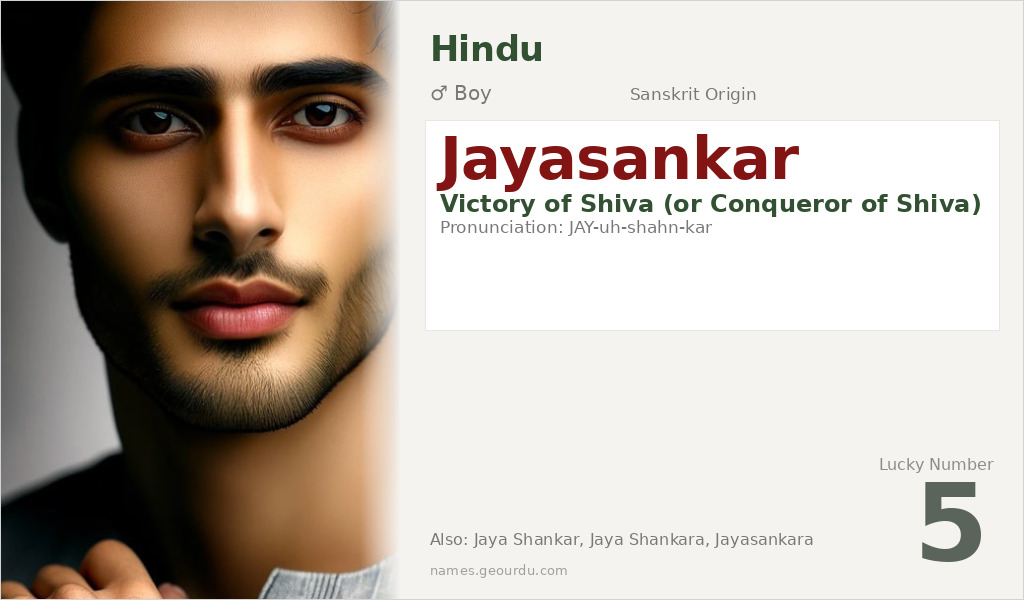
Jayasankar is a profound Sanskrit name that carries centuries of spiritual heritage within its syllables. Meaning ‘Victory of Shiva’, this name connects its bearer to one of Hinduism’s most revered deities while symbolizing triumph through divine grace. Popular primarily in South India and among Hindu communities worldwide, Jayasankar represents both cultural tradition and personal aspiration. Its compound structure reveals the rich linguistic tapestry of Sanskrit naming conventions.
Meaning of Jayasankar
Jayasankar derives from classical Sanskrit, combining ‘Jaya’ (जय), meaning victory, conquest, or triumph, with ‘Shankar’ (शंकर), a primary name for Lord Shiva that signifies ‘the beneficent one’ or ‘giver of bliss’. The complete name therefore translates literally to ‘victory of Shankar’ or ‘conqueror of Shiva’, though in theological context this is understood as achieving victory through Shiva’s blessings rather than opposing the deity. This naming pattern reflects the common Hindu practice of creating theophoric names that invoke divine protection and favor. Similar constructions appear throughout Sanskrit literature, where ‘Jaya’ prefixes various divine names to create compound names with auspicious meanings. The name’s etymology is well-documented in Sanskrit lexicons and religious texts, making its meaning unambiguous and historically verified.
| 📛 Name | Jayasankar |
| 💎 Meaning | Victory of Shiva (or Conqueror of Shiva) |
| 👤 Gender | Boy |
| 🕌 Religion | Hindu |
| 🌍 Origin | Sanskrit |
| 🗣 Pronunciation | JAY-uh-shahn-kar |
| ✍️ Urdu | جے شنکر |
| ✍️ Arabic | جاياشانكار |
| 🔢 Numerology | 5 |
| ✨ Spellings | Jaya Shankar, Jaya Shankara, Jayasankara, Jaya Shankar |
Origin & Cultural Significance
Originating from Sanskrit, the liturgical and classical language of Hinduism, Jayasankar has been used for centuries within Hindu communities, particularly in South India where Sanskrit names remain prevalent. The name reflects the deep Shiva worship tradition within Hinduism, where Shiva is revered as the destroyer and transformer within the Trimurti. Culturally, names ending with ‘Shankar’ or containing Shiva’s epithets are especially common among communities with strong Shaivite traditions. While primarily used in India, the diaspora has carried the name to Hindu communities worldwide. The name’s structure follows established Sanskrit compounding rules, making it linguistically consistent with thousands of other Sanskrit-derived names still in use today.
Personality Traits
Those named Jayasankar are often associated with qualities of determination and spiritual depth, reflecting the name’s connection to Shiva, who represents both asceticism and power. They may exhibit a balanced nature—combining strategic thinking with philosophical insight—much like Shiva’s dual aspects as destroyer and benefactor. The ‘victory’ element in the name suggests an inherent resilience and capacity to overcome obstacles through thoughtful perseverance rather than brute force.
Similar Names
If you like Jayasankar, consider: Jagadish, Mahesh, Shivansh, Harishankar, Vishwanath
Famous People Named Jayasankar
- Jayasankar (Indian classical musician) — Renowned Carnatic vocalist and composer from Kerala
- Jayasankar (academic) — Notable Indian educator and former vice-chancellor of University of Kerala
Frequently Asked Questions About Jayasankar
What does Jayasankar mean?
Jayasankar means 'Victory of Shiva' or 'Conqueror of Shiva' in Sanskrit, combining 'Jaya' (victory) with 'Shankar' (a name for Shiva).
Is Jayasankar a boy or girl name?
Jayasankar is exclusively a masculine name in Hindu naming tradition, following the pattern of Sanskrit compound names ending with masculine divine epithets.
What is the origin of Jayasankar?
Jayasankar originates from Sanskrit, the classical language of Hinduism, and specifically references Lord Shiva through the component 'Shankar', making it a theophoric name within Hindu tradition.





