
Table of Contents
Jehoshaphat is a name steeped in ancient Biblical history and Hebrew tradition. Meaning ‘Yahweh has judged,’ this name carries profound religious significance and has been borne by notable figures in sacred texts. While primarily used in Jewish and Christian contexts, its rich etymology and historical depth make it a meaningful choice for parents seeking a name with spiritual resonance. Explore the origins, variations, and cultural impact of this timeless name.
Meaning of Jehoshaphat
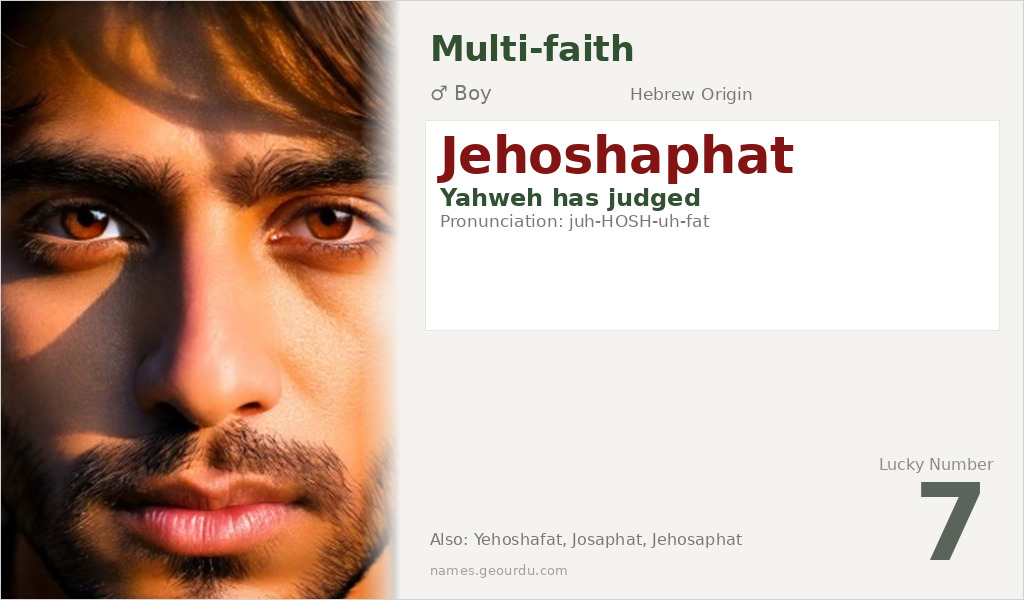
The name Jehoshaphat derives from the Hebrew language, specifically from the elements ‘Yeho’ (a contraction of Yahweh, the personal name of God in the Hebrew Bible) and ‘shaphat’ (meaning ‘to judge’ or ‘has judged’). Thus, the full meaning is ‘Yahweh has judged’ or ‘God has judged.’ This construction follows common theophoric patterns in ancient Semitic naming, where divine names were combined with verbs or nouns to express devotion or divine attributes. In the Hebrew Bible, the name appears in the Books of Kings and Chronicles, referring to a king of Judah known for his piety and judicial reforms. The name’s linguistic roots are well-documented in Biblical Hebrew lexicons and etymological studies, making its meaning clear and historically verified.
| 📛 Name | Jehoshaphat |
| 💎 Meaning | Yahweh has judged |
| 👤 Gender | Boy |
| 🕌 Religion | Multi-faith |
| 🌍 Origin | Hebrew |
| 🗣 Pronunciation | juh-HOSH-uh-fat |
| ✍️ Urdu | یحوشفط |
| ✍️ Arabic | يهوشافاط |
| 🔢 Numerology | 7 |
| ✨ Spellings | Yehoshafat, Josaphat, Jehosaphat, Yehoshaphat |
Origin & Cultural Significance
Jehoshaphat originates from ancient Hebrew culture and is deeply embedded in Jewish religious texts, particularly the Hebrew Bible/Old Testament. It gained prominence through King Jehoshaphat of Judah, who reigned in the 9th century BCE and was noted for his efforts to promote worship of Yahweh and establish judicial systems. The name spread to Christian traditions through the adoption of the Old Testament, where it is used in various translations and occasionally appears in Christian hagiography (e.g., Saint Josaphat). While not commonly used in modern Muslim contexts, it is recognized in Islamic tradition due to shared prophetic narratives. The name’s usage has historically been almost exclusively male and remains rare in contemporary times, primarily found in religious or historical references rather than as a popular given name.
Personality Traits
Those named Jehoshaphat are often associated with qualities of justice, leadership, and spiritual integrity, mirroring the name’s meaning of divine judgment. Biblical accounts depict King Jehoshaphat as a ruler who prioritized religious law and ethical governance, suggesting traits of righteousness and decisiveness. In modern interpretations, the name may imply a person with strong moral principles, a contemplative nature, and a sense of responsibility toward others. While personality traits can vary individually, the name’s historical and etymological background provides a foundation for these characteristic associations.
Similar Names
If you like Jehoshaphat, consider: Joshua, Josiah, Hezekiah, Jehoram, Zedekiah
Famous People Named Jehoshaphat
- Jehoshaphat — Biblical king of Judah (c. 870–849 BCE) known for religious reforms and military campaigns against Moab and Ammon
- Jehoshaphat (Josaphat) — Legendary Christian saint in medieval hagiography, often paired with Barlaam in Eastern Orthodox tradition
Frequently Asked Questions About Jehoshaphat
What does Jehoshaphat mean?
Jehoshaphat means 'Yahweh has judged' or 'God has judged' in Hebrew, derived from the elements 'Yeho' (Yahweh) and 'shaphat' (to judge).
Is Jehoshaphat a boy or girl name?
Jehoshaphat is traditionally a boy's name, originating from the Hebrew Bible where it was borne by male figures, and it has historically been used almost exclusively for males.
What is the origin of Jehoshaphat?
Jehoshaphat originates from ancient Hebrew language and culture, with its first recorded use in the Hebrew Bible/Old Testament as the name of a king of Judah in the 9th century BCE.





