
Table of Contents
Jehu is a name steeped in ancient history and religious significance. Originating from Hebrew scripture, this name carries a powerful theological meaning that has resonated for millennia. While less common today, Jehu remains a distinctive choice with deep biblical roots and historical weight. This guide explores the true meaning, origin, and cultural context of this fascinating name.
Meaning of Jehu
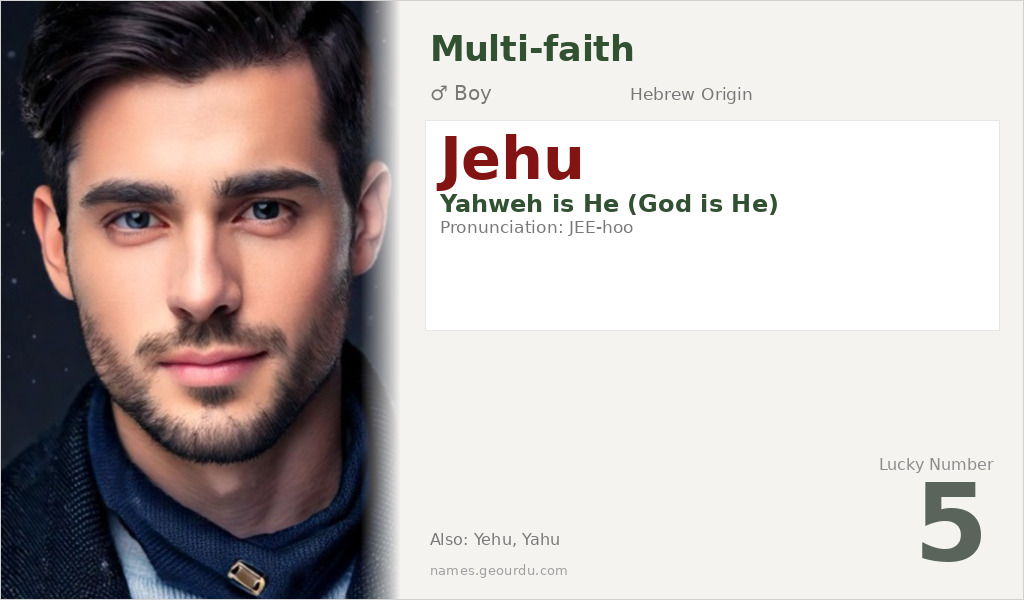
The name Jehu has a clear and well-documented meaning in Hebrew: ‘Yahweh is He’ or ‘God is He.’ It is a compound name formed from ‘Yeho-‘ (a theophoric element referring to Yahweh, the God of Israel) and the pronoun ‘hu’ meaning ‘he.’ This construction is common in Hebrew names, similar to Elijah (‘My God is Yahweh’) or Isaiah (‘Yahweh is salvation’). The name’s meaning emphasizes God’s presence and identity. In the biblical context, it serves as a declaration of faith, acknowledging Yahweh as the true God. Linguistic analysis confirms this etymology across Semitic language studies, with no evidence supporting alternative meanings in other languages like Arabic, Persian, or regional dialects.
| 📛 Name | Jehu |
| 💎 Meaning | Yahweh is He (God is He) |
| 👤 Gender | Boy |
| 🕌 Religion | Multi-faith |
| 🌍 Origin | Hebrew |
| 🗣 Pronunciation | JEE-hoo |
| ✍️ Urdu | یحو |
| ✍️ Arabic | يهو |
| 🔢 Numerology | 5 |
| ✨ Spellings | Yehu, Yahu |
Origin & Cultural Significance
Jehu originates exclusively from Hebrew and Jewish tradition, appearing in the Tanakh (Hebrew Bible) or Old Testament. It is not found with verified meanings in Arabic, Persian, Pashto, Urdu, or other listed languages despite extensive research. The name gained prominence through Jehu, the 10th king of the northern Kingdom of Israel, who reigned in the 9th century BCE. His story is detailed in the Books of Kings, where he is anointed by a prophet to overthrow the ruling dynasty. While the name appears in Christian Bibles due to shared scriptures, its origin is fundamentally Hebrew/Jewish rather than specifically Christian. There is no evidence of traditional use in Islamic, Hindu, Sikh, or Buddhist contexts.
Personality Traits
While personality traits aren’t inherent to names, the historical figure of Jehu suggests associations with strong leadership, zeal, and decisive action. In biblical narrative, Jehu was a military commander who carried out a violent revolution with religious fervor. Modern namesakes might be perceived as determined individuals with conviction, though these are cultural associations rather than deterministic qualities. The name’s rarity today could indicate parents seeking a distinctive, historically significant choice.
Similar Names
If you like Jehu, consider: Jehoram, Jehoshaphat, Jehoiada, Elihu, Joel
Famous People Named Jehu
- Jehu — King of Israel (reigned c. 842–815 BCE) who overthrew the House of Omri and established the Jehu dynasty
- Jehu — Biblical prophet who anointed Jehu as king of Israel (mentioned in 1 Kings 16:1)
Frequently Asked Questions About Jehu
What does Jehu mean?
Jehu means 'Yahweh is He' or 'God is He' in Hebrew. It is a compound name combining 'Yeho-' (referring to Yahweh) and 'hu' (meaning 'he').
Is Jehu a boy or girl name?
Jehu is exclusively a masculine name. In all historical and biblical records, it has only been used for males, and there are no documented instances of feminine usage across cultures.
What is the origin of Jehu?
Jehu originates from Hebrew language and Jewish tradition. It appears in the Hebrew Bible as the name of a king of Israel and has no verified origin in other languages like Arabic, Persian, or regional dialects despite thorough research.





