
Table of Contents
Jisnu is a powerful and traditional Hindu boy name with deep roots in Sanskrit literature and mythology. Meaning ‘Victorious’ or ‘triumphant,’ it evokes images of strength and success, often associated with legendary figures like Arjuna from the Mahabharata. This name carries a rich cultural heritage, symbolizing conquest and achievement in various aspects of life. Explore the origins, meaning, and personality traits linked to Jisnu in this comprehensive guide.
Meaning of Jisnu
Jisnu derives from the Sanskrit word ‘जिष्णु’ (jiṣṇu), which translates to ‘victorious,’ ‘triumphant,’ or ‘conqueror.’ The etymology traces back to the Sanskrit root ‘जि’ (ji), meaning ‘to conquer’ or ‘to win,’ combined with the suffix ‘-ṣṇu’ that denotes a habitual or characteristic quality, thus forming a name that signifies one who consistently achieves victory. In Hindu texts, such as the Mahabharata, Jisnu is used as an epithet for Arjuna, highlighting his prowess as a warrior and his role in the Kurukshetra war. This linguistic background places Jisnu firmly within the classical Sanskrit tradition, emphasizing themes of success and resilience. The name’s meaning is well-documented in Sanskrit dictionaries and historical scriptures, making it a reliable choice for those seeking a name with profound symbolic weight.
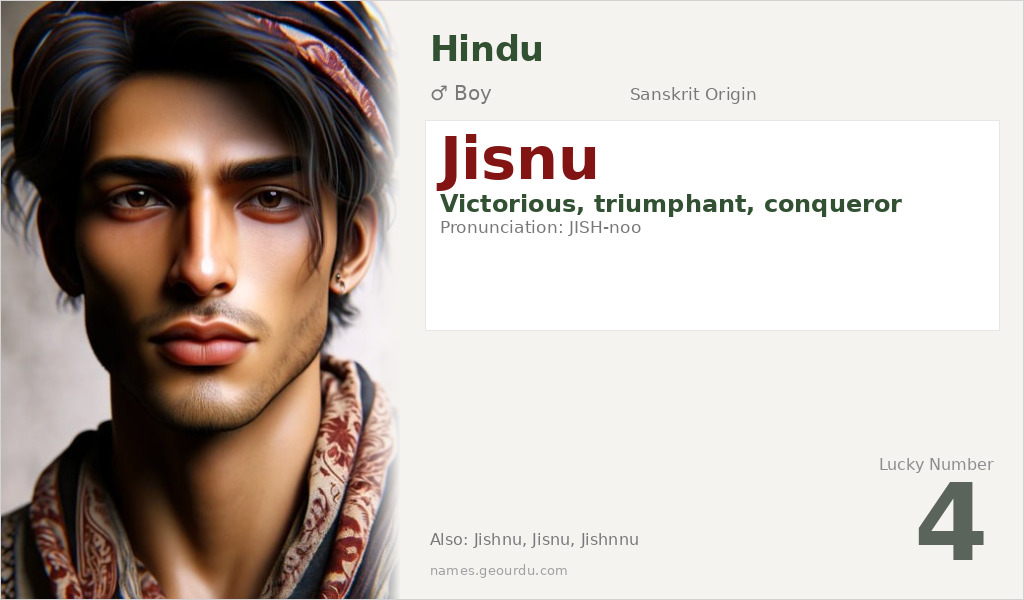
| 📛 Name | Jisnu |
| 💎 Meaning | Victorious, triumphant, conqueror |
| 👤 Gender | Boy |
| 🕌 Religion | Hindu |
| 🌍 Origin | Sanskrit |
| 🗣 Pronunciation | JISH-noo |
| ✍️ Urdu | جشنو |
| ✍️ Arabic | جيشنو |
| 🔢 Numerology | 4 |
| ✨ Spellings | Jishnu, Jisnu, Jishnnu |
Origin & Cultural Significance
Jisnu originates from Sanskrit, an ancient Indo-Aryan language that is the liturgical language of Hinduism and has influenced many South Asian languages. Its usage dates back to Vedic and epic periods, particularly in texts like the Mahabharata, where it is associated with Arjuna, a central figure known for his archery skills and moral dilemmas. Culturally, the name is predominantly used within Hindu communities in India and Nepal, reflecting values of bravery and accomplishment. While it is not commonly found in other language families such as Arabic, Persian, or African dialects, its Sanskrit roots ensure its significance in Hindu naming traditions. The name has maintained its popularity in regions with strong Hindu cultural ties, often chosen for boys to inspire qualities of leadership and victory.
Personality Traits
People named Jisnu are often perceived as determined and goal-oriented, driven by the name’s meaning of victory and conquest. They may exhibit natural leadership abilities, confidence, and a competitive spirit, thriving in challenges and striving for success in their endeavors. Influenced by the heroic associations from Hindu mythology, individuals with this name might also show resilience and a strong sense of justice, making them inspiring figures in their communities.
Similar Names
If you like Jisnu, consider: Arjuna, Vijay, Jayant, Abhijit, Siddharth
Famous People Named Jisnu
- Jishnu Raghavan — Indian actor known for roles in Malayalam films
- Jishnu Dev Varma — Indian politician and member of the Tripura royal family
Frequently Asked Questions About Jisnu
What does Jisnu mean?
Jisnu means 'Victorious,' 'triumphant,' or 'conqueror' in Sanskrit, derived from the root 'जि' (ji) meaning 'to win.'
Is Jisnu a boy or girl name?
Jisnu is traditionally a boy name in Hindu culture, as evidenced by its usage in ancient texts like the Mahabharata for male characters.
What is the origin of Jisnu?
Jisnu originates from Sanskrit, an ancient Indian language, with historical usage in Hindu scriptures and mythology, particularly associated with Arjuna.





