
Table of Contents
Julia is a timeless feminine name with roots stretching back to ancient Rome. Carrying the beautiful meaning of ‘youthful’ or ‘soft-haired’, this name has graced empresses, saints, artists, and leaders across centuries. From its Latin origins to its global popularity today, Julia represents elegance, vitality, and classical heritage that transcends cultural boundaries.
Meaning of Julia
The name Julia originates from the Latin ‘Iulius’, a Roman family name meaning ‘descended from Jove’ (Jupiter, the chief Roman god). More specifically, it relates to the Latin word ‘iulus’ meaning ‘downy-bearded’ or ‘soft-haired’, which metaphorically signifies youthfulness and vitality. As the feminine form of Julius, it was borne by women of the Julian gens, Rome’s most illustrious patrician family. The name’s connection to youthfulness comes from both the ‘soft-haired’ meaning and its association with Iulus (also called Ascanius), the youthful son of the Trojan hero Aeneas in Roman mythology.
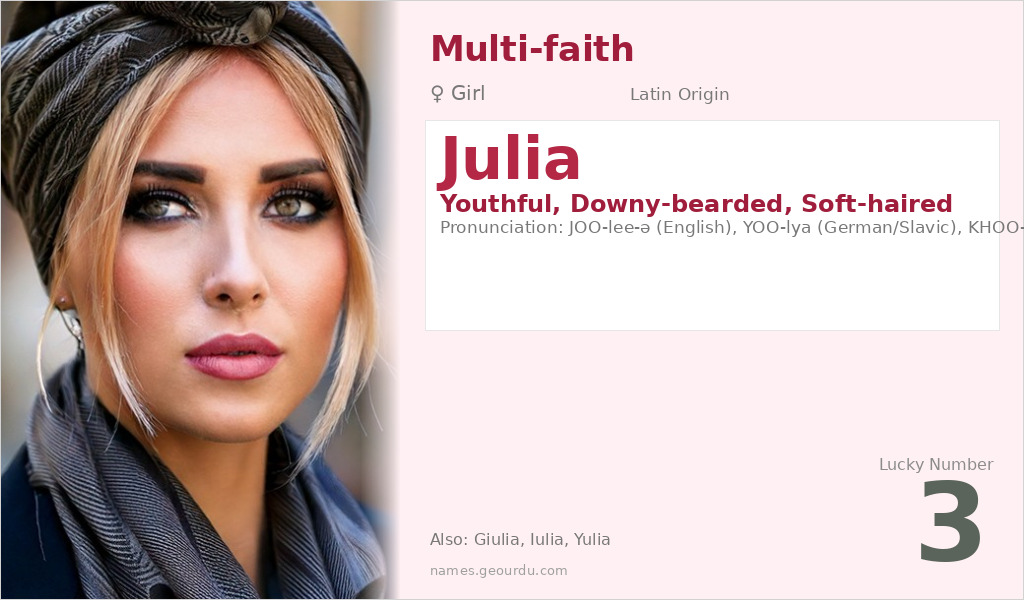
| 📛 Name | Julia |
| 💎 Meaning | Youthful, Downy-bearded, Soft-haired |
| 👤 Gender | Girl |
| 🕌 Religion | Multi-faith |
| 🌍 Origin | Latin |
| 🗣 Pronunciation | JOO-lee-ə (English), YOO-lya (German/Slavic), KHOO-lya (Spanish) |
| ✍️ Urdu | جولیا |
| ✍️ Arabic | جوليا |
| 🔢 Numerology | 3 |
| ✨ Spellings | Giulia, Iulia, Yulia, Julija, Júlia, Julie |
Origin & Cultural Significance
Julia has its origins in ancient Rome as a feminine cognomen of the prestigious Julian family, which included Julius Caesar. The name gained prominence through Julia Caesaris, daughter of Julius Caesar, and Julia Augusta, wife of Emperor Augustus. It spread throughout Europe via the Roman Empire and early Christianity, with Saint Julia of Corsica becoming a venerated martyr. During the Renaissance, the name revived across Europe, taking forms like Giulia (Italian), Julie (French), and Yulia (Russian). Today it remains popular worldwide, transcending its specifically Roman-Christian origins to become a multicultural classic.
Personality Traits
Those named Julia often exhibit a vibrant, creative personality with natural social grace. They tend to approach life with youthful optimism and artistic sensibility, making them effective communicators and collaborators. Their classical name heritage often gives them an appreciation for history, culture, and timeless elegance, balanced with a modern, approachable warmth that draws people to them.
Similar Names
If you like Julia, consider: Julian, Juliana, Juliet, Julius, Giuliana
Famous People Named Julia
- Julia Roberts — American Academy Award-winning actress known for roles in 'Pretty Woman' and 'Erin Brockovich'
- Julia Child — American chef, author, and television personality who introduced French cuisine to the American public
Frequently Asked Questions About Julia
What does Julia mean?
Julia means 'youthful', 'downy-bearded', or 'soft-haired' from its Latin origin 'Iulius', relating to the Roman family name and the word 'iulus'.
Is Julia a boy or girl name?
Julia is exclusively a feminine name, being the feminine form of the masculine Julius. While Julian is the masculine equivalent, Julia itself is used only for girls across all cultures.
What is the origin of Julia?
Julia originates from ancient Latin/Roman culture as the feminine form of the Julian family name, with specific roots in the Latin word 'iulus' meaning 'soft-haired' or 'downy-bearded'.





