
Table of Contents
Kabandha is a name steeped in Hindu mythology and Sanskrit tradition, carrying a meaning that reflects ancient epic narratives. Unlike common modern names, Kabandha has a specific mythological origin that connects directly to one of India’s great epics, the Ramayana. This name represents not just an individual but a symbolic figure in Hindu literature. Understanding Kabandha requires exploring its etymological roots and cultural context.
Meaning of Kabandha
Kabandha derives from Sanskrit, combining the elements ‘ka’ and ‘bandha’ to create the meaning ‘headless torso’ or ‘trunk without head’. The ‘ka’ component relates to the head, while ‘bandha’ indicates being bound or without. In the Ramayana, Kabandha was a Rakshasa cursed to exist as a monstrous being with his face on his chest and extraordinarily long arms. After being killed by Rama and Lakshmana, he regained his original form as the Gandharva Vishvavasu and provided crucial guidance to the princes. The name thus carries layers of meaning: the literal anatomical reference, the mythological narrative of curse and redemption, and symbolic transformation.
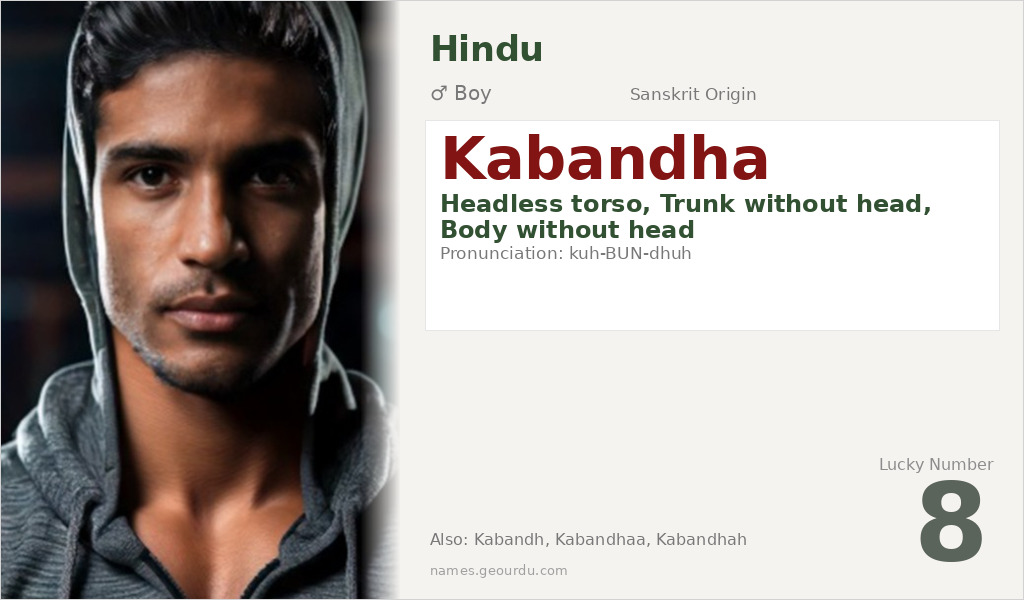
| 📛 Name | Kabandha |
| 💎 Meaning | Headless torso, Trunk without head, Body without head |
| 👤 Gender | Boy |
| 🕌 Religion | Hindu |
| 🌍 Origin | Sanskrit |
| 🗣 Pronunciation | kuh-BUN-dhuh |
| ✍️ Urdu | کبندھ |
| ✍️ Arabic | كاباندا |
| 🔢 Numerology | 8 |
| ✨ Spellings | Kabandh, Kabandhaa, Kabandhah |
Origin & Cultural Significance
Kabandha originates from ancient Sanskrit literature, specifically the Ramayana attributed to Valmiki (circa 5th century BCE to 1st century CE). The name belongs to a significant secondary character in the epic who plays a pivotal role in directing Rama toward Sugriva and the search for Sita. As a mythological name, it has remained primarily within Hindu religious and literary contexts rather than becoming a common given name. The cultural significance lies in its association with transformation, guidance, and the intersection of divine and demonic realms in Hindu cosmology. While not widely used as a personal name today, it maintains importance in classical Indian literature and religious storytelling.
Personality Traits
Those named Kabandha might be perceived as having a transformative nature, capable of significant personal evolution. Like the mythological figure who transitioned from cursed monster to liberated celestial being, individuals with this name may demonstrate resilience through difficult circumstances. They often possess hidden wisdom that emerges after challenges, and may serve as guides or advisors to others during transitional periods. The name suggests someone with depth beyond initial appearance and the potential for redemption and enlightenment.
Similar Names
If you like Kabandha, consider: Kumbhakarna, Maricha, Ravana, Vibhishana, Shurpanakha
Famous People Named Kabandha
- Kabandha (mythological figure) — Rakshasa from the Ramayana who was originally a Gandharva named Vishvavasu, cursed by Indra to become a headless monster
- No contemporary famous people found with this name as it is primarily mythological
Frequently Asked Questions About Kabandha
What does Kabandha mean?
Kabandha means 'headless torso' or 'trunk without head' in Sanskrit. It refers specifically to a mythological Rakshasa from the Hindu epic Ramayana who was cursed to exist as a headless monster.
Is Kabandha a boy or girl name?
Kabandha is exclusively a boy name in Hindu tradition, as it refers to a male mythological figure from the Ramayana. There are no feminine variants or usage in any cultural context.
What is the origin of Kabandha?
Kabandha originates from Sanskrit and Hindu mythology, specifically from the ancient Indian epic Ramayana. The name belongs to a Rakshasa (demon) character who plays a significant role in guiding Rama during his search for Sita.





