
Table of Contents
Kacesvara is a distinctive Hindu boy name with deep roots in Sanskrit language and Indian geography. Unlike common modern names, it carries a specific territorial connotation that reflects ancient naming traditions. This name connects the divine with particular landscapes, offering a unique choice for parents seeking meaningful, historically rich names. Exploring Kacesvara reveals how names can preserve geographical and cultural memory across generations.
Meaning of Kacesvara
Kacesvara derives from the Sanskrit compound ‘Kaccha’ + ‘Ishvara,’ where ‘Kaccha’ (कच्छ) specifically refers to marshy coastal regions or tidal flats in ancient Indian geography. This term appears in historical texts describing areas like the Kutch region in Gujarat and similar landscapes in Sindh. ‘Ishvara’ (ईश्वर) is a well-documented Sanskrit term meaning ‘lord,’ ‘ruler,’ or ‘sovereign,’ frequently used as an epithet for Hindu deities, particularly Shiva. Thus, Kacesvara literally translates to ‘Lord of the Kaccha region’ or ‘Ruler of the marshy lands,’ suggesting either a local deity protecting specific terrain or a human ruler governing such areas. The name exemplifies how Sanskrit compounds often combine geographical features with divine or royal titles to create meaningful identifiers.
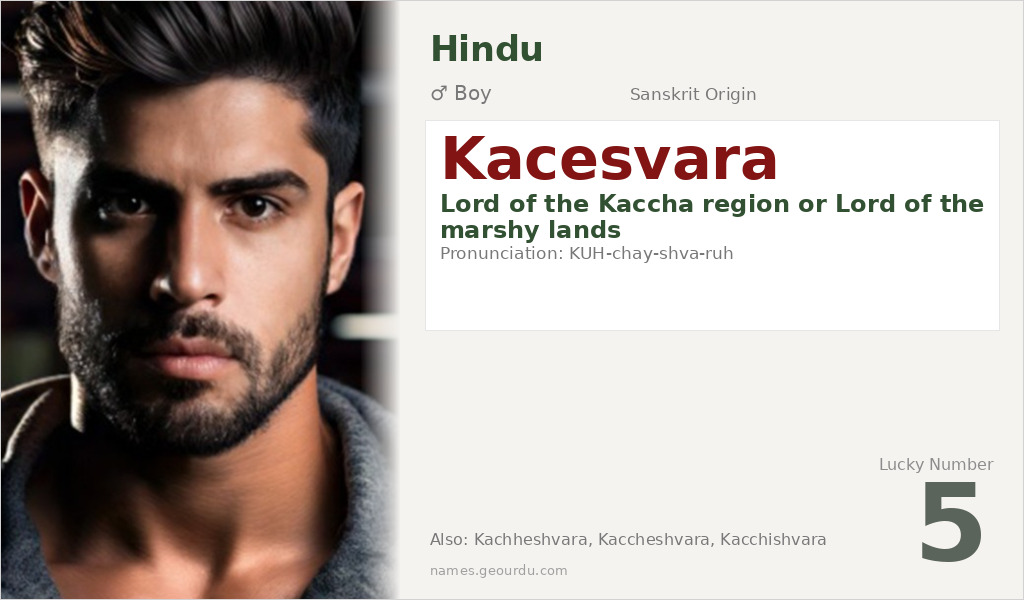
| 📛 Name | Kacesvara |
| 💎 Meaning | Lord of the Kaccha region or Lord of the marshy lands |
| 👤 Gender | Boy |
| 🕌 Religion | Hindu |
| 🌍 Origin | Sanskrit |
| 🗣 Pronunciation | KUH-chay-shva-ruh |
| ✍️ Urdu | کچیشور |
| ✍️ Arabic | كاشيشوارا |
| 🔢 Numerology | 5 |
| ✨ Spellings | Kachheshvara, Kaccheshvara, Kacchishvara |
Origin & Cultural Significance
The name Kacesvara originates from Sanskrit, the classical language of ancient India, and reflects specific geographical associations within Hindu culture. It likely emerged in regions with marshy coastal landscapes, particularly in western India (modern Gujarat) and the Sindh area, where such terrain was historically significant. In Hindu tradition, names combining geographical terms with ‘Ishvara’ often denoted local forms of Shiva or other deities worshipped as protectors of specific territories. While not among the most common Sanskrit names today, Kacesvara appears in some regional temple inscriptions and local historical records, preserving its connection to particular landscapes. The name represents how ancient Indians integrated environmental features into their spiritual and naming practices.
Personality Traits
Those named Kacesvara are often associated with stability, protection, and connection to their heritage. The name’s meaning suggests someone who is grounded and responsible, potentially exhibiting leadership qualities tied to caring for their community or environment. They may possess a practical, nurturing nature combined with spiritual depth, reflecting the balance between earthly and divine elements in the name’s etymology. While personality traits vary individually, the name’s historical connotations often inspire perceptions of reliability and rootedness.
Similar Names
If you like Kacesvara, consider: Keshava, Maheshvara, Vishveshvara, Rameshvara, Someshvara
Famous People Named Kacesvara
- No widely known contemporary figures with this name found in historical records
- The name appears in some regional Hindu temple inscriptions and local folklore in Gujarat and Sindh regions
Frequently Asked Questions About Kacesvara
What does Kacesvara mean?
Kacesvara means 'Lord of the marshy lands' or 'Lord of the Kaccha region,' derived from the Sanskrit words 'Kaccha' (marshy area) and 'Ishvara' (lord/ruler).
Is Kacesvara a boy or girl name?
Kacesvara is traditionally a boy's name in Hindu naming conventions, as indicated by the masculine suffix 'Ishvara' and historical usage patterns.
What is the origin of Kacesvara?
Kacesvara originates from Sanskrit, the classical language of ancient India, with specific geographical associations to marshy coastal regions in western India and Sindh.





