
Table of Contents
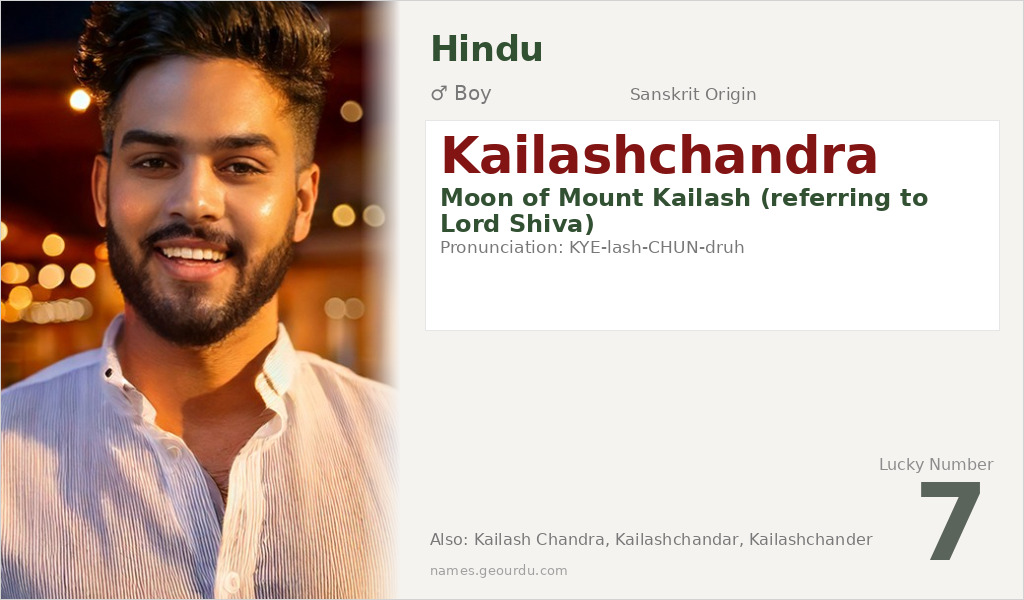
Kailashchandra is a profoundly meaningful Sanskrit name that beautifully combines two sacred elements of Hindu tradition. Literally translating to ‘Moon of Mount Kailash,’ this name serves as a poetic epithet for Lord Shiva, who is often depicted with the moon adorning his matted locks. As a compound name, it carries deep spiritual symbolism and cultural resonance within Hindu communities. Parents choosing this name often seek to imbue their child with qualities of serenity, wisdom, and divine connection.
Meaning of Kailashchandra
Kailashchandra is a classical Sanskrit compound name with precise etymological roots. The first component, ‘Kailash,’ refers to Mount Kailash in the Himalayas, considered the celestial abode of Lord Shiva in Hindu cosmology. The second component, ‘Chandra,’ means ‘moon’ in Sanskrit and appears in numerous Indian names. Together, they create the metaphorical meaning ‘Moon of Kailash,’ which poetically describes Shiva himself. This construction follows traditional Sanskrit compounding rules (samāsa) where two nouns combine to create a new metaphorical meaning. The name appears in Hindu literary and religious contexts as an honorific for Shiva, though it’s less common as a personal name than simpler Shiva-related names like Shankar or Mahesh.
| 📛 Name | Kailashchandra |
| 💎 Meaning | Moon of Mount Kailash (referring to Lord Shiva) |
| 👤 Gender | Boy |
| 🕌 Religion | Hindu |
| 🌍 Origin | Sanskrit |
| 🗣 Pronunciation | KYE-lash-CHUN-druh |
| ✍️ Urdu | کیلاش چندر |
| ✍️ Arabic | كايلاش تشاندرا |
| 🔢 Numerology | 7 |
| ✨ Spellings | Kailash Chandra, Kailashchandar, Kailashchander, Kailas Chandra |
Origin & Cultural Significance
Kailashchandra originates from classical Sanskrit, the ancient liturgical language of Hinduism, Buddhism, and Jainism. The name emerges from Hindu devotional and poetic traditions where compound names celebrating deities became popular. While Mount Kailash has significance across multiple Asian religions including Hinduism, Buddhism, Jainism, and Bon, the specific combination ‘Kailashchandra’ is distinctly Hindu in its Shiva-focused symbolism. The name gained some popularity in India during the 20th century, particularly among families with strong Shaivite (Shiva-worshipping) traditions. It remains more common in regions with strong Sanskrit naming traditions, particularly in Northern and Western India, though it’s not among the most frequently used names in contemporary India.
Personality Traits
Those named Kailashchandra are often associated with the calm, reflective qualities of the moon and the steadfast, majestic nature of the mountain. They may exhibit a balanced personality that combines emotional depth with intellectual strength. In social settings, they often project an aura of quiet authority and spiritual maturity that draws respect from others. Their connection to Shiva symbolism suggests potential interests in philosophy, meditation, or artistic pursuits that explore deeper truths.
Similar Names
If you like Kailashchandra, consider: Chandrashekhar, Shivansh, Himanshu, Somendra, Induchandra
Famous People Named Kailashchandra
- Kailash Chandra Meher — Renowned Indian Pattachitra artist from Odisha known for traditional scroll painting
- Kailash Chandra Joshi — Indian politician who served as Chief Minister of Madhya Pradesh and Speaker of Lok Sabha
Frequently Asked Questions About Kailashchandra
What does Kailashchandra mean?
Kailashchandra means 'Moon of Mount Kailash' in Sanskrit. It's a compound name where 'Kailash' refers to the sacred Himalayan mountain and 'Chandra' means moon. The name is a poetic epithet for Lord Shiva.
Is Kailashchandra a boy or girl name?
Kailashchandra is exclusively a masculine name in Hindu naming tradition. The '-chandra' ending is typically masculine in Sanskrit names, and the name's association with Lord Shiva reinforces its male gender assignment.
What is the origin of Kailashchandra?
Kailashchandra originates from Sanskrit, the classical language of ancient India. It combines two Sanskrit words: 'Kailash' (Mount Kailash) and 'Chandra' (moon), creating a name deeply rooted in Hindu religious and poetic traditions.





