
Table of Contents
Kailashnath is a profound Sanskrit name that carries deep spiritual significance in Hindu culture. Meaning ‘Lord of Mount Kailash’, this name directly references Shiva, one of the principal deities in Hinduism. As a compound name combining ‘Kailash’ (the sacred mountain) and ‘nath’ (lord), it embodies both geographical and divine symbolism. Parents choosing this name often seek to honor Shiva’s protective and powerful qualities.
Meaning of Kailashnath
Kailashnath has a precise and well-documented meaning in Sanskrit: ‘Lord of Mount Kailash’. The name breaks down into two Sanskrit components: ‘Kailash’ (कैलाश), referring to the sacred Himalayan mountain considered Shiva’s celestial abode, and ‘nath’ (नाथ), meaning ‘lord’, ‘master’, or ‘protector’. This compound formation follows classical Sanskrit naming conventions where ‘nath’ is appended to signify mastery or lordship. In Hindu mythology, Mount Kailash is not just a physical location but a spiritual symbol of purity and transcendence. Thus, Kailashnath represents Shiva’s dominion over both the physical mountain and the spiritual realm it symbolizes.
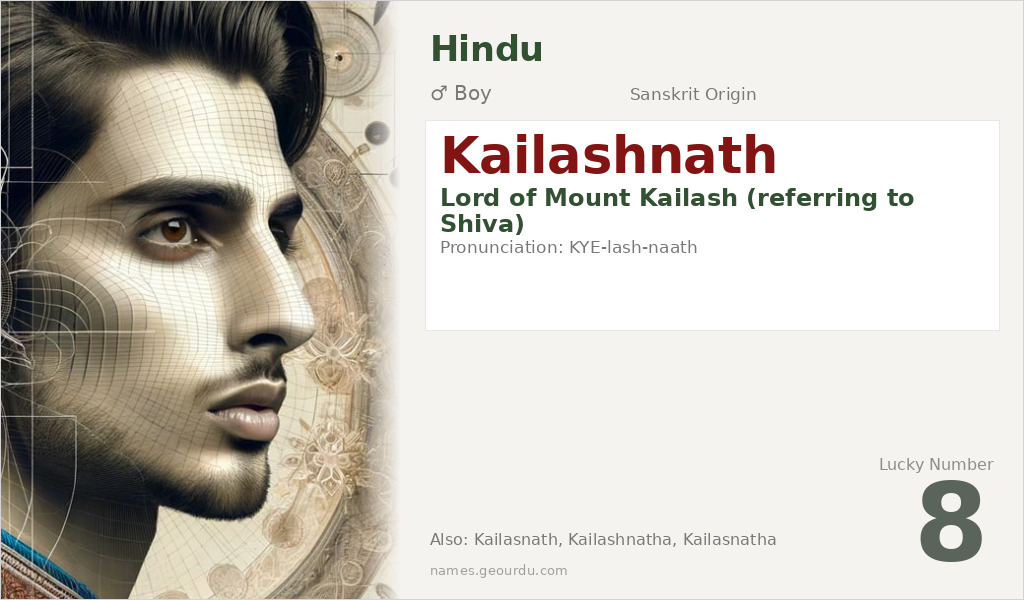
| 📛 Name | Kailashnath |
| 💎 Meaning | Lord of Mount Kailash (referring to Shiva) |
| 👤 Gender | Boy |
| 🕌 Religion | Hindu |
| 🌍 Origin | Sanskrit |
| 🗣 Pronunciation | KYE-lash-naath |
| ✍️ Urdu | کیلاش ناتھ |
| ✍️ Arabic | كايلاش ناث |
| 🔢 Numerology | 8 |
| ✨ Spellings | Kailasnath, Kailashnatha, Kailasnatha |
Origin & Cultural Significance
Kailashnath originates from classical Sanskrit, the ancient liturgical language of Hinduism. The name appears in Hindu scriptures and texts as one of Shiva’s many epithets, reflecting his association with Mount Kailash in the Himalayas. This connection is central to Shaivism (the worship of Shiva), where the mountain is considered Shiva’s earthly home. The name has been used for centuries in India and among Hindu communities worldwide, particularly in regions with strong Shaivite traditions. While primarily a given name, it also appears in temple names and titles, maintaining its religious significance across generations.
Personality Traits
Those named Kailashnath are often associated with qualities of strength, spirituality, and protection, mirroring Shiva’s attributes. They may exhibit natural leadership abilities and a deep respect for tradition and spirituality. The name suggests a person who is both grounded and transcendent, capable of providing stability while pursuing higher ideals. This combination of earthly and divine associations makes Kailashnath a name that conveys both power and spiritual depth.
Similar Names
If you like Kailashnath, consider: Shiva, Shankar, Mahadev, Kailash, Nath
Famous People Named Kailashnath
- Kailashnath Katju – Indian politician and former Governor of Odisha and West Bengal
- Kailashnath Temple – A famous Shiva temple in Ellora Caves, Maharashtra, India
Frequently Asked Questions About Kailashnath
What does Kailashnath mean?
Kailashnath means 'Lord of Mount Kailash' in Sanskrit, directly referring to Shiva, who is believed to reside on this sacred Himalayan mountain.
Is Kailashnath a boy or girl name?
Kailashnath is exclusively a boy's name in Hindu tradition, as it refers to Shiva, a male deity, and uses masculine Sanskrit grammatical forms.
What is the origin of Kailashnath?
Kailashnath originates from Sanskrit, the classical language of Hinduism, combining 'Kailash' (Mount Kailash) and 'nath' (lord) to create a name for Shiva.





