
Table of Contents
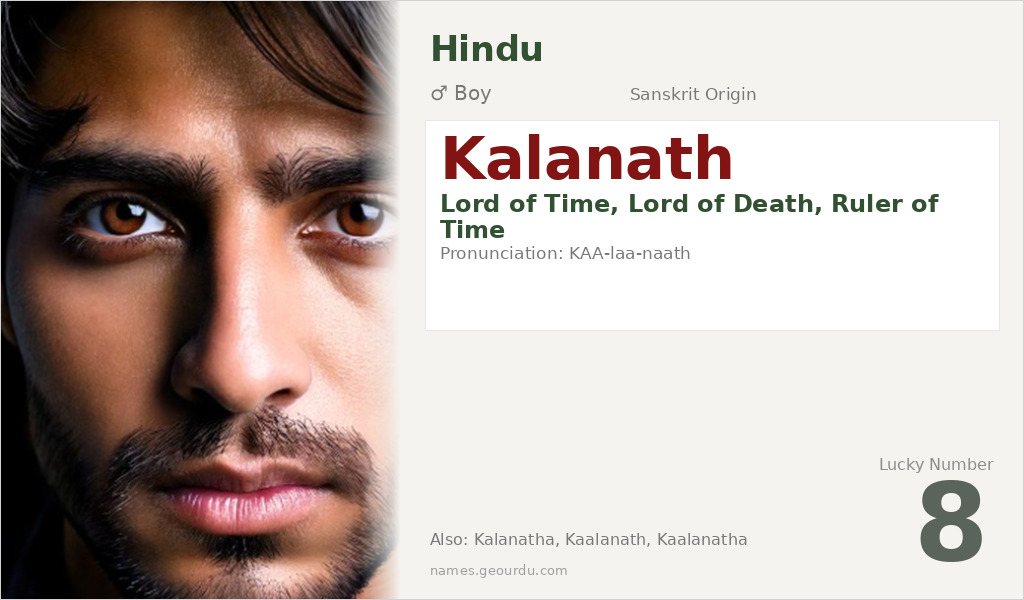
Kalanath is a profound and ancient Sanskrit name that carries deep philosophical and religious significance in Hindu culture. Meaning ‘Lord of Time’ or ‘Lord of Death’, it evokes the powerful concept of time as a divine force. This name is traditionally given to boys and is associated with qualities of mastery, destiny, and spiritual depth. Explore the rich etymology and cultural context of this timeless name.
Meaning of Kalanath
Kalanath derives from the Sanskrit words ‘Kāla’ (काल) and ‘Nātha’ (नाथ). ‘Kāla’ has multiple layers of meaning, including ‘time’, ‘death’, ‘black’, and ‘destiny’, and is personified in Hinduism as a deity controlling the cosmic order. ‘Nātha’ means ‘lord’, ‘master’, or ‘protector’. Combined, Kalanath translates to ‘Lord of Time’ or ‘Lord of Death’, often referring to Shiva, who embodies the cyclical nature of creation and destruction. The name is well-documented in Sanskrit literature and Hindu texts, emphasizing its role in expressing reverence for the forces that govern existence. It is not related to the moon, which is ‘Chandra’ in Sanskrit.
| 📛 Name | Kalanath |
| 💎 Meaning | Lord of Time, Lord of Death, Ruler of Time |
| 👤 Gender | Boy |
| 🕌 Religion | Hindu |
| 🌍 Origin | Sanskrit |
| 🗣 Pronunciation | KAA-laa-naath |
| ✍️ Urdu | کلاناتھ |
| ✍️ Arabic | كالاناث |
| 🔢 Numerology | 8 |
| ✨ Spellings | Kalanatha, Kaalanath, Kaalanatha, Kalanath |
Origin & Cultural Significance
Kalanath originates from classical Sanskrit, the ancient liturgical language of Hinduism, Buddhism, and Jainism. It is deeply rooted in Indian religious traditions, particularly associated with Shaivism, where Shiva is revered as Kāla (time) and Mahākāla (great time). The name reflects Hindu philosophical concepts of time (Kāla) as an imperishable, all-pervading reality. Historically, it has been used in religious contexts, scholarly works, and as a given name in Hindu communities across India and Nepal. Its usage underscores cultural values of spirituality, destiny, and the cyclical nature of life.
Personality Traits
Those named Kalanath are often seen as wise, composed, and introspective individuals. They may possess a natural authority and a thoughtful approach to life’s challenges, mirroring the name’s connection to time and destiny. Their personality might include traits like patience, resilience, and a philosophical outlook, making them respected figures in their communities.
Similar Names
If you like Kalanath, consider: Kaladhara, Kalapriya, Kalanidhi, Kalavati, Kalesh
Famous People Named Kalanath
- Kalanath Shastri — 20th century Indian Sanskrit scholar and writer
- Kalanath Jha — Indian classical vocalist in the Dhrupad tradition
Frequently Asked Questions About Kalanath
What does Kalanath mean?
Kalanath means 'Lord of Time' or 'Lord of Death' in Sanskrit, derived from 'Kāla' (time/death) and 'Nātha' (lord).
Is Kalanath a boy or girl name?
Kalanath is traditionally a boy's name in Hindu culture, reflecting masculine divine attributes in Sanskrit naming conventions.
What is the origin of Kalanath?
Kalanath originates from Sanskrit, an ancient Indian language, with deep roots in Hindu mythology and philosophy, particularly associated with Shiva as the controller of time.





