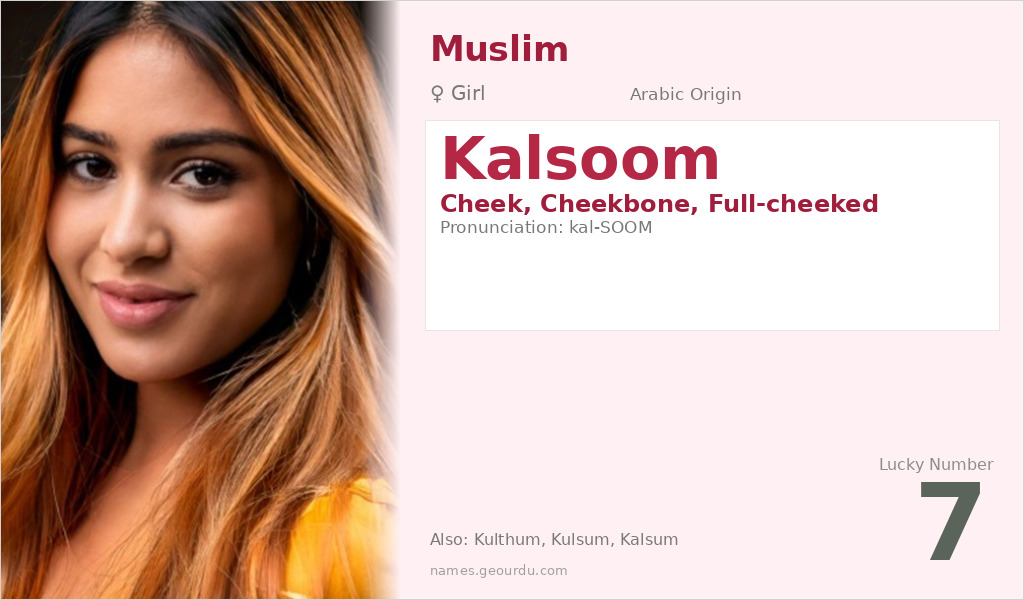
Table of Contents
Kalsoom is a beautiful Arabic name with deep historical roots in Islamic tradition. Meaning ‘cheek’ or ‘full-cheeked’, this name carries both linguistic charm and cultural significance. Traditionally given to girls, Kalsoom (also spelled Kulthum) has been borne by important figures throughout Islamic history. Today, it remains a popular choice in Muslim communities worldwide, connecting modern bearers to a rich heritage.
Meaning of Kalsoom
Kalsoom derives from the Arabic root ‘k-l-th-m’ (ك ل ث م), which specifically refers to the cheek or cheekbone. The name literally means ‘cheek’ but carries the connotation of ‘full-cheeked’ or ‘plump-cheeked’, often used as an affectionate term in Arabic poetry and literature. This physical descriptor was commonly used in pre-Islamic and early Islamic Arabia as a name, reflecting appreciation for certain facial features. The most famous historical bearer was Kulthum bint Muhammad, traditionally considered one of the daughters of Prophet Muhammad (PBUH), though scholarly opinions vary about which daughters carried this name. The name’s persistence through centuries demonstrates how a simple physical descriptor evolved into a cherished personal name with religious and cultural resonance.
| 📛 Name | Kalsoom |
| 💎 Meaning | Cheek, Cheekbone, Full-cheeked |
| 👤 Gender | Girl |
| 🕌 Religion | Muslim |
| 🌍 Origin | Arabic |
| 🗣 Pronunciation | kal-SOOM |
| ✍️ Urdu | کلثوم |
| ✍️ Arabic | كلثوم |
| 🔢 Numerology | 7 |
| ✨ Spellings | Kulthum, Kulsum, Kalsum, Kulsoom, Kalthum |
Origin & Cultural Significance
Kalsoom originates from classical Arabic and has been used since pre-Islamic times in the Arabian Peninsula. With the advent of Islam, the name gained particular significance through its association with the family of Prophet Muhammad (PBUH). The name spread throughout the Muslim world via Arabic influence, appearing in various forms across regions from North Africa to South Asia. In different cultures, the pronunciation and spelling adapted slightly—becoming Kulsum in Urdu-speaking regions, Kulthum in Arabic countries, and various other transliterations. Despite these variations, the core meaning and cultural associations remained consistent, making Kalsoom a name that transcends geographical boundaries while maintaining its Arabic linguistic roots.
Personality Traits
Those named Kalsoom are often perceived as warm, compassionate individuals with strong family values. They tend to be emotionally expressive and nurturing, qualities that align with the name’s affectionate origins. Many Kalsooms demonstrate resilience and depth of character, perhaps influenced by the historical figures who bore this name. Their connection to tradition often gives them a grounded perspective, while their inherent warmth makes them beloved in their social circles.
Similar Names
If you like Kalsoom, consider: Fatima, Zainab, Ruqayyah, Umm Kulthum, Khadija
Famous People Named Kalsoom
- Umm Kulthum bint Muhammad — Traditionally considered one of the daughters of Prophet Muhammad (PBUH), though historical sources vary
- Umm Kulthum (singer) — Legendary Egyptian singer (1904-1975), often called 'Kawkab al-Sharq' (Star of the East), one of the most famous Arab singers of the 20th century
Frequently Asked Questions About Kalsoom
What does Kalsoom mean?
Kalsoom means 'cheek', 'cheekbone', or 'full-cheeked' in Arabic, derived from the root word 'k-l-th-m'. It was traditionally used as a term of endearment referring to plump cheeks.
Is Kalsoom a boy or girl name?
Kalsoom is exclusively a girl's name in all cultural contexts where it is used. It has never been recorded as a masculine name in historical or contemporary usage.
What is the origin of Kalsoom?
Kalsoom originates from classical Arabic and has been used since pre-Islamic times. It gained particular significance in Islamic tradition through its association with the family of Prophet Muhammad (PBUH).