Table of Contents
Kamal is a name that resonates with depth and cultural richness, primarily known in the Arab and Muslim worlds. While it might be confused with similar-sounding names in other languages, its core meaning of ‘perfection’ or ‘completeness’ has made it a timeless choice for boys. This name carries a legacy of intellectual and spiritual pursuit, often associated with individuals who strive for excellence in their endeavors.
Meaning of Kamal
The name Kamal originates from the Arabic root K-M-L (ك-م-ل), which conveys concepts of completeness, perfection, and excellence. In Arabic, ‘kamal’ (كمال) literally means ‘perfection’ or ‘the state of being whole,’ and it is used in both religious and secular contexts to denote the highest attainable standard. This root is also found in related words like ‘kamil’ (complete) and ‘takamul’ (integration). The name has been adopted into languages such as Persian, Urdu, and Turkish without significant alteration, maintaining its core meaning. It is important to distinguish this from the Sanskrit ‘Kamal’ (कमल), meaning ‘lotus,’ which shares a phonetic similarity but has a different etymological origin rooted in ancient Indian languages.
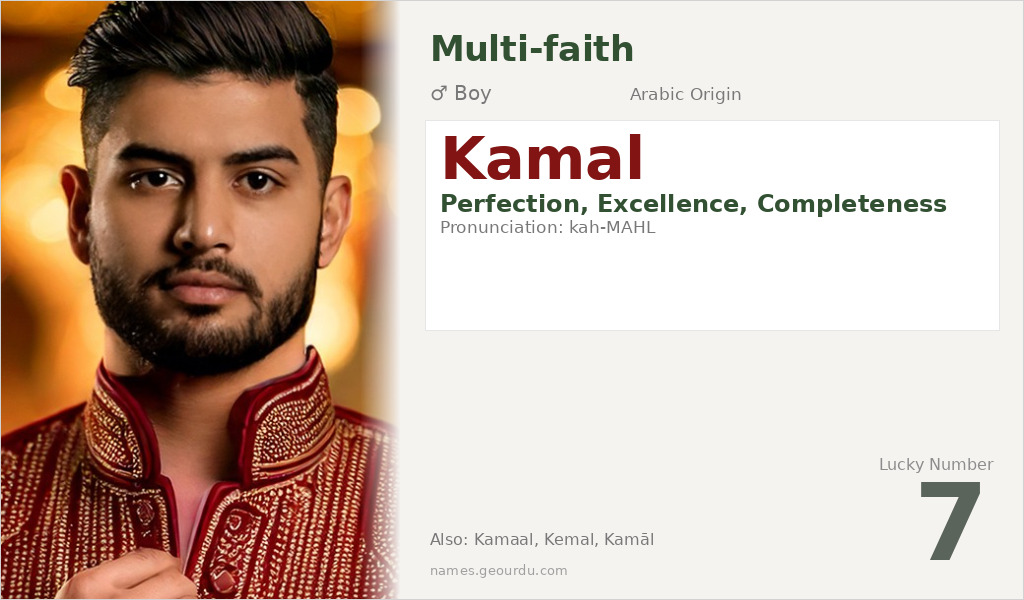
| 📛 Name | Kamal |
| 💎 Meaning | Perfection, Excellence, Completeness |
| 👤 Gender | Boy |
| 🕌 Religion | Multi-faith |
| 🌍 Origin | Arabic |
| 🗣 Pronunciation | kah-MAHL |
| ✍️ Urdu | کمال |
| ✍️ Arabic | كمال |
| 🔢 Numerology | 7 |
| ✨ Spellings | Kamaal, Kemal, Kamāl, Kamael |
Origin & Cultural Significance
Kamal has its origins in classical Arabic, where it has been used for centuries as a masculine given name. It spread across the Muslim world through Islamic civilization, including regions like the Middle East, South Asia, and Southeast Asia. In countries like Egypt, Turkey, and Pakistan, Kamal is a common name, often chosen for its positive connotations of moral and intellectual integrity. Historically, it has been borne by scholars, leaders, and artists, reflecting its association with achievement and refinement. While the Sanskrit ‘Kamal’ exists in Hindu contexts, the Arabic-derived Kamal is predominantly used in Muslim and multi-faith settings, transcending strict religious boundaries in some modern usages.
Personality Traits
People named Kamal are often seen as thoughtful and meticulous, with a natural inclination toward perfectionism. They may exhibit strong analytical skills and a desire to understand complex systems, whether in academic, professional, or personal spheres. Their pursuit of excellence can make them reliable and detail-oriented, though they might also be prone to high self-expectations. In social settings, they tend to be reserved but deeply loyal to those they trust.
Similar Names
If you like Kamal, consider: Kamil, Kamran, Kamaluddin, Kamlesh, Kamala
Famous People Named Kamal
- Kamal Haasan — Indian actor and filmmaker, primarily known for Tamil cinema
- Kamal Ahmed — British journalist and former BBC economics editor
Frequently Asked Questions About Kamal
What does Kamal mean?
Kamal means 'perfection,' 'excellence,' or 'completeness.' It comes from the Arabic root K-M-L (ك-م-ل), and is widely used in Muslim cultures as a boy's name.
Is Kamal a boy or girl name?
Kamal is primarily a boy's name in Arabic and Muslim traditions. In Hindu contexts, the Sanskrit 'Kamal' (meaning lotus) can be gender-neutral, but the Arabic-derived Kamal is overwhelmingly masculine.
What is the origin of Kamal?
Kamal originates from Arabic, with the root meaning 'to be complete or perfect.' It has spread to languages like Persian, Urdu, and Turkish, and is distinct from the Sanskrit 'Kamal' meaning lotus.