
Table of Contents
Kamaleshwar is a profound and elegant Hindu boy name that carries deep spiritual significance. Derived from ancient Sanskrit, this name beautifully combines natural imagery with divine reverence. It is primarily associated with Lord Vishnu, one of the principal deities in Hinduism, symbolizing purity, creation, and cosmic order. Choosing Kamaleshwar for a child connects them to a rich tradition of mythological and cultural heritage.
Meaning of Kamaleshwar
Kamaleshwar is a compound Sanskrit name with a precise and well-documented meaning. The first part, ‘Kamala,’ refers to the lotus flower, which in Hindu symbolism represents purity, beauty, and spiritual awakening, as it rises unsullied from muddy waters. The second part, ‘Ishwar,’ translates to ‘lord,’ ‘god,’ or ‘master,’ denoting supreme authority. Together, Kamaleshwar means ‘Lord of the lotus,’ specifically identifying Lord Vishnu, who is often depicted with a lotus in iconography and is believed to reside in Vaikuntha, a celestial realm adorned with lotuses. This name is not merely descriptive but evokes Vishnu’s role as the preserver and protector of the universe, with the lotus symbolizing the manifested world. Its usage in texts and temples underscores its importance in Vaishnavism, the worship of Vishnu.
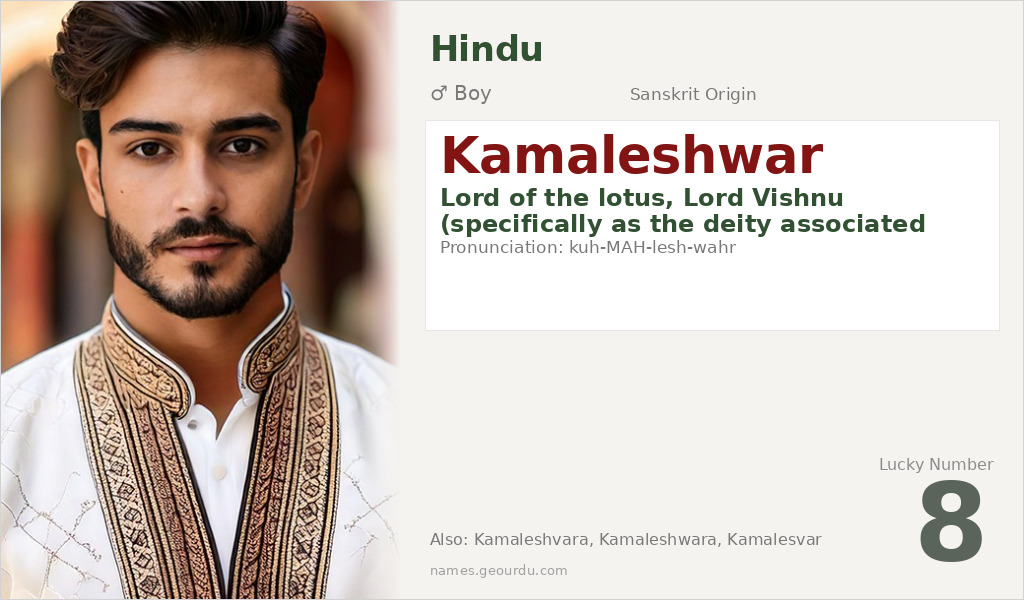
| 📛 Name | Kamaleshwar |
| 💎 Meaning | Lord of the lotus, Lord Vishnu (specifically as the deity associated with the lotus) |
| 👤 Gender | Boy |
| 🕌 Religion | Hindu |
| 🌍 Origin | Sanskrit |
| 🗣 Pronunciation | kuh-MAH-lesh-wahr |
| ✍️ Urdu | کملشور |
| ✍️ Arabic | كاماليشوار |
| 🔢 Numerology | 8 |
| ✨ Spellings | Kamaleshvara, Kamaleshwara, Kamalesvar |
Origin & Cultural Significance
Kamaleshwar originates from Sanskrit, the classical language of ancient India, and is deeply rooted in Hindu religious and cultural traditions. It is primarily used within Hindu communities, especially in India and Nepal, where Sanskrit-derived names are common. The name appears in Hindu scriptures and is often found in the names of temples dedicated to Vishnu, such as the Kamaleshwar Temple in Ujjain, India. Its usage reflects the enduring influence of Sanskrit on Indian naming practices and the reverence for Vishnu in Hinduism. While it is specific to Hindu contexts, variations or similar compounds might exist in other cultures influenced by Sanskrit, but Kamaleshwar itself remains distinctly Hindu in origin and association.
Personality Traits
Those named Kamaleshwar are often seen as embodying the qualities of their namesake—calm, compassionate, and spiritually grounded. They may exhibit a natural grace and resilience, much like the lotus that thrives in challenging environments. Their personality tends to be reflective and wise, with a strong sense of duty and a nurturing demeanor, making them reliable and respected figures in their communities.
Similar Names
If you like Kamaleshwar, consider: Kamalnath, Kamalkant, Vishnu, Narayan, Lakshminarayan
Famous People Named Kamaleshwar
- Kamaleshwar Sharma — Indian classical vocalist and musicologist
- Kamaleshwar Mukherjee — Indian film director and screenwriter from Bengal
Frequently Asked Questions About Kamaleshwar
What does Kamaleshwar mean?
Kamaleshwar means 'Lord of the lotus' in Sanskrit, specifically referring to Lord Vishnu, the Hindu deity associated with preservation and purity.
Is Kamaleshwar a boy or girl name?
Kamaleshwar is traditionally a boy name in Hindu culture, as it is a masculine compound ending in 'Ishwar' (lord) and is used for male deities and individuals.
What is the origin of Kamaleshwar?
Kamaleshwar originates from Sanskrit, the ancient language of India, and is deeply embedded in Hindu religious traditions, particularly Vaishnavism, the worship of Vishnu.





