
Table of Contents
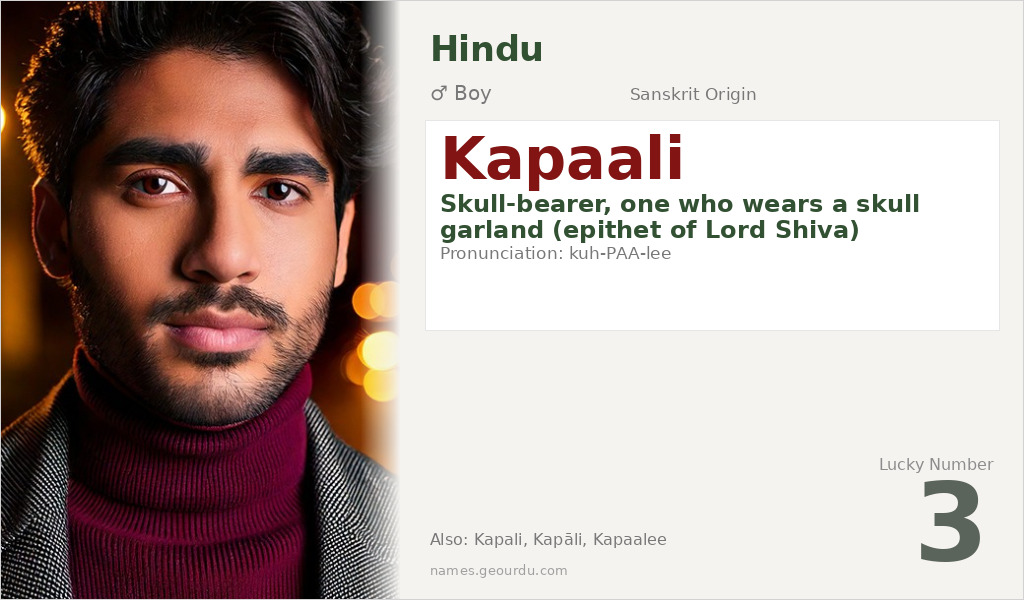
Kapaali is a profound Sanskrit name with rich mythological roots in Hinduism. Primarily used for boys, this name carries the powerful meaning of ‘skull-bearer’ or ‘one who wears a skull garland.’ It serves as a significant epithet for Lord Shiva, representing his ascetic and transformative aspects. Discover the fascinating etymology and cultural significance of this distinctive name.
Meaning of Kapaali
Kapaali derives from the Sanskrit root ‘kapāla’ (कपाल), meaning ‘skull,’ ‘cranium,’ or ‘bowl made from a skull.’ The suffix ‘-ī’ transforms it into ‘possessor of skulls’ or ‘one associated with skulls.’ In Hindu theology, this specifically refers to Lord Shiva’s manifestation as an ascetic who wears a garland of skulls (kapālamālā) or carries a skull-bowl. The name appears in ancient texts like the Shiva Purana (Chapter 2, Rudra Samhita) where Shiva is described as ‘Kapālin’ – the skull-bearer. This epithet symbolizes Shiva’s transcendence over death, his role as destroyer in the Trimurti, and his mastery over time and mortality.
| 📛 Name | Kapaali |
| 💎 Meaning | Skull-bearer, one who wears a skull garland (epithet of Lord Shiva) |
| 👤 Gender | Boy |
| 🕌 Religion | Hindu |
| 🌍 Origin | Sanskrit |
| 🗣 Pronunciation | kuh-PAA-lee |
| ✍️ Urdu | کپالی |
| ✍️ Arabic | كابالي |
| 🔢 Numerology | 3 |
| ✨ Spellings | Kapali, Kapāli, Kapaalee |
Origin & Cultural Significance
Kapaali originates from classical Sanskrit language and Hindu religious texts dating back to at least the early centuries CE. It emerges from the Shaivite tradition where Shiva is worshipped in various forms, including his fearsome aspects. The name reflects the tantric and ascetic dimensions of Hinduism, particularly associated with Shiva’s role as the destroyer of ego and ignorance. While primarily used in Hindu communities, the name’s Sanskrit roots give it pan-Indian linguistic connections. It remains a traditional though uncommon name choice, preserving ancient mythological references in contemporary naming practices.
Personality Traits
Those named Kapaali are often associated with qualities of spiritual depth, introspection, and transformative energy. They may exhibit a philosophical nature, with an inclination toward seeking deeper truths beyond surface appearances. The name’s connection to Shiva suggests potential characteristics of resilience, non-attachment, and the ability to navigate life’s profound changes with wisdom.
Similar Names
If you like Kapaali, consider: Kapalin, Kaparddin, Kapilesh, Kapish, Kapil
Famous People Named Kapaali
- No widely known contemporary figures with this name found in verified sources
- Mythological: Lord Shiva as Kapaali – described in Hindu scriptures as the ascetic form of Shiva wearing a garland of skulls
Frequently Asked Questions About Kapaali
What does Kapaali mean?
Kapaali means 'skull-bearer' or 'one who wears a skull garland' in Sanskrit. It is an epithet of Lord Shiva in Hindu mythology.
Is Kapaali a boy or girl name?
Kapaali is exclusively a boy's name in Hindu naming tradition, as it refers to the masculine deity Lord Shiva.
What is the origin of Kapaali?
Kapaali originates from Sanskrit language and Hindu religious texts, specifically from the word 'kapāla' meaning skull, with deep roots in Shaivite mythology.





