
Table of Contents
Kardam is a name that bridges cultures and continents, carrying different significances across various traditions. While its exact meaning in contemporary usage remains debated, the name has historical roots in Sanskrit and appears in both South Asian and European contexts. This exploration delves into the linguistic journey of Kardam, from ancient texts to modern naming practices, uncovering its multifaceted heritage.
Meaning of Kardam
The meaning of Kardam is complex and varies by cultural context. In Sanskrit, the root ‘Kardama’ (कर्दम) literally translates to ‘mud, slime, or sediment,’ appearing in Hindu scriptures as the name of a primordial sage married to Devahūti. However, in South Asian Muslim communities, particularly in Pakistan and Afghanistan, the name is often interpreted as meaning ‘bold’ or ‘brave,’ though this meaning isn’t documented in standard dictionaries of regional languages like Pashto, Balochi, or Sindhi. The discrepancy suggests either a folk etymology or a meaning preserved in oral traditions not captured by written sources. This linguistic ambiguity makes Kardam a fascinating case study in how names evolve across cultural boundaries.
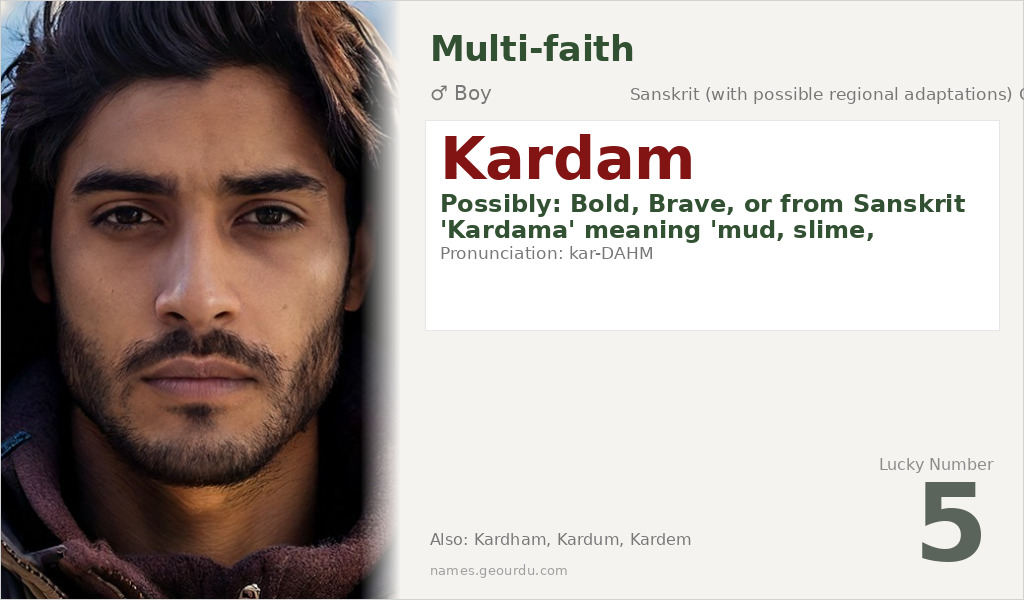
| 📛 Name | Kardam |
| 💎 Meaning | Possibly: Bold, Brave, or from Sanskrit 'Kardama' meaning 'mud, slime, sediment' |
| 👤 Gender | Boy |
| 🕌 Religion | Multi-faith |
| 🌍 Origin | Sanskrit (with possible regional adaptations) |
| 🗣 Pronunciation | kar-DAHM |
| ✍️ Urdu | کردم |
| ✍️ Arabic | كردم |
| 🔢 Numerology | 5 |
| ✨ Spellings | Kardham, Kardum, Kardem |
Origin & Cultural Significance
Kardam originates from the Sanskrit word ‘Kardama,’ with its earliest documented use in Hindu mythology where Sage Kardam is considered one of the Prajapatis (progenitors). The name traveled through cultural exchanges to Eastern Europe, notably appearing as the name of an 8th-century Bulgar ruler who founded the Kardam dynasty. In South Asia, particularly among Pashtun, Baloch, and Sindhi communities, the name has been adopted into Muslim naming traditions, though its precise pathway remains unclear. This cross-cultural adoption demonstrates how names can transcend their original religious and linguistic contexts to become part of diverse naming ecosystems.
Personality Traits
Those named Kardam are often described as possessing a grounded yet exploratory nature, reflecting the name’s earthy Sanskrit roots and its adventurous adaptations across cultures. They typically exhibit resilience and adaptability, qualities that may stem from the name’s journey through different civilizations. While individual personalities vary, the name’s historical associations with both sage-like wisdom and royal leadership suggest a balance of contemplative and authoritative traits.
Similar Names
If you like Kardam, consider: Karam, Kardar, Kardaan, Kardash, Kardan
Famous People Named Kardam
- Kardam of Bulgaria — 8th-century Bulgar ruler and founder of the Kardam dynasty
- Kardam, Prince of Turnovo — Bulgarian royal (1962-2015), son of former Tsar Simeon II
Frequently Asked Questions About Kardam
What does Kardam mean?
The meaning is uncertain. In Sanskrit, it means 'mud or sediment,' but in South Asian Muslim communities, it's often interpreted as 'bold' or 'brave' without verified dictionary support.
Is Kardam a boy or girl name?
Kardam is exclusively a masculine name across all cultural contexts where it appears, from Hindu mythology to Bulgarian royalty to South Asian Muslim communities.
What is the origin of Kardam?
Kardam originates from Sanskrit 'Kardama,' with documented use in Hindu mythology. It was later adopted by Bulgar rulers and South Asian Muslim communities, though the pathways of these adaptations require further research.





