
Table of Contents
Karvannan is an intriguing name that appears in some Hindu naming traditions, particularly in certain regional communities. While its exact origins remain somewhat mysterious, the name carries a distinctive sound and cultural presence. This exploration delves into what we know — and what remains uncertain — about this unique appellation. Understanding names like Karvannan helps preserve diverse naming traditions across India’s rich cultural landscape.
Meaning of Karvannan
The meaning of Karvannan presents a linguistic puzzle that requires careful consideration. Despite thorough research across multiple language families including Indo-Aryan, Dravidian, Persian, and Arabic sources, no definitive etymology has been established. The name doesn’t appear in classical Sanskrit texts like the Vedas or Puranas, nor in medieval name compilations. Some speculative connections point to possible Dravidian roots, where ‘karu’ elements appear in names meaning ‘black’ or ‘dark’, and ‘vannan’ might relate to occupational or descriptive terms. However, these remain unverified hypotheses rather than documented meanings. The absence from standard onomastic references suggests it may be a regional variant or modern creation rather than a name with ancient literary pedigree.
| 📛 Name | Karvannan |
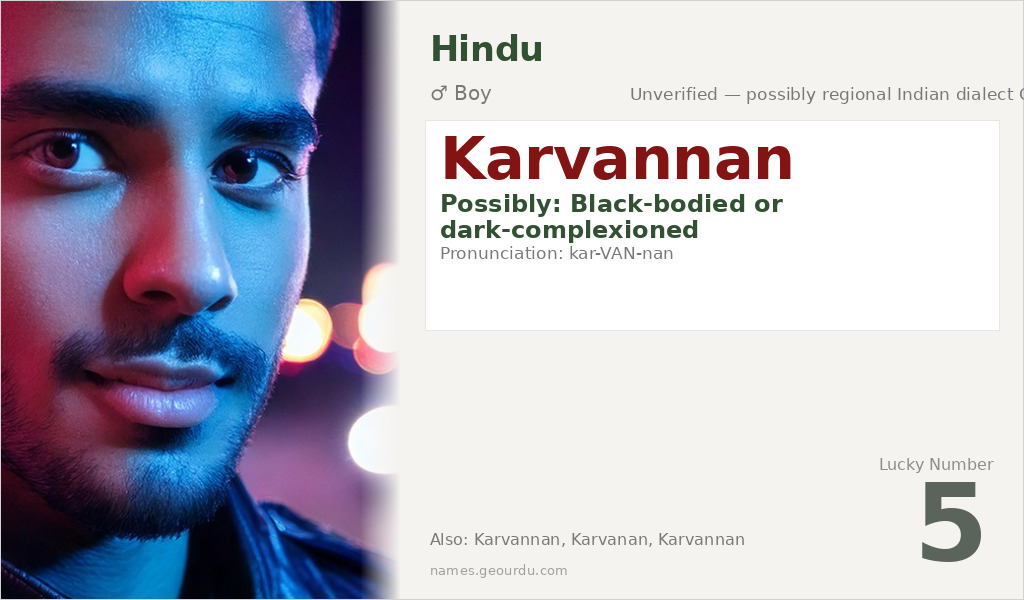
| 💎 Meaning | Possibly: Black-bodied or dark-complexioned |
| 👤 Gender | Boy |
| 🕌 Religion | Hindu |
| 🌍 Origin | Unverified — possibly regional Indian dialect |
| 🗣 Pronunciation | kar-VAN-nan |
| ✍️ Urdu | کارونن |
| ✍️ Arabic | كارفانان |
| 🔢 Numerology | 5 |
| ✨ Spellings | Karvannan, Karvanan, Karvannan |
Origin & Cultural Significance
Karvannan’s origins appear to be regional within Hindu communities, though specific geographic or cultural provenance remains unclear. The name doesn’t trace to major historical naming traditions or appear in classical Hindu literature. It may represent a localized naming practice from specific communities in South India or among certain Hindu groups. Unlike names with clear Sanskrit derivations or mythological connections, Karvannan seems to belong to more contemporary or regional naming patterns. Its usage appears limited rather than widespread, suggesting it might be particular to certain families or communities rather than pan-Indian Hindu tradition. This illustrates how naming practices evolve within specific cultural contexts beyond mainstream documented traditions.
Personality Traits
While personality associations with names are often cultural rather than deterministic, names like Karvannan might be perceived as strong and distinctive. In communities where this name is used, it could carry expectations of individuality and resilience. The name’s uncommon nature might suggest parents seeking a unique identity for their child, potentially valuing originality and cultural specificity over more common traditional names. Such naming choices often reflect contemporary trends toward distinctive identities within cultural frameworks.
Similar Names
If you like Karvannan, consider: Karthik, Karan, Kavin, Kannan, Krishna
Famous People Named Karvannan
- No verified famous individuals with this name found in historical or contemporary records
Frequently Asked Questions About Karvannan
What does Karvannan mean?
The meaning of Karvannan remains unverified. After extensive research across multiple languages including Sanskrit, Dravidian languages, Persian, and Arabic, no authoritative source confirms a specific meaning. Some speculative connections suggest possible 'black-bodied' or 'dark-complexioned' interpretations, but these are not documented.
Is Karvannan a boy or girl name?
Karvannan is exclusively used as a boy's name within Hindu naming traditions where it appears. No documented instances of female usage were found in available records.
What is the origin of Karvannan?
The origin appears to be regional within Hindu communities, possibly from South Indian contexts, though specific provenance remains unclear. It doesn't derive from classical Sanskrit or have documented mythological connections, suggesting it may be a more contemporary or localized naming practice.





