
Table of Contents
Khan is one of the most powerful and historically significant names in human history, carrying the weight of empires and conquests. Originally a title for rulers and military commanders among Central Asian nomadic tribes, it has evolved into a popular given name and surname across multiple cultures. From the Mongol Empire’s founders to modern Bollywood superstars, the name Khan represents leadership, authority, and enduring legacy. This comprehensive guide explores the true meaning, origin, and cultural impact of this iconic name.
Meaning of Khan
The name Khan derives from the Old Turkic and Mongolian word ‘khagan’ or ‘khan’, meaning ‘ruler’, ‘sovereign’, ‘leader’, or ‘military commander’. Historically, it was used as a title for chiefs of nomadic tribes across the Central Asian steppes, particularly among Turkic and Mongol peoples. The term entered Persian as ‘khān’ during the Mongol Ilkhanate period and subsequently spread to South Asian languages like Urdu, Pashto, and Hindi through cultural and political exchanges. While often translated as ‘prince’, its original meaning encompasses broader concepts of authority, including kingship, tribal leadership, and military command. In modern contexts, it functions both as a surname (particularly among Pashtuns and Mughal descendants) and as a given name, preserving its noble connotations.
| 📛 Name | Khan |
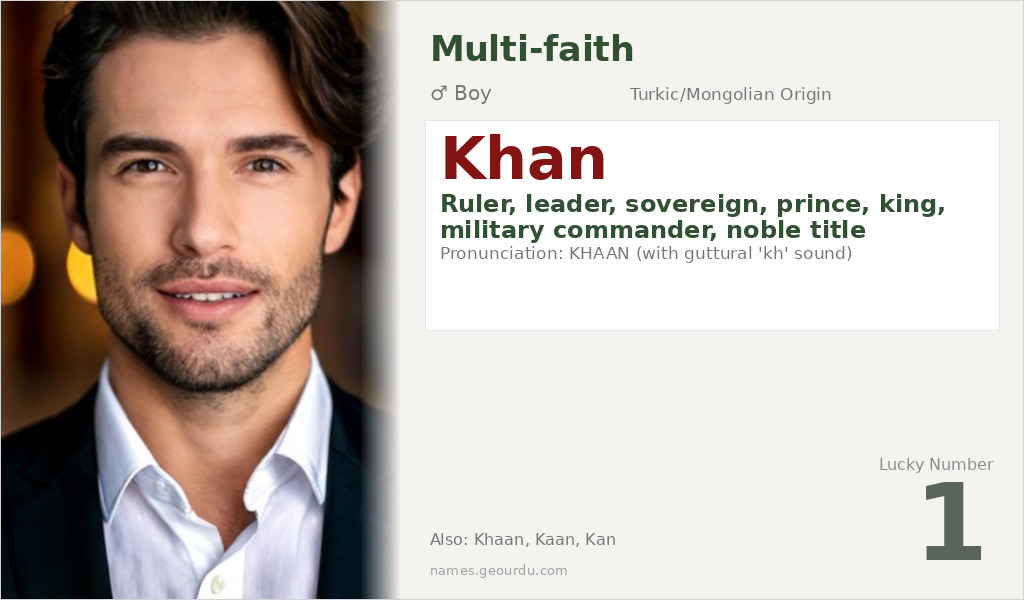
| 💎 Meaning | Ruler, leader, sovereign, prince, king, military commander, noble title |
| 👤 Gender | Boy |
| 🕌 Religion | Multi-faith |
| 🌍 Origin | Turkic/Mongolian |
| 🗣 Pronunciation | KHAAN (with guttural 'kh' sound) |
| ✍️ Urdu | خان |
| ✍️ Arabic | خان |
| 🔢 Numerology | 1 |
| ✨ Spellings | Khaan, Kaan, Kan, Xan |
Origin & Cultural Significance
Khan originated among the nomadic tribes of Central Asia, with its earliest documented use among the Xianbei and Rouran peoples before becoming prominent with the Göktürks and Mongols. The title gained worldwide recognition through Genghis Khan, who unified the Mongol tribes and established history’s largest contiguous empire. As the Mongol Empire expanded, the title spread across Eurasia, influencing languages from Turkish to Persian to Urdu. In South Asia, it became associated with Pashtun tribes and Mughal nobility, eventually evolving into a common surname and given name. Today, Khan transcends specific religious boundaries, used by Muslims, Hindus, Sikhs, and others across Central Asia, South Asia, and the global diaspora.
Personality Traits
Those bearing the name Khan often inherit its historical associations with leadership and authority. They typically exhibit strong, confident personalities with natural commanding presence and strategic thinking abilities. While ambitious and decisive, they also tend to be protective and responsible toward their communities or families. The name’s imperial legacy can inspire a sense of destiny and accomplishment in its bearers.
Similar Names
If you like Khan, consider: Sultan, Shah, Emir, Malik, Raja
Famous People Named Khan
- Genghis Khan — Founder of the Mongol Empire, one of history's greatest conquerors
- Salman Khan — Indian film actor and producer, one of Bollywood's biggest stars
- Imran Khan — Former Prime Minister of Pakistan and cricket legend
- Chingiz Khan — 13th century Mongol ruler who established the largest contiguous empire in history
- Shah Rukh Khan — Indian actor known as 'King of Bollywood', one of the world's most successful film stars
Frequently Asked Questions About Khan
What does Khan mean?
Khan means 'ruler', 'leader', 'sovereign', or 'military commander'. It originates from Old Turkic and Mongolian languages, where it was used as a title for tribal chiefs and emperors.
Is Khan a boy or girl name?
Khan is predominantly a masculine name, reflecting its historical use as a title for male rulers and military leaders. While extremely rare, it could theoretically be used for girls in modern creative naming, but traditionally it's a boy's name.
What is the origin of Khan?
Khan has Central Asian origins, specifically from Old Turkic and Mongolian languages. It was used by nomadic tribes like the Mongols, Turks, and other steppe peoples before spreading to Persian, Urdu, Pashto, and other languages through historical conquests and cultural exchange.





