Table of Contents
Khanam is a name that resonates with elegance and historical prestige, evoking images of nobility and grace. Used across various cultures from Central Asia to South Asia, this name carries a rich heritage tied to aristocratic titles. Whether chosen for its melodic sound or its dignified meaning, Khanam remains a timeless choice for parents seeking a name with depth and cultural resonance. Let’s explore the fascinating origins and significance of this distinguished name.
Meaning of Khanam
The name Khanam originates from the Persian and Turkic linguistic traditions, where it functions as a feminine title meaning ‘lady’ or ‘noblewoman.’ It is constructed from the word ‘Khan,’ a historic title for rulers or leaders in Turkic and Mongolic cultures, combined with the Persian suffix ‘-am,’ which denotes possession or relation. Thus, Khanam literally translates to ‘wife of a khan’ or ‘lady of the khan,’ but over time it has evolved into a standalone term of respect for women of high status. This etymology is well-documented in Persian, Urdu, and Turkish dictionaries, reflecting its use in historical contexts such as the Mughal Empire and Ottoman courts. The name emphasizes dignity and social standing rather than mere wealth, making it a symbol of aristocratic heritage.
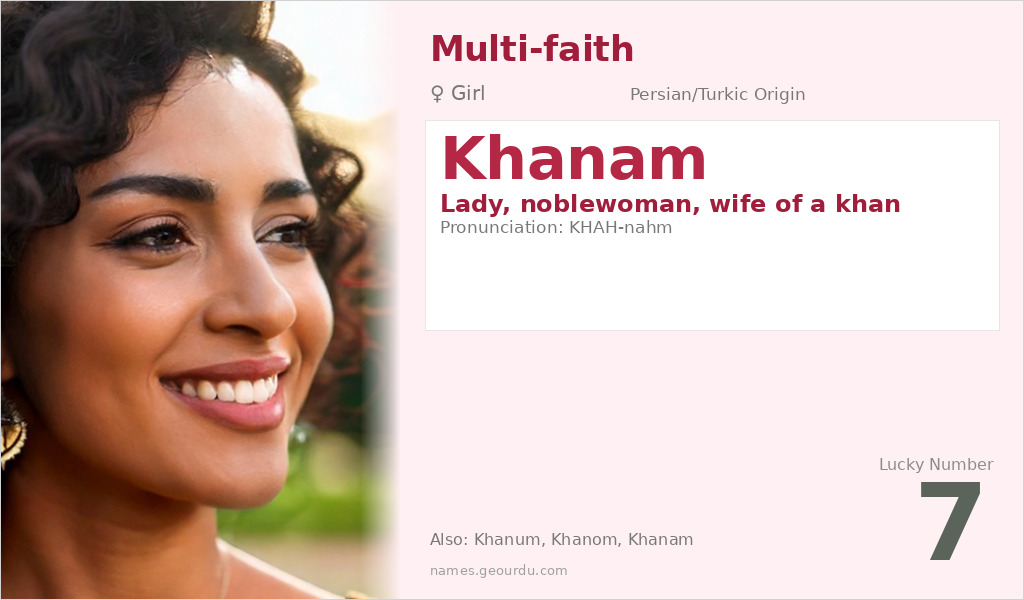
| 📛 Name | Khanam |
| 💎 Meaning | Lady, noblewoman, wife of a khan |
| 👤 Gender | Girl |
| 🕌 Religion | Multi-faith |
| 🌍 Origin | Persian/Turkic |
| 🗣 Pronunciation | KHAH-nahm |
| ✍️ Urdu | خانم |
| ✍️ Arabic | خانم |
| 🔢 Numerology | 7 |
| ✨ Spellings | Khanum, Khanom, Khanam, Xanım |
Origin & Cultural Significance
Khanam has its roots in the Persian and Turkic cultures, spreading across regions like Iran, Turkey, Afghanistan, Pakistan, and India through historical migrations and empires. It was commonly used as a title for women in noble families, particularly during the Mughal and Ottoman periods, where it denoted wives or female relatives of khans. Over centuries, it transitioned from a formal title to a popular given name, adopted by various communities including Muslims, Christians, and others in multi-faith societies. Its usage in literature, poetry, and historical records underscores its cultural importance, making it a cross-cultural name that transcends religious boundaries while retaining its regal connotations.
Personality Traits
Those named Khanam are often associated with traits of grace, authority, and resilience, reflecting the name’s noble origins. They may exhibit natural leadership abilities, combined with a sense of tradition and respect for cultural heritage. In social settings, they are perceived as dignified and compassionate, often inspiring confidence and admiration in others.
Similar Names
If you like Khanam, consider: Khan, Sultana, Begum, Malika, Shahzadi
Famous People Named Khanam
- Khanum Agha — 19th-century Persian poet and calligrapher
- Khanum Jan — Afghan singer and composer
Frequently Asked Questions About Khanam
What does Khanam mean?
Khanam means 'lady' or 'noblewoman,' derived from the Persian/Turkic title 'Khan' (ruler) with a feminine suffix, historically referring to the wife of a khan or a woman of high status.
Is Khanam a boy or girl name?
Khanam is exclusively a girl's name, as it includes a feminine suffix and has been used historically as a title for women in Persian, Turkic, and South Asian cultures.
What is the origin of Khanam?
Khanam originates from Persian and Turkic languages, with documented use in historical contexts across Central Asia, the Middle East, and South Asia, particularly among noble families.